


Yom Kippur, beginning on the tenth day of the month of Tishrei, is the holiday that connects Rosh Hashanah and Sukkot (the central holiday of the Tishrei holidays), and therefore some see it as preparation for the holiday of Sukkot: the purification of the Temple and the people in preparation for the holiday of Sukkot, similar to the atonement ceremonies that were common in the ancient East. Akkadian literature also features ceremonies of propitiation of the gods by purifying and driving away evil, in the sense of "for on this day atonement will be made for you to cleanse you from all your sins..." as stated in the book of Leviticus (16:30).
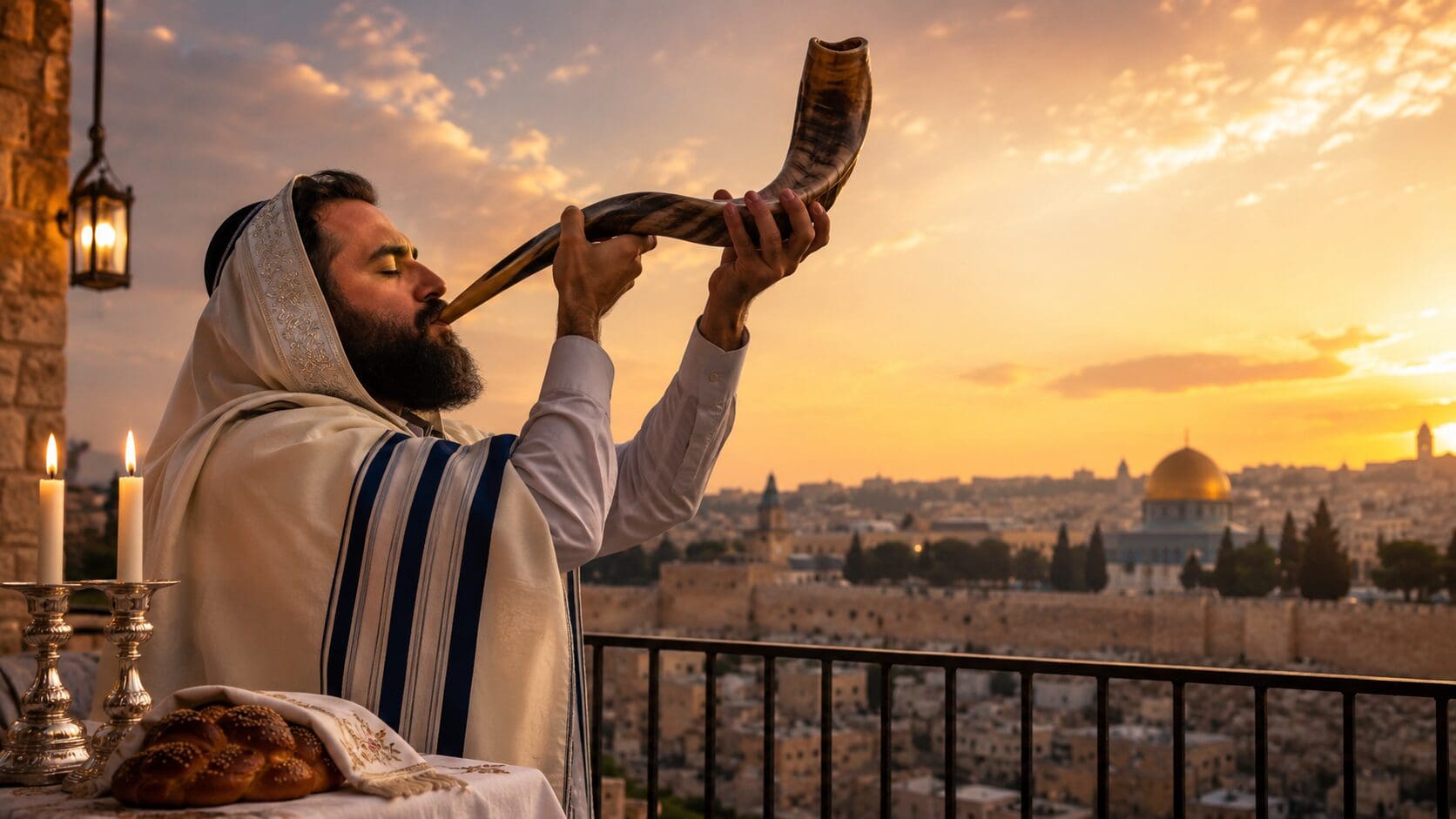
This special day, on which the High Priest entered the Holy of Holies in linen garments, offered a burnt offering, and confessed, while the entire people fasted and abstained from eating and drinking, bathing, anointing the body with oil, wearing leather sandals, and having sexual relations, represented a "kind of death" or a symbolic renunciation of physical existence, in order to ensure a renewed resurrection. Yom Kippur, in this sense, is also a turning back of time, to the previous year. With the blowing of the shofar at the end of Yom Kippur, the new season begins and society allows itself the joy and debauchery characteristic of the holiday of Sukkot.
Yom Kippur is mentioned in ancient Jewish records as one of the holidays of Israel, and therefore it can be assumed that it was not only a day of fasting and mourning, but also a day of good fortune, as recounted in the Mishnah, Tractate Taanit: "There were no days as good for Israel as the fifteenth of Av and Yom Kippur, on which the daughters of Israel go out in borrowed white vessels, so as not to shame those who do not have them, and the daughters of Jerusalem go out and defile themselves in the vineyards."
Were the virgin dances ritual dances performed during days of fasting and mental torture? It is possible that in ancient times Yom Kippur was a day of joy over the cleansing of the Temple, over personal purification from sins, and perhaps also due to the feeling that one could control fate and influence the sealing of judgment.
According to biblical sources, the essence of Yom Kippur in the Bible is "torment of the soul," as a condition for atonement for sins, and the prohibition of all labor. From the book of Isaiah we learn that the torment of the soul was interpreted as fasting. The essence of the Yom Kippur ritual is described in the book of Leviticus, as the work of the High Priest in the Temple. Individual sins were therefore atoned for by fasting and, in the terms of the Sages, by repentance, prayer, and charity, while the sins of the community were purified by the High Priest. The ritual also included sending a goat's hair to hell, apparently to a desolate desert. Various scholars see this as a remnant of pagan influences, while some traditional commentators maintain that it was a kind of sacrifice given to Satan so that he would not harm Israel.
The laws of Yom Kippur are detailed in the Mishnah (Tractate Yoma) and include customs that were added during the Second Temple period: a night of observance for the High Priest and the dignitaries of Jerusalem, in preparation for his important role on Yom Kippur, and a prayer and party held by the High Priest after he left the Holy of Holies unharmed.
After the destruction of the Second Temple, the center of the holiday moved from the Temple to the synagogue, and instead of the sacrifices came the prayer. The central prayer is the "Confession," which was previously said by the High Priest and after the destruction was transferred to each individual. The "Confession" prayer ("For the sin we have sinned against you on Yom Kippur") is said ten times during Yom Kippur and includes a list of 44 sins, in alphabetical order, two sins for each letter. Confession always involves repentance, which helps the person who desires repentance. However, according to the version of the Mishnah in Tractate Yoma: "He who says: I have sinned, and Yom Kippur atones, Yom Kippur does not atone. For offenses between a person and the place, Yom Kippur atones, for offenses between a person and his fellow man, Yom Kippur does not atone, until he pleases his fellow man."
During Yom Kippur, in the haftarah of the morning prayer, the 58th chapter of Isaiah is read in the synagogue, which contains a strongly expressed protest against those who believe that fasting can cover up moral wrongdoings. Some argue that this attack on the centrality of fasting in the midst of the great fast day expressed not only the position of the Tan'aim, who demanded to emphasize the priority of moral behavior over ritual behavior, but also anti-priestly tendencies. In the haftarah of the mincha prayer, the entire book of Jonah is read, which contains a deep reflection on God's ways in His world and also a relevant link to fasting, prayer, and repentance.
Two prayers recited on Yom Kippur are well-known among all Jews: "Kol Nidrei" and "Ne'ila." "Kol Nidrei" is recited on Yom Kippur night, before the evening prayer, and is intended to cancel vows that a person has made or will make. The origin of the prayer is unknown, but the first evidence of its existence is found in the period of the Ge'onim, many of whom, led by Amram Gaon, Rosh Yeshiva of Sura, strongly opposed it ("It is a foolish custom"). Changes were introduced in the 12th century. The phrase "the criminals" ("By local and public opinion we permit praying with the criminals") was introduced into prayer in the 13th century by the Maharam of Rothenburg, but popular consciousness associates it with the phenomenon of the Anosi in Spain and Portugal in the 15th and 16th centuries. In Jewish-Christian polemics in the Middle Ages, Jews were accused of invalidating their vows and oaths due to the declaration of "all vows," and they replied that "all vows" only meant to annul vows that a person made to himself, and not vows between a person and his fellow man.
Although in terms of content and wording, the "Kol Nidrei" prayer does not have any valuable advantage over other prayers, it has gained a special status in the people's consciousness, apparently because it is a kind of opening proclamation for the "Holy and Holy" day. There is no doubt that the special melody in which the prayer is recited also strengthened its status.
The name "Neila" is an abbreviation of the phrase "Neilat Shearim." This prayer is said at the end of the day, near sunset. It was originally called this because it was said when the gates of the Temple were closed, but after the destruction it was intended to refer to the closing of the gates of heaven when the judgment was signed.
Yom Kippur is also characterized by folk customs, which, among other things, attest to its importance in Jewish popular society. Since it became, at the end of the Second Temple, the holiest day in Israel, even customs that seem foreign and pagan to us today, "the ways of the Amorites," were granted "kosher."
Among these customs:
atonements – A rooster is turned around the head, male for a man and female for a woman, and they say: "This is my atonement, this is my atonement, this rooster will go to death and I will enter and go to a long, good life and peace." The custom of using a rooster for atonement is widespread among various peoples and originates in the popular belief that illness, suffering or sin can be passed from body to body. This is, perhaps, a substitute for the "scapegoat," which is sent into the desert by the High Priest, carrying the sins of the people on its back. According to ancient beliefs, the rooster has magical powers, because its call drives away darkness, tempts the evildoers and brings light. Its red plumage was also attributed with magical powers, and therefore the "atonements" are a kind of sacrifice to the evildoers, to instill fear in them and appease them. This custom was controversial from the beginning: the Rashba and the Ramban came out against it (the Maimonides did not mention it at all), and Rabbi Yosef Karo (author of the Shulchan Aruch) defined it as a "foolish custom" and ruled unequivocally that it should not be observed. Despite this, mainly due to Kabbalistic influence and popular support, the custom was accepted, although even today many observant people, including rabbis, do not observe this ceremony.
flogging – In various communities, it was customary, after the evening prayer, to flog. The sun would flog the wealthy householders, who were kneeling on a haystack in the synagogue, with a large strip, forty lashes minus one. The poor were not flogged because they could not afford to pay the sun.
The Candle of Life – The prevailing hypothesis is that in the Middle Ages, Jews in Western European countries used to come to synagogue with a candle in their hand, in honor of family members, who wished on Yom Kippur that they would be blessed with a long and good life. Over time, family members began to bring candles equal to the number of males in the family. This custom gradually spread to other communities, both near and far.
Soul candle – In one of the Tannaite midrash, the idea was raised that the dead also need atonement. It seems that it was on the basis of this midrash that the lighting of a “soul candle” in the synagogue was introduced in the Middle Ages to atone for the souls of the deceased parents of the lighters, alongside the “life candle.” The candles were prepared by women and were related to the custom of “laying the wicks” that was prevalent in Eastern Europe: the women measured the graves of their ancestors and other relatives with strings, folded the measuring strings, and from them prepared wicks for wax candles in memory of the souls. At the time of laying the wicks, special supplications were recited and prayers were prayed to the dead for the living.
The color white – In various denominations, it is customary to wear white clothes, which are both a symbol of purification and purification and a reference to the shroud, on the day of death. In several denominations (Babylon, Turkey, Greece) they used to drink a white drink that has a similar meaning.
😍"White" in "Israeli Holidays" means: a symbol - holiday/festive clothing, a sign of purity/cleanliness/purity...!!!
And it expresses: "Renewal" & "Joy" = as is customary with ✨️"The Jews" = "The Chosen People" – the "enlightened" people, who serve as a "light" to the nations, including all!🙏😭
😍It's surprising that there is no connection between the "title" and the "content", because you could write a lot about it...!
* During the month of ✨️"Tishrei" – an important opportunity to continue to strive to "reconcile" – Face to Face🙏
Another progressive article instead of the essence of Yom Kippur – an attempt to present customs and traditions as pagan or contrary to what was done in other times. We are tired of this, Aliza. How much longer can we try to harm every holiday and festival of the Jewish people?