


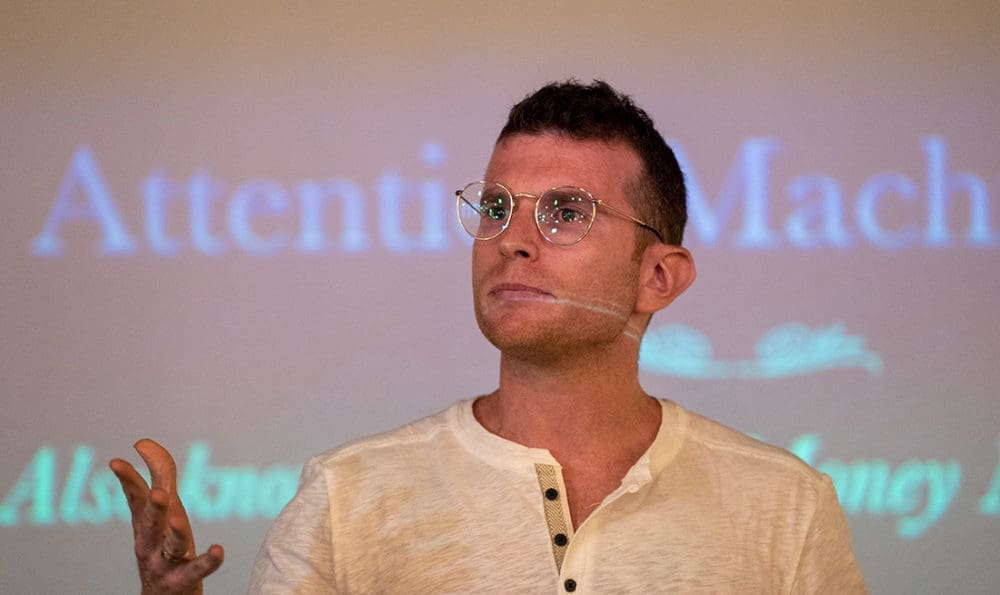
(Live here is the news corporation of Haifa and the surrounding area) After years of crafting messages for others, waging media battles, and being behind the scenes of big stories, Ido Minkowski is choosing to speak in his own voice this time. With a new album, which includes seven songs he wrote, composed, and performed, a lot of self-humor, and quite a bit of pain and personal exposure, he moves from the strategic advisor's chair to the forefront.
In a special interview with Haifa, he talks about the music that has become an inseparable part of his life, about fatherhood, loss, dreams, about Etti Karif and Liron Ofir, who participate in the music videos, and the unconventional path of being a failure who manages to rise to the top.
The man behind the messages, this time with his own story
Ido Minkowski is one of those people who enter a room and you can't remain indifferent to their presence. A sharp-witted, opinionated, witty communications and strategist with an extraordinary ability to identify a story and know how to tell it.
Minkowski, originally from Kiryat Yisrael, is also well known in the Haifa scene. In July 2012, he was appointed spokesman for the Haifa municipality, during the term of then-mayor Yona Yahav, after serving as communications advisor to then-Minister of Public Security Yitzhak Aharonovitch. In January 2015, after about three years in the position, he resigned and joined the spokesperson team of the "Kulunu" party headed by Moshe Kahlon.
He later founded the "Minkowski Group," a strategy and communications firm, and continued to support organizations, public figures, and public struggles. In 2019, he was hired as a communications consultant by the Haifa Municipality Workers' Committee during their struggle against the then mayor, Einat Kalisch Rotem, and later publicly criticized her conduct. But behind the strategist, who is accustomed to constructing other people's stories, his own personal plot has also developed in recent years: music.
On Sunday, November 15, his new album, "The Greatest Hits - Part 1," was released, featuring seven songs that he wrote, composed, and performed himself. The lead song, "The Crown Fell to You," features former judge Attorney Eti Kraif. The video for the song "Be a Man" features stand-up comedian and content creator from Haifa, Liron Ofir.
This time Minkowski does not formulate messages for others, but reveals himself through the words, melodies and voice. And as you might expect from him, here too there is no attempt to hide behind a pose. There is humor, there is provocation, there are big dreams, but most of all there is a man who brings life itself to the songs.
In an interview with Live, he speaks candidly about the transition from the world of speakers to the world of music, about the choice to reveal even the painful places, about his children, about his collaborations, and about the dream of continuing to create.

How did the transition from the world of speakers to the personal story in music come about?
For years I have been working with people, words and stories. I publicized artists, accompanied them, was moved by their work, and at a certain point I realized that talent alone is not enough. It is maybe ten percent of the matter. I already bring the other ninety percent with me, with the experience I have gained over the years.
A little advice, don't rush to meet your childhood heroes. I didn't listen to that cliché, and today I'm paying the price. There are artists whose music I can no longer listen to.
In public speaking, you usually know what you want to say, and the whole job is to find the exact way to convey the message. In music, it works a little differently. Sometimes it's only after you write a song that you realize what you were really trying to say in it. Every now and then, the PR guy in me reads the lyrics and asks the singer in me if he's gone crazy. Unfortunately, they both agree.
Has music always been a significant part of your life?
If I'm being honest, like everyone else, I wanted to be Britney Spears and Axl Rose together. Wallack, so far it hasn't worked out.
When did you decide to release an album?
I've released four albums and seven singles in two and a half years on the road, I mean, my strategic plan is to release 200 songs and then see how many more are needed.
Why "Greatest Hits – Part 1"?
Because I'm a publicist. What did you expect, that I would call it "Seven Songs, Let's Hope for the Best"?
There's a lot of self-humor in this name, and also permission to dream big. I invest seriously in my work, but I enjoy laughing at my own pretensions. And "Part One" is already a commitment to continue. I set myself a deadline without anyone asking.
I'll be in Miami for three more weeks, completing the second part with Omri Segal, 69 my teacher and rabbi, my teacher, mentor, friend, and dear brother to me.
To what extent is the album a personal diary?
Very much. Longing, loss, fatherhood, ego, nonsense and people I love.
I am a widower and a father to Dan and Eitan, and this life is within who I am and within my writing. In "The Days of Glory" Eitan sang with me, and suddenly my child was with me in the work. For me, it is a moment that no viewership figure can compare to. Every father and certainly every mother will understand.
What is the story of "The Crown Has Fallen" and to whom is it dedicated?
It's a song that addresses someone at a moment when they need to be reminded of their worth. The chorus says: "We all make mistakes, we all see the ten tenths." On the one hand, there's something about this sentence that I love: it's possible to make mistakes, get hurt, go through a difficult time, and still be worthy of love.
Proactive compassion. It wasn't written about Eti Kharif. But there's no doubt that without much investment, she made him her own.
What does Eti Kraif bring to the music video and message?
Eti brings a very strong presence. She is a woman who the public already comes to with an opinion, and her encounter with a song about falling, self-worth, and compassion adds meaning to it. In my opinion, there is power in letting the viewer meet a face and a person amidst all this noise. The song allows for a moment to listen and see something beyond the title that you already know.
It's easy to slip into those who are victims, but even a specific and exceptionally good person, like Eti, deserves compassion, perhaps forgiveness, perhaps sympathy.
What is the message of "Be a man"?
We hear this sentence from a young age, and each one burdens us with different instructions: succeed, hold on, don't break, don't cry. I play with this command and the pressure it creates.
There's a line in the song: "Take the pain, don't pass it on." As a father of two sons, this sentence is meaningful to me. I want them to be able to feel, speak, and ask for help. That's manhood, too.
What were you looking for in Liron Ophir for the music video?
Liron is me 1000 times over. He's one of the sharpest people I've ever met. And I'm someone who got to have a night out with Clinton.
Liron brings humor, timing, and the ability to convey a lot with a look. It's very fitting for a song that has both a wildness and a serious thought underneath. In my opinion, humor allows people to open up: you laugh, let down some defenses, and then suddenly a sentence grabs you and its Haifa-ness adds another natural connection to the world I know and love.
How important is it to you to incorporate talents from Haifa?
I'm from Kiryat Ata, and it's easy. Haifa residents are included because they're the most talented. Unfortunately, only when they leave Haifa.
How does it feel to be center stage this time?
I'll try to explain the feeling.
They say it sometimes takes twenty years of failures, disappointments, and heartache to become an overnight success. I feel like I managed to squeeze all of that into three years, while life itself continues to happen. Maybe that's what you call failing on top.
I also don't think anyone has to listen to me just because I know the media. I wish it worked that way. I try to help artists get on playlists, and to this day, after dozens of attempts, I haven't succeeded even once. It's part of the journey, and I'm learning to live with that too.
But anyone who chooses to give me three minutes of their time, to listen or read what I have to say, makes me truly happy. I don't take it for granted. On the contrary, every time I'm surprised and appreciate it. I've never felt like anyone owed me their attention, let alone that I deserved it just because I had something to say.
Will the people who know you from the speakers be surprised?
Not anymore today.
Which microphone would be harder for you to give up?
The order in my life is this: my children, my business, and everything else. I reserve the first place for my children, followed by business activities, but I dedicate the inner space, thoughts, and free time in my head to music. Because music has long been not just a hobby or another career experience, but a personal place where I can create, vent, dream, and most importantly, be myself.
Between the speaker's microphone and the singer's microphone
There is something symbolic about Ido Minkowski's transition from the world of speakers to the world of music. For years he knew how to take the story of others, refine it, find the right words and bring it to the public. Now, when he himself is at the center, he discovers that the message doesn't always need to be polished, and sometimes it is precisely the cracks that make it real.
Behind the humor, the sarcasm, and the unfiltered statements, there is also a story of longing, fatherhood, and loss. This is perhaps the most interesting connection on the album: between a media person who knows the power of words well and a person who seeks to use them to tell what is not always easy to say out loud.
And judging by his strategic plan, 200 songs are just the beginning. Because Minkowski may have replaced the speaker's microphone with the singer's microphone, but one thing remains the same: he still knows how to create a story that you can't remain indifferent to.
And this time, the story is his.
Who else is participating in my album "Greatest Hits Part 1"?
- Television presenter and forecaster Danny Deutsch participates in the music video "Hiding My Tears."
- Elad Tsafni, from "Big Brother," appears in the "Sold Out" music video.
- Oral Sharabi from Minkowski Records, who is managing the project, participates in "Cinderella's Boy."
- In "The Glory Days" Eitan, Minkowski's son joins him in singing.
- Singer and actress Einat Sharoff participates in the music video "The Jews Are Coming."
- Omri Segal 69 (Omrizy) produced, arranged and is in charge of the musical direction, mixing and mastering. Tapsh plays guitars and string instruments. Amit Angel filmed, directed and edited the music videos.