


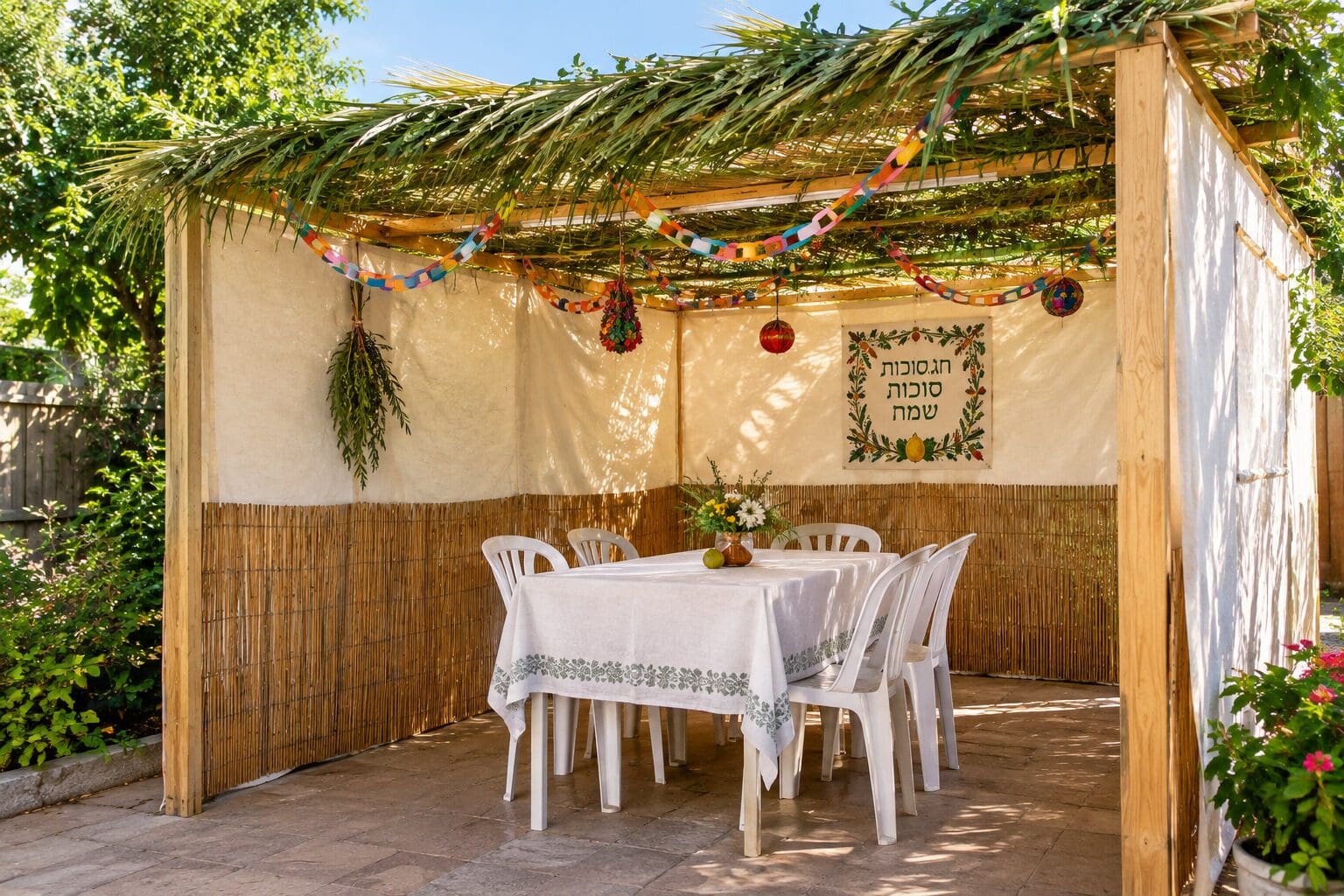
If we go back in time to the days of the First Temple, we would probably discover a surprising fact: the main, largest, and most important holiday of the year was not Passover or Shavuot, but rather the holiday of Sukkot.
In the ancient world, where man was completely dependent on the grace of heaven, on rains and crops, Sukkot was not only a historical milestone of the desert wanderings, but it was the culmination of the agricultural life cycle, a moment when all of reality hung in the balance. In the Torah, we encounter the holiday in its earliest names that are directly connected to the land: "And the feast of ingathering at the end of the year" (Exodus 34:23) and also "And the feast of ingathering at the end of the year, when you gather in your work from the field" (Exodus 23:16).
In the days of the First Temple, Sukkot was simply "the holiday" in the knowledge of God. In the Book of Numbers and elsewhere it is simply called "the holiday," because no further explanation was needed. It was the moment when the threshing floor and the winepress were gathered, the hard year of work was over, and the bounty was given thanks. For the early farmer, the beginning of autumn and the first signs of rain marked the victory of life over the forces of decay and the dryness of the scorching summer.
Alongside the agricultural aspect, the Sukkot circle poses a fascinating challenge for biblical scholars: What, in fact, is the origin of the Sukkah itself, and what was its role in the ancient ritual system?
In biblical studies, we find two main approaches to this subject: the historical-national approach, which sees the sukkah as a direct reminder of the temporary huts in which the Israelites lived when they left Egypt and during their years of wandering in the desert, and the ritual-agricultural approach, which offers a different explanation: Originally, the ancient farmers of the land built temporary sukkahs in the fields and vineyards during the harvest and ingathering periods, in order to stay close to their crops and protect them from thieves and animals. Over time, this agricultural custom took on a deep religious and national significance and became integrated into the sacred calendar.
"You shall keep the Feast of Tabernacles for yourself seven days, when you gather in from your threshing floor and your winepress. And you shall rejoice in your feast, you and your son and your daughter and your male servant and your female servant and the Levite and the stranger and the fatherless and the widow who are within your gates. You shall celebrate the feast to the Lord your God for seven days in the place which the Lord will choose, because the Lord your God will bless you in all your produce and in all the work of your hands, and you shall be joyful only." (Deuteronomy 16:13-15).
In these verses, the element of joy is added, which is no longer the joy of the farmers' instinctive jubilation over the success of the harvest, but the joy of thanking God for His blessing. The worship is no longer a folk worship celebrated in the fields, but is concentrated in one place, holy, divine. The holiday is still democratic and intended for everyone: even immigrants and the socio-economic marginalized (foreigners and orphans).
However, the story of the holiday of Sukkot is not only a happy agricultural holiday, but it also, at times, constitutes a dramatic focus of acute political and religious conflicts.
Two events in particular illustrate how loaded the holiday was with public significance:
When the Northern Kingdom of Israel was established after the division of the united kingdom, its first king, Jeroboam son of Nebat, faced a huge political challenge: as long as the inhabitants of the north continued to make pilgrimages to the Temple in Jerusalem, which was within the Kingdom of Judah, to celebrate the Feast of Tabernacles, their hearts were likely to return to the House of David. In order to create a complete religious and political break, Jeroboam took a drastic step: he established alternative centers of worship in Dan and Bethel, appointed priests who were not Levites, and most importantly, he established his holiday on the fifth day of the month of Hashvan. The Bible describes this step with great severity and notes that it was a holiday "that he created in his heart," a move designed to adjust the northern gathering times and distance the people from the center in Jerusalem.
The second event occurred hundreds of years later, during the Second Temple period. The Sukkot holiday became the scene of a bloody clash between the Hasmonean king Alexander Jannaeus, and Pharisees and opponents from among the people. In his book "The Antiquities of the Jews," Josephus ben Matityahu describes how King Jannaeus, who also served as High Priest, stood before the altar in the Temple during the Sukkot holiday. The public, deeply displeased with his policies and his failure to follow Pharisee laws, erupted in spontaneous and harsh protest: worshippers threw the etrogs they held at him and shouted insults at him that questioned his fitness to serve. In an angry and harsh response, Jannaeus, who had lost control, ordered his soldiers to charge into the crowd, and thousands of Jerusalem residents were massacred.
Another dramatic moment that the holiday of Sukkot holds, which strongly linked the Temple worship to existential anxiety and the hope for the new year's rains, was the ceremony of pouring out the water and the beginning of the recitation of the rain prayer.
During the days of the Second Temple, the Feast of Tabernacles was not only a festival of the summer harvest, but became the turning point where the congregation and the priests began to look to the heavens in prayer for the coming rainy season.
Alongside the sacrificial work, the ceremony of the drawing of water was held every day during the holiday: at dawn, the priests descended to the well of Siloam, carried water in golden vessels, and ascended on foot to the Temple to the sound of the shofars and the blowing of trumpets. This water was poured onto the altar along with the drawing of wine. According to tradition, this ceremony was intended to please God over the water, because on the holiday of Sukkot, "we are judged over the water."
The nights of this ceremony turned into huge celebrations in the courtyards of the Temple, which included dancing, singing, and musical instruments, to the point that the Sages said that "he who has not seen the joy of the House of the Waterblower has never seen joy in his life."
Thus, the holiday of Sukkot, in addition to being an agricultural harvest holiday, became an arena where joy over the abundance that had ended was mixed with deep vigilance and collective prayer for the water that would sustain life next year.
But while the holiday of Sukkot had previously focused on giving thanks for the fruits of the land and asking for rain, a tradition developed in Judaism during the time of the Geonim (Gentiles) of concluding the annual Torah reading and beginning it anew on the last day of the holiday. On Simchat Torah, which is a holiday that is essentially later than the Feast of Ingathering, the focus of joy shifts from nature to the book, from the field to the scroll and the book. In other words, it is no longer the joy of the harvest but joy, dancing, and seven "laps" with the Torah scrolls, the conclusion of the reading of the Torah and the beginning of its rereading, and the invitation of all members of the community to "ascend to the Torah." As mentioned, the life of the body, agriculture, the field, and nature were replaced by the life of the spirit, and the story replaced the deed. The Torah, which plays the role of water and rain, is life. Hence the popular belief among some Jewish communities that the "ascending to the Torah" is the source of life, and whoever does not call for "ascending" will not live out his life.
Thus, after seven days of sitting in the Sukkah, and an exposure that reminds us of the transience of man in the face of nature, along with bringing the four species to the synagogue, Simchat Torah arrives and closes the holiday season with a sense of eternal connection to the words.
And what about the new sukkah?
If in the ancient world, the Sukkahs were built among olive groves and grapevines to preserve the harvest, today the real architectural and creative challenge takes place in the heart of crowded cities. In Haifa, for example, you can see how the urban Sukkah knows how to utilize every possible bit of space. On the slopes of Mount Carmel, where one person's balcony is another person's roof, many balconies are transformed into temporary Sukkah enclosures overlooking Haifa Bay and the sea.
However, it must be admitted that the importance of the Sukkot holiday has declined significantly among the secular public over the years, and this change is clearly evident in our urban space.
In the past, until the 70s, the predominantly secular neighborhoods of Haifa were full of Sukkot. The experience of building them was similar in nature to the cooperative spirit of collecting planks for Lag BaOmer. When I was a child, in a secular family on Masada Street, for example, all the children in the house, with the help of the adults, would join in the task and build a Sukkah in the yard from old blankets, which we would decorate to perfection.
Today, however, the picture is different. While the religious and ultra-Orthodox neighborhoods in the city are full of Sukkot, the phenomenon has all but disappeared in the secular sphere. This may also have something to do with the disappearance of the neighborhood as a warm community institution, the increasing individual nature of modern lifestyles, and the shift to a consumer society that prefers ready-made products over collaborative, improvised creation.
Thus, the holiday of Sukkot transformed from a warm and lively community demonstration in the heart of the neighborhood into a holiday in which the gaps are glaring: on the one hand, an ancient legacy of prayers for rain, historical struggles, and the joy of the Torah, created in exile when the people were cut off from their land, and on the other, the diminishing longing for those old blankets that were once stretched out in the heart of Haifa, among the various ones.
The gap between the religious neighborhoods, where the sukkah continues to stand in all its glory as part of the permanent way of life, and the secular space where childhood memories remain, tells more than a religious story. It tells the story of the profound cultural change that has taken place in our society.
And perhaps these days, there is great value in asking the question: Where did those old blankets from Masada Street go? The sukkah, in its most ancient essence, is also meant to remind us of the fragility of man and the need for community and a simple connection to the earth and the sky. Our way of life has also changed, and the longing for the simplicity of the past, for partnership and the ability to stop for a moment and build something together from nothing, is a precious Haifa memory that is worth finding a new place for in the heart.
There is no one who can do it better than you in writing.
thanks for sharing.