



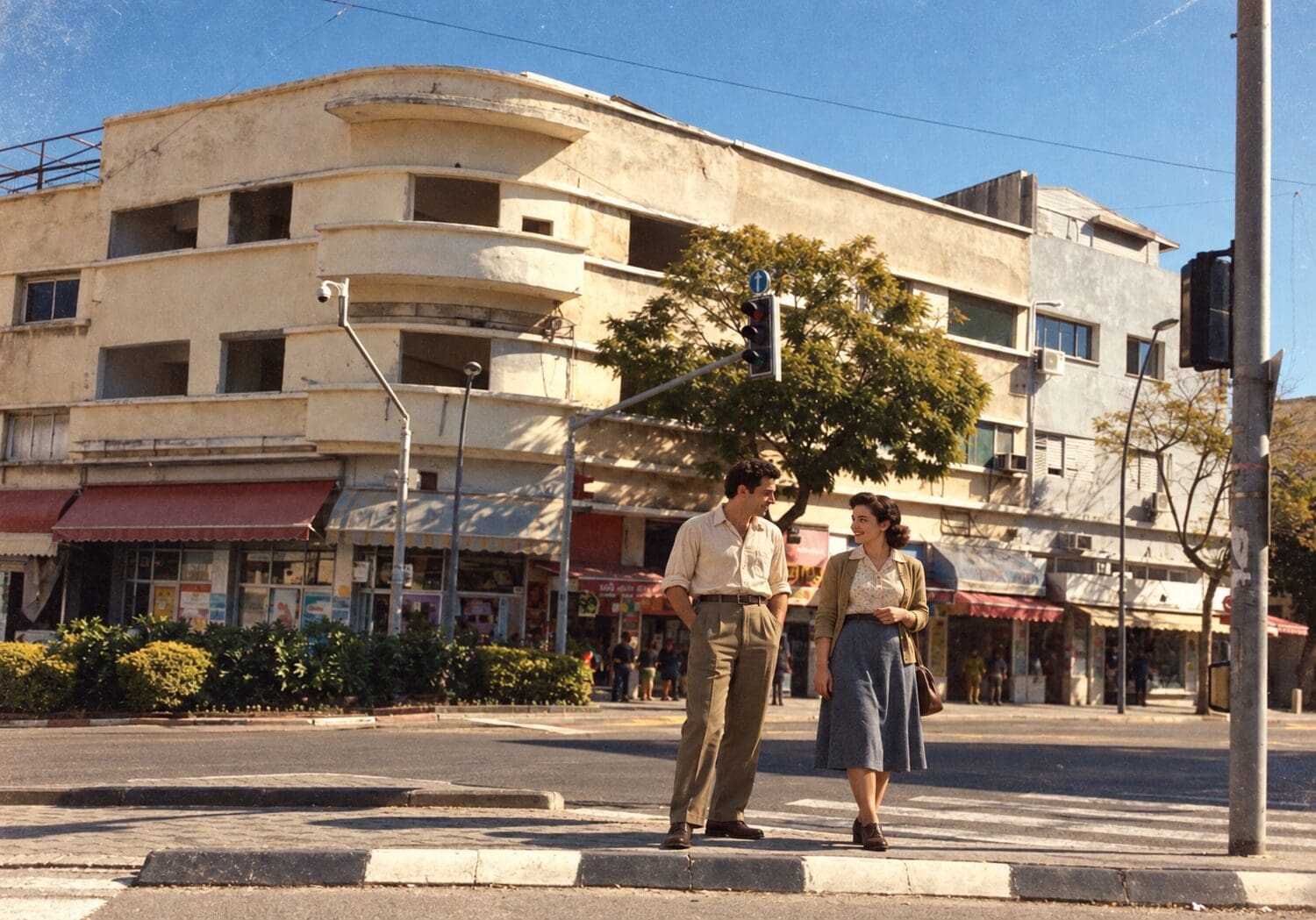
Ahead of the Haifa Bauhaus Week, which will take place between November 8-15, 2026One can look at Hadar's buildings and ask: How did ideas that came from Europe take on a local form here? The answer lies not only in the windows and balconies, but also in the fabrics, cuts, and stories of the fashion created in Israel.
What was the Bauhaus, and how did its ideas reach Israel?
The Bauhaus school was founded in 1919 in Weimar, Germany, by architect Walter Gropius. It connected art, craft, design, and architecture, and sought to combine form with use. The school moved to Dessau in 1925 and Berlin in 1932, and was closed in 1933 under Nazi rule. Teachers and students who emigrated carried its ideas to different parts of the world.
Not all architects who worked in Israel studied at the Bauhaus. Many were influenced by modernism and the International Style, and adopted ideas such as clean lines, simple shapes, and functional planning. In Haifa, they adapted them to the city’s conditions and building materials. Therefore, the name “Bauhaus” is sometimes used in Israel to broadly describe buildings in the International Style.
How did Bauhaus ideas reach fashion?
The connection between geometry, form, and utility is not limited to architecture. Designer Mary Katrantzou presented her Fall-Winter 2018 collection at London Fashion Week. In the collection, she combined inspiration from the Bauhaus alongside other influences from the history of design. In this way, ideas from an artistic movement were expressed on the runway, through prints, colors, and cuts.

The story behind the garment
To understand the fashion created here, it is also worth looking at the material from which the garment is made. Fabric is not just a color or a pattern: behind it there is work, hands, techniques and knowledge that is passed down from person to person. Sometimes it carries with it the traditions and stories of a community. Ata and Meshkit suggested two different ways to transform the material into a garment with a local character.
The story of Ata Company - from fabric to workwear
Ata was founded in the village of Ata in 1934 by the Muller family, a Jewish industrialist family originating from Slovakia, then part of Czechoslovakia. The factory sought to produce textiles and clothing in Israel, and focused on work and everyday clothing: useful and durable items designed to accompany the body during a working day.
Out of practical necessity, a recognizable look was also created: simple, connected to the material, production, and labor. Ata's clothes became part of a broader story about local industry and a working society.
How did Maskit connect craft and design?
Maskit was established in 1954 at the initiative of Ruth Dayan, as a government company designed to promote handicrafts and employment among new immigrants. It incorporated the knowledge and traditions of artisans from various communities into its designs, including embroidery and weaving.
Pini Leitersdorf, Maskit's chief designer for years, transformed these techniques and materials into garments with a distinct design language. Maskit's designs were also featured in the Bonds fashion shows of the 1960s and 1970s. Thus, handcraft, design, and stories from different communities came together on the runway.

What connects the buildings to the clothes?
Ata and Maskhit offered two different answers: Ata through production, utility, and durability; Maskhit through craft, tradition, and story. In architecture, too, ideas that came from outside took on a form that suited the place.
In both areas, design is created from the encounter between ideas, materials and people. Haifa buildings tell the story through lines and shapes; Ata and Meshit add to it the perspective of textiles, handicrafts and fashion.
Interesting and looking forward to it. I read it with great pleasure. You taught me many new things.
Styling is a wonderful and wonderful field. Good luck Ronen and enjoy!
Is it the poor collection, or is it AI?
None of this conveys an international style or a reference to Bauhaus.
The worst thing is to try to juxtapose Maskit and Ata's clothes, which have no connection whatsoever to the style, the period, or Haifa.
Something very bad is happening to articles in the AI era – misleading images, unreliable (even false) texts that seem to have been produced in a shallow and repetitive manner.
It's simply amazing that no one has been fooled about the nonsense recorded and presented here.. perhaps out of ignorance or willful ignorance..
Eyal, that's exactly what you wrote!
As a Haifa-born textile designer who has been creating and working in the fashion field for about 40 years, I remember Ata as an antithesis to fashion in general and innovation in particular, also in terms of fabrics... and certainly the lack of a touch or visibility of fashion.
Regarding Maskit, I have positive and valued memories of good taste, quality, originality, with an emphasis on using high-quality natural fabrics whenever possible, with inspiring designs, elaborate and original embroideries and handicrafts, a stunning and special store on Nordau Street, and of course I remember impressive fashion photos with Israeli models...innovation and originality at its best.
I miss the old Haifa.
When do you hold a guided tour?
I would love to come.
Thanks
doe
The Haifa History Association holds signers at least twice a month…you are invited
Fascinating. So nostalgic and yet can also herald the future. Great.
Today all these beautiful little things are in full bloom
Full of drugs and this... and not just one person is interested
Full of drug stations and people destroying the most beautiful neighborhood in the country. It's a real shame.
Will there be guided tours?
Excellent article, but for the sake of historical accuracy I would like to note that Bauhaus Week is an initiative of the Haifa History Association, which cooperates and coordinates with Fatah, led by the leader, Yossi Kori.
😇 Everything that was "once" was "beautiful" with a "romantic" atmosphere: 🤩People! Houses! Cars! Fashion! Furniture! & MUSIC…
Give us back this time… every time… = "once" the ❤️
The Arab village of Kupritta gave its name to the Jewish settlement of Kfar Ata. Later, Ata was changed to Ata, today's Kiryat Ata. S. Y. Agnon retrospectively gave an interpretation for the name of the factory, Ata - fabrics made in our country.
Very interesting article. As a Shenkar graduate stylist, I would love to receive details about Haifa Fashion Week.
Interesting and informative article.
You have some educational articles.
Looking forward to more..
Interesting and educational, dear Ronen.
Very interesting, well done Ronen.