



(haipo) – Haifa ranked 187th in the 2026 Happy City Index, with a total score of 5,660 points. The international index examined cities around the world using 64 indicators in the areas of residents, municipal governance, environment, economy, health and transportation. The data presents a complex picture of Haifa: notable achievements in education, employment, life expectancy, digital services and transportation accessibility, alongside gaps in the areas of environmental quality, recycling and public transportation use.
187th place in the world, ahead of New York and Istanbul
Haifa received 5,660 points and ranked 187th in the 2026 index. Ahead of it is Tashkent in Uzbekistan in 186th place with only 5,661 points, followed by Bratislava in 188th place and Buenos Aires in 189th place.
In the ranking, Haifa is ahead of a number of well-known international cities, including Istanbul, New York, Beijing, Shanghai, Mumbai and Chicago.
Copenhagen takes first place in the index, followed by Helsinki, Geneva, Uppsala and Tokyo. The top 50 cities in the index are awarded the GOLD designation.
Haifa residents are more educated than average in the index
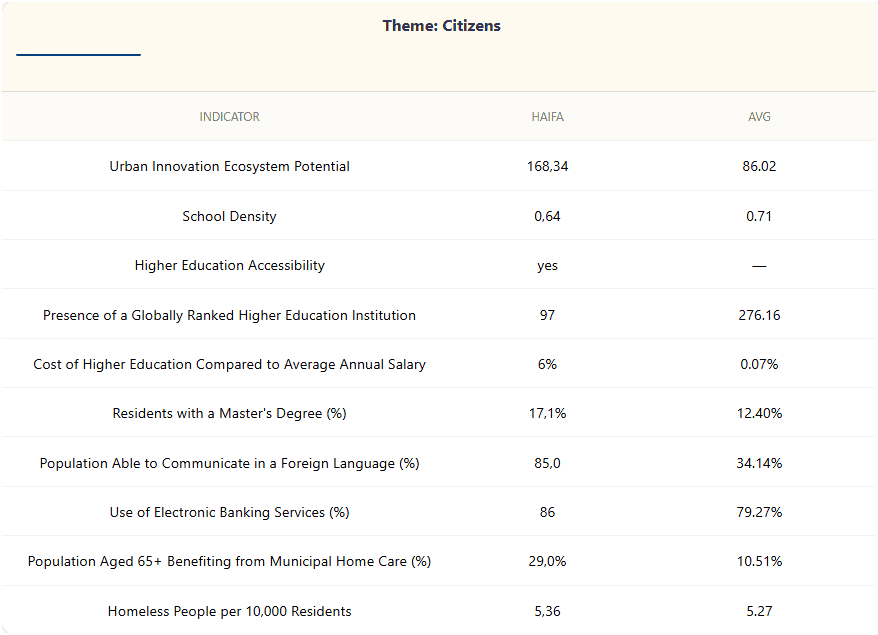
One area in which Haifa stands out is its human capital. According to published data, 17.1% of the city's residents have a master's degree, compared to an average of 12.4% in the cities surveyed.
Haifa also presents an especially high figure in the area of languages: 85% of the population is defined as being able to communicate in a foreign language, compared to an average of 34.14% in the index. Use of electronic banking services stands at 86%, compared to an average of 79.27%.
The accessibility of higher education in Haifa was also reflected in the index, which indicates the presence in the city of a higher education institution ranked in international rankings.
The care of senior citizens stands out
Another interesting statistic concerns those aged 65 and over who receive municipal home care services. In Haifa, the figure shown by the index stands at 29%, compared to an average of 10.51% across all cities examined.
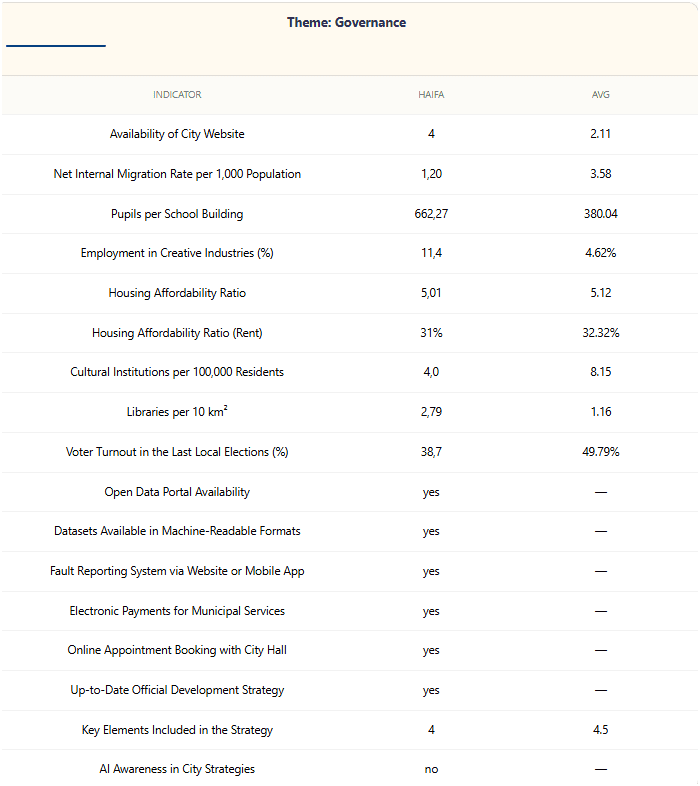
On the other hand, the number of students per school building, according to the index, is about 662 students, compared to an average of about 380.
A digital city, but low participation in local elections
In the municipal government chapter, Haifa presents a series of digital services: a municipal website, an open information portal, databases in a computer-processable format, an online system for reporting malfunctions, online municipal payments, and the option to schedule appointments online.
The number of libraries in relation to the city's area is also higher than average: 2.79 libraries per 10 square kilometers, compared to an average of 1.16.
On the other hand, the voter turnout in local elections recorded in the index is 38.7%, compared to an average of 49.79%. The number of cultural institutions per 100 residents is 4, compared to an average of 8.15.
The Haifa economy: low unemployment and higher-than-average GDP
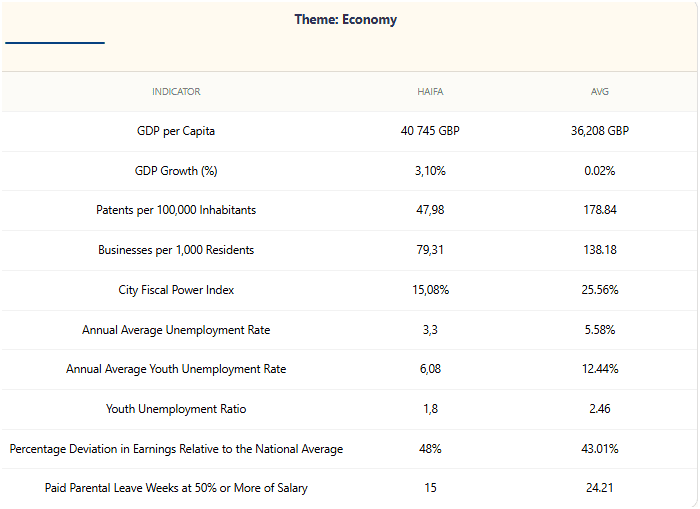
In the economic sphere, Haifa presents some positive data. According to the index, the GDP per capita stands at 40,745 pounds, compared to an average of 36,208 pounds.
The annual unemployment rate in Haifa is 3.3%, significantly lower than the index average, which is 5.58%. Among young people, the gap is even greater: 6.08% unemployment in Haifa compared to an average of 12.44%.
However, in terms of the number of businesses per 1,000 residents, Haifa is below average, with 79.31 businesses compared to an average of 138.18. There is also a gap in the number of patents per 100 residents: 47.98 in Haifa compared to 178.84 in the index.
Environmental quality is one of the weak points
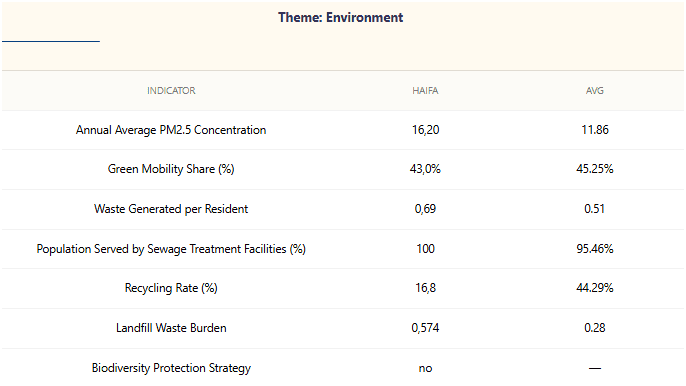
Environmental data indicates several significant challenges. The average annual concentration of PM2.5 particles in Haifa stands at 16.2, compared to an average of 11.86.
The city's recycling rate is 16.8%, significantly lower than the index average of 44.29%. The amount of waste per resident is also higher than average.
In contrast, 100% of the population in Haifa is defined in the index as connected to wastewater treatment systems, compared to an average of 95.46%. The green mobility rate stands at 43%, relatively close to the average of 45.25%.
Life expectancy in Haifa is higher than average.
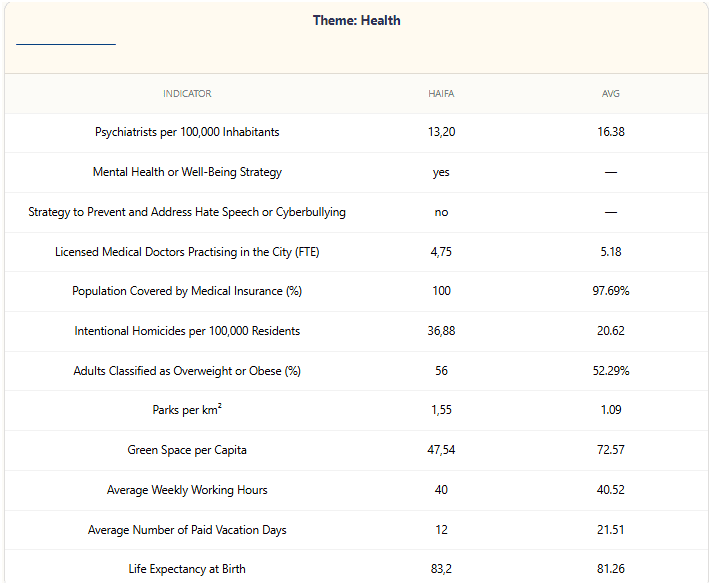
In the field of health, the life expectancy figure is particularly notable: 83.2 years in Haifa, compared to an average of 81.26 years among the cities examined.
The index also indicates medical insurance coverage of 100% of the population. The density of parks in Haifa is 1.55 parks per square kilometer, compared to an average of 1.09.
However, the area of green space per capita is lower than average: 47.54 compared to 72.57 in the index. The number of paid annual vacation days shown in the data is 12, compared to an average of 21.51.
Transportation accessibility and an international airport within the city
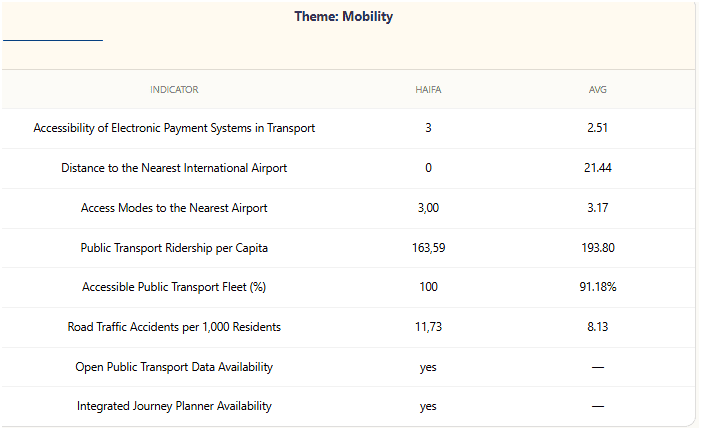
One of the most notable figures in the transportation and accessibility section is the distance from an international airport. According to the index, the distance in Haifa is 0 km, a figure that reflects the location of Haifa Airport within the city limits.
This figure gives Haifa a unique advantage in the field of air accessibility, especially at a time when civil aviation activity from Haifa Airport is expanding and strengthening the connection of the city and the north to international destinations.
Haifa also presents an advantage in accessibility in the field of public transportation: according to the index, 100% of the public transportation fleet examined is defined as accessible, compared to an average of 91.18%.
The city offers open information about public transportation and an integrated trip planning system.
On the other hand, the number of trips per capita by public transportation stands at 163.59, compared to an average of 193.8. The rate of traffic accidents is also higher than the average recorded in the index: 11.73 accidents per 1,000 residents compared to 8.13.
64 indicators that attempt to measure the quality of life in the city
Happy City Index 2026 includes 64 indicators divided into six areas: residents, governance, environment, economy, health and mobility.
The 2026 edition involved 466 researchers and collected and analyzed approximately 150 data records. Of the more than 3,400 cities examined in the initial phase, nearly 1,000 were further analyzed.
The index's editors emphasize that its goal is not to definitively determine what the "best city in the world" is, but rather to compare cities through a combination of quality of life, sustainability, governance, resilience, and long-term development.
The picture that emerges regarding Haifa is not one-dimensional. The city enjoys a high life expectancy, an educated population, relatively low unemployment, digital municipal services, high accessibility by public transportation, and an international airport located within the city limits. On the other hand, data on turnover, air pollution, the volume of businesses and patents, the use of public transportation, and participation in local elections indicate areas where Haifa still has significant room for improvement.
What is this false article? A false publication by someone from the city of Haifa. You are delusional. What is the pollution index? The cleanliness? The killing of nature? Animals? Stop with your lies. Try to embellish reality when the opposite is true.