


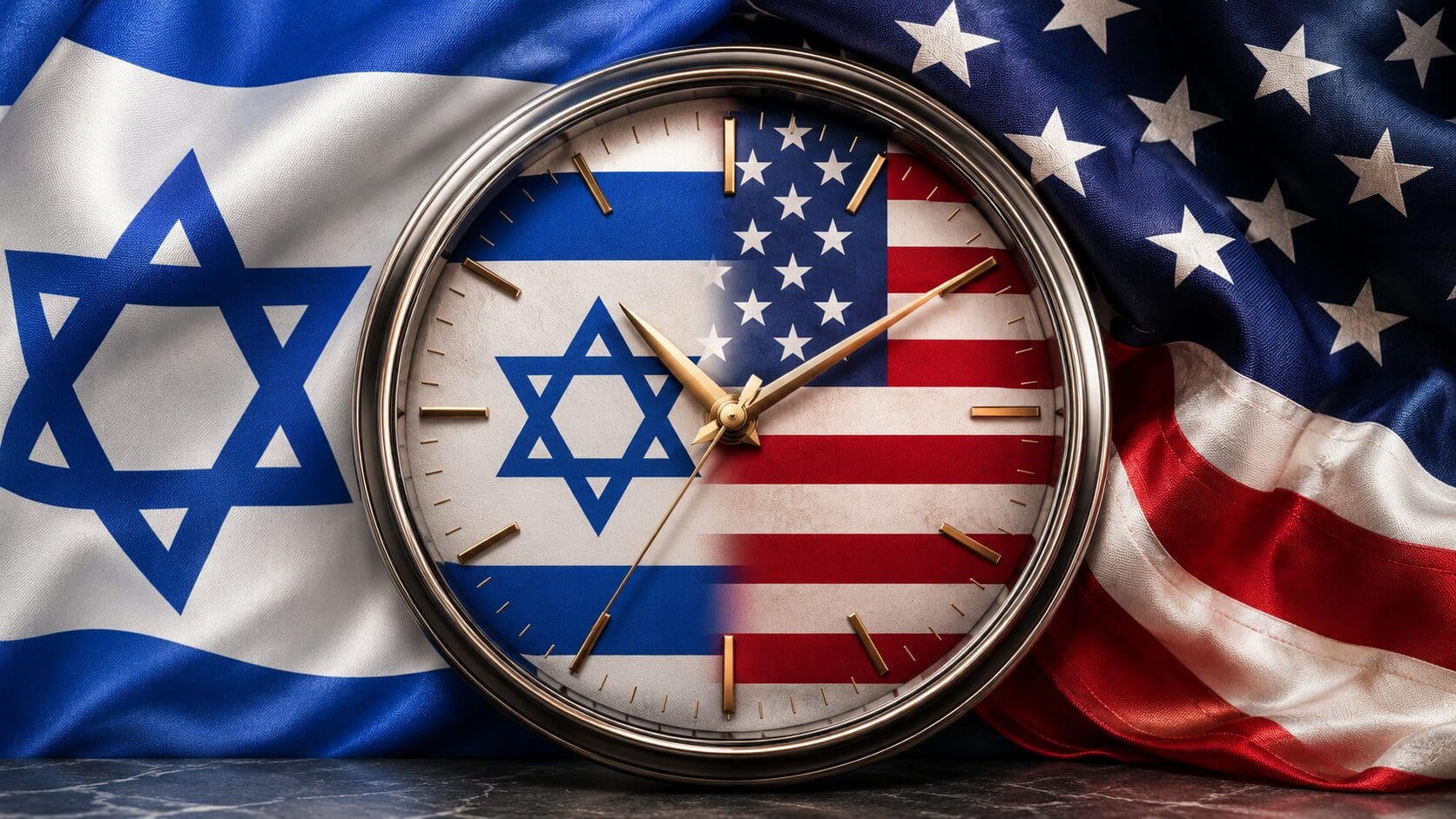
Trump needs quiet ahead of the midterm elections, Netanyahu can't go to the polls with Hamas armed, and Iran needs time to recover. From Kosrae to the Gulf, through Beirut, Gaza and Syria, political timetables could themselves become a factor heating up the Middle East.
The Middle East is entering a particularly sensitive period. Two clocks are ticking simultaneously: the election clock and the war clock.
In Israel, elections are approaching, and in the United States, Donald Trump is looking toward the midterm elections. At the same time, talks with Iran are not ripe for an agreement, the Gulf continues to be a focus of friction, Gaza remains unresolved, Hezbollah is trying to maintain its power, the test of governance continues in Qusra, and now Syria is also returning to the center of the picture.
The question is whether political considerations will begin to dictate policy and who in the region will try to take advantage of them.
Kosrae – The Test of Governance
The situation in Kosrae remains problematic. The issue has gone beyond the borders of Judea and Samaria and has become a topic that also concerns the international community and the American administration.
The intention to transfer some of the law enforcement of Israeli citizens to the police does not in itself solve the problem. Judea and Samaria is under Israeli military control, and therefore the IDF has security responsibility in the area.
The police and the Border Guard are the appropriate bodies for enforcing the law and handling disturbances. The solution should be integration and coordination between the three bodies. There is no need to turn a Golani battalion into a police force when there are police and Border Guards trained for these tasks.
Kosrae is more than a one-off event. It is Governance test, the state's ability to exercise authority and enforce the law. When the weakness of governance becomes an international issue, it also exacts a political price from Israel.
Iran – The calm Trump needs is the time Tehran needs
The attempt to reach an agreement with Iran has not matured, and tensions in the Gulf are rising. The United Arab Emirates has accused Iran of launching missiles, while Tehran denies responsibility. Following the crisis, Abu Dhabi has intensified its economic measures against Iran.
Trump has no interest in being drawn into a protracted war ahead of the midterm elections. Escalation in the Gulf could harm energy routes and raise oil prices.
Iran understands this. It needs time to rebuild infrastructure, rebuild missile arrays, and strengthen its proxies, but it may at the same time try to manage Controlled escalation in the Gulf to put pressure on Washington.
Here lies the paradox: The calm that Trump needs is the time that Tehran needs, but a little fire can become a tool of pressure for Iran.
A threat to the Gulf states, shipping lanes, or the Strait of Hormuz could place Trump in a dilemma: respond and risk escalation and rising energy prices, or exercise restraint and allow Iran more time.
The Gulf states, which fear becoming the scene of the conflict, may also increase pressure on Washington to reach a settlement.
This is a dangerous game. An escalation that is intended to be limited can quickly turn into a conflict that no one is able to control.
Lebanon – Strengthen the State to Weaken Hezbollah
Hezbollah needs friction with Israel to maintain the claim that only its weapons can defend Lebanon. A renewed conflict could help it justify its continued status as an armed force and prevent progress toward a settlement.
Therefore, alongside security determination, Israel should allow the Lebanese government and the Lebanese army to show the public that they are capable of achieving achievements through diplomacy.
Measured Israeli gestures toward the Lebanese state are not a reward for Hezbollah; they may be a tool for weakening it.
On the eve of the Israeli elections, one must be wary of extremist statements and marches that are not necessary from a security perspective and could strengthen Hezbollah and the Iranian axis.
The goal should be twofold: To weaken Hezbollah and strengthen the Lebanese state as an alternative to it.
Gaza – Netanyahu’s Trap
Jared Kushner's renewed involvement illustrates how determined the Trump administration is to make progress in Gaza. The talks he held with the Hamas leadership and then with Netanyahu did not lead to a breakthrough.
The very fact of direct contact with the Hamas leadership shows that the American administration is willing to use almost any channel when it believes it can advance its goals.
The main disagreement remains over the order of operations: Israel demands Hamas disarmament before withdrawal and rehabilitation, while Hamas seeks to tie disarmament to withdrawal and a broader arrangement.
For Netanyahu, the dilemma is difficult: A withdrawal, while Hamas is still armed, is dangerous from a security and political perspective; continued fighting could put it in conflict with Trump.
As the elections in Israel approach, the trap is tightening.
Syria – Is a front opening against Turkey??
The Israeli attack on the Abu a-Duhur base in northwestern Syria adds a new dimension to the equation. The attack targeted the runway and facilities at the base, amid the controversy surrounding the possibility of a Turkish military presence there.
The Israeli message to Ankara is clear: Israel is not ready for a Turkish military establishment in Syria that would change the security balance or limit its freedom of action.
However, it is not at all clear that the attack will stop the Turks. Turkey is a key supporter of Ahmed al-Shara's regime and seeks to establish long-term influence in Syria.
American criticism is particularly important. Trump's envoy to Syria, Tom Burke, described the attack as "Unnecessary escalation", and the fear in Washington is that Israeli-Turkish friction in Syria could quickly develop into another arena that the administration is not interested in.
This raises a real dilemma. Israel cannot ignore a Turkish military buildup that could harm its security interests. But it must ask whether attacks alone are capable of stopping the process, or whether they create another focal point of conflict.
It is too early to know what the consequences of the attack will be. But it is clear that Syria is no longer just an arena for a struggle to establish itself.
The Iranian one. It could also become an arena of friction between Israel and Turkey.
Trump, Netanyahu and Iran – Three Watches
This is where all the arenas connect.
Trump wants to reach the midterm elections without a broad regional war, with energy prices under control and with the ability to present political achievements.
Netanyahu wants to reach the elections in Israel without an armed Hamas as a threat and without concessions that would be seen as weakness.
But in Tehran they also read the calendar.
We have no proof that Iran has decided to heat up the arenas to influence the elections in Israel or the United States. But it certainly has an interest in testing the limits of Washington's patience.
Controlled warming in the Gulf, through Hezbollah or other elements in the Iranian axis, could, from Tehran's perspective, put pressure on Trump, present Netanyahu with dilemmas on the eve of the elections, and at the same time buy time to restore its power.
The danger is that a move intended to create limited pressure will turn into an escalation that neither side planned.
When the ballot box enters the battlefield
Trump wants to reach the midterm elections with the Middle East as quiet as possible. Netanyahu wants to reach the elections in Israel without an armed Hamas and without concessions that would be seen as weakness. Iran wants to reach the same point when it is more restored and able to apply pressure again. Now Turkey is also entering deeper into the Syrian equation.
All these clocks are ticking at the same time.
In Kosrae, governance and law enforcement are needed. In the face of Iran, we need to prevent the calm from turning into a time of reconstruction and understand how Tehran might use the Gulf as a lever of pressure. In Lebanon, Hezbollah needs to be weakened while strengthening the state. In Gaza, we need to find a formula that will neutralize the Hamas threat. And in Syria, we need to prevent the Israeli-Turkish dispute from becoming another front.
Above all, there is one test: The ballot box must not be allowed to run the battlefield.
The election clock and the war clock are now ticking together. Trump wants to slow the war, Netanyahu cannot afford to be seen to be giving up on its goals, and Iran may try to exploit the gap between them to buy time, restore its power, and apply pressure.
The test in the coming months will not only be who is stronger on the battlefield, but who will succeed in preventing the ballot box from running it. Because in the Middle East, an attempt to heat up one arena for the sake of political achievement could ignite them all within days.
As long as Arab terrorism only aims to create destruction, attacks, and death, then the Middle East is always in a sensitive period, wherever radical Islam strikes. Once Syria, once Yemen, once Iraq, for a change, Iran got kidnapped after funding terrorism throughout the Middle East, and it's a shame Qatar doesn't get kidnapped too. There's always a sensitive period here.