


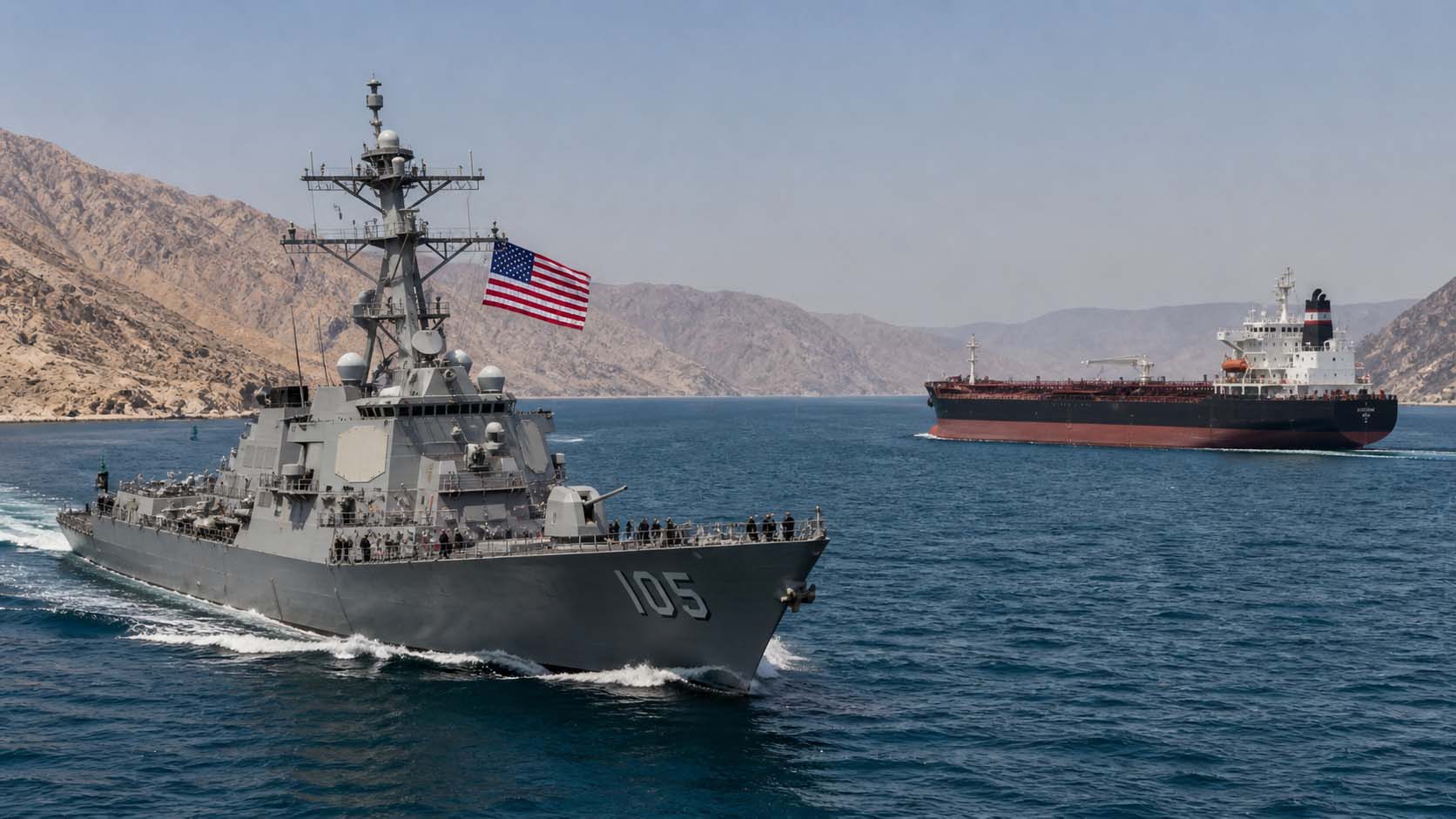
The great conflict is no longer just about nuclear weapons.
The Middle East is at the threshold of a new strategic phase. For more than two decades, the Iranian nuclear program has been at the center of Israel's and the international community's security agenda. Today, it remains one of the main threats to Israel's security, but the regional reality has expanded and become much more complex.
The struggle between the United States and Iran is no longer just about the number of centrifuges or the level of uranium enrichment. It deals with a broader question: who will shape the Middle East in the coming decade, and what the balance of power will be between the moderate camp and the axis led by Iran.
The Strait of Hormuz, through which a significant portion of the world's oil and gas traffic passes, has once again become a key arena. Any violation of freedom of navigation affects the global economy, energy prices, and regional stability. Therefore, for Washington, Hormuz is much more than a maritime passage; it is a top-notch strategic interest.
Is Israel preparing for the right war??
In Israel, the discussion for years has focused on the possibility of a military attack on Iran's nuclear facilities. This is an important discussion, but it is not enough.
Today, it is clear that the confrontation with Iran includes a much broader campaign: freedom of navigation in the Gulf, economic warfare and sanctions, the ballistic missile system, Iran's branches in Lebanon, Syria, Iraq, and Yemen, as well as the competition between the United States, China, and Russia for regional influence.
Therefore, the real question is not just how to prevent Iran from obtaining nuclear weapons, but how to deal with the full range of challenges it poses to Israel and the West.
Hormuz – the arena that shapes the region
Iran sees the Strait of Hormuz as one of its most important levers of pressure. The very threat to freedom of navigation allows it to influence the global energy market, exert pressure on the West, and improve its negotiating position.
On the other hand, the United States sees ensuring freedom of navigation as a top strategic goal. The stability of the Gulf is essential to the American economy, its allies in the Middle East, and the global economy.
This means that the conflict over Hormuz is not just a maritime issue. It has become one of the decisive points in the struggle for the new regional order.
What does Iran want??
Iran's goal is not just to lift the sanctions; it seeks to preserve its status as a regional power and continue to hold the levers of influence it has built over decades.
Alongside its ambition to improve its economic situation, it seeks to maintain its nuclear capabilities, its ballistic missile array, and the network of proxies it has built in the region, led by Hezbollah in Lebanon, the Shiite militias in Iraq, the Houthis in Yemen, and other elements.
From the perspective of the leadership in Tehran, these are its main deterrent assets. Therefore, even if certain policy understandings are reached in the future, it cannot be assumed that Iran will voluntarily give up all the elements of power it has accumulated.
Trump – Between Pressure and Agreement
The policy of United States President Donald Trump combines maximum pressure with a willingness to reach an agreement.
On the one hand, he reiterates that he will not allow Iran to obtain nuclear weapons. On the other hand, he understands that a large-scale regional war could damage the global economy, raise energy prices, and also harm American interests.
Therefore, it appears that the American administration prefers to first exhaust the limited political, economic, and military pressure, while leaving a credible military option on the table.
Does the military option still exist??
The answer is yes.
The mere existence of a credible military option strengthens the United States' negotiating position. One of the key issues is the fate of Iran's deeply fortified nuclear facilities.
If it becomes clear in the future that airstrikes alone are unable to destroy or neutralize them over time, a discussion of additional alternatives may develop. Any such decision will require close coordination between Israel and the United States, along with a careful examination of the risks and costs.
What is the right thing for Israel to do??
In my opinion, Israel must act on four key levels:
- First, deepen strategic and intelligence cooperation with the United States. The alliance between the two countries is an irreplaceable strategic asset.
- Second, to preserve the IDF's operational freedom of action in the face of any direct threat, while avoiding moves that do not serve Israel's strategic goals.
- Third, continue to build advanced capabilities to deal with the threat of missiles, drones, and the multi-threat war waged by Iran through its proxies.
- Fourth, understand that the campaign against Iran is not only being waged on the battlefield. It also includes the political, economic, technological, and informational arenas. Israel's success will be measured by its ability to combine all the components of national power.
Summary
The confrontation between the United States and Iran has entered a new phase. The nuclear program continues to be a central component, but it is no longer the only component. Hormuz, freedom of navigation, the global economy, ballistic missiles, and regional proxies have become an integral part of the campaign.
For Israel, the challenge is not only to prevent Iran from obtaining nuclear weapons, but to understand how the Middle East is changing and to adapt its policy to the new reality.
In the second part We will examine how these developments affect Lebanon, Syria, the Gaza Strip, and Judea and Samaria, what the rapprochement between the United States and Saudi Arabia means, and what the three possible scenarios for the future of the region are, and my recommendations for Israeli policy.