


The smell of carob is from the "camembert scent" family:
Towards Rosh Hashanah, the carob trees begin to bloom, carrying a heavy, brazen scent that cannot be mistaken or ignored. Ariel Hirschfeld writes about the carob blossom and its strong scent: "... I knew a great poet who once drew me to Ben Maimon Boulevard in the autumn with the intention of smelling the carob blossoms, and he stood there, smiling all over, happy with the scent of the male fantasy painted by the river of scent that filled the street.
I have seen quite a few people who, the moment they noticed the scent of a blooming carob tree above them, suddenly opened their eyes in wonder and smiled brightly. A dear woman once said to me, to the smell of a large carob tree that was blooming near her house: "I am embarrassed that I am not embarrassed that I know this smell." Do you like it? - I asked in a slightly invasive tone. "Look," she said, "not everything about it was good." And she did not continue. One artist, Polish by origin, a great Eastnian and an extreme expert in the field of smells, able to distinguish even between different smells of clean water, who knows how to get up and turn off the kettle the moment the smell of boiling water spreads in the room, once explained, with complete seriousness, to a small group of friends I was sitting with, that the smell of carob is from the "smells of Camembert" family and also some cheeses from the Normandy region, especially around the town of Font-l'Avèque. "A smell that has a hint of fluff and of protein on the verge of rot, but it is mixed with a strong and fresh smell of wet clay soil"... The conversation, which took place of course at the foot of a carob tree, but not during flowering, thus reached an oppressive moment. Who could argue with such a virtuoso, who knows the fresh smell of wet clay soil? And especially: what remains of the smell of the seed, or the carobs, after so many words."
This unambiguous smell spread and also reached Meir Shalev's book "Ginat Bar" (p. 234): "When I lived in Jerusalem, I often found myself walking or pedaling up Marcus Street in Talbiya. Large carob trees grow on both sides of this street, and in the autumn months, the males, whose bloom is much more abundant than the females, give off an unmistakable scent. Not all passersby understand where all this living beauty comes from, and more than once I saw an amusing sight there: passersby, both male and female, their faces raised and different expressions on them, each according to their life experience and inclinations: Who would have believed it... in Katamon, but here in Talbiya?!". Elsewhere, the same author writes: "...Uncle Menachem did not trust the wind to carry the carob pollen to the carob flowers and fertilize them himself. At the end of the summer, he climbed the male trees, shook the fragrant pollen into paper bags, and hastened to scatter it among the female branches. Because of this, the heavy, distinct, and unfading smell of semen clung to him, which embarrassed the neighbors, amused the neighbors, and drove his wife crazy." (Khimim Ahaddim, p. 64).
The fiancee test:
An ancient Bedouin legend tells: "One day, a young Bedouin was walking with his pious fiancée, and they both passed under a male carob tree that was in full bloom. The fiancée inhaled the heavy scent with all her lungs and a broad smile spread across her face from ear to ear. The young man realized that she knew the smell, so he got up and killed her on the spot. Since then, when they want to test the virginity of their fiancée before her wedding, they bring her under a blooming carob tree and test her reaction." This legend appears on several websites in different versions on the Internet. The story behind it is much less "ancient." One day, I (A.D.) guided a botanical tour of Shul teachers during the carob blossom season on a hot, steamy, and decidedly unfriendly day. The tired and bored participants pestered me with idle comments, and then on the spot I invented this legend according to the rule coined by Hananiah Reichman: "The curious listener spurs on the liar." Someone told the legend further, and that's how the "legend" found its way into writing. If I were writing the legend today, I would be more moderate and end the legend by returning her to her parents' house and breaking off the engagement with her, and then every reader/listener would be able to imagine how the story ended... Maybe thanks to this legend I will apply for the title of "Old Bedouin or Bedouin."
Here is a true story: "A man who lived in a distant place had four sons and one daughter. One day the sons went hunting and left the daughter to take care of the goats and the tent. The girl was sleeping under a carob tree that was in full bloom and thought it was perfume. She took one branch to the tent and placed it in her corner. The men returned a few days later and smelled a strange man's scent, suspecting the girl of having harmed the family's honor. They killed her immediately and buried her secretly. The smell remained in the tent for several days, and when they went to check her corner, they found the carob branch and regretted their actions. And since then, there is no need to rush to judgment, because haste is from Satan" (according to Mahfouz and Ahabi al-Khatib, Barta'a, 10/23/13).
Among the villagers in the Galilee, we heard the saying: "Behind the scent of the carob blossom is a story that only the young people will understand." That is, behind the scent of the carob blossom is a message that only the young people will understand, and they certainly know what it is about.
The carob is a love potion
In Persian folk medicine, carob fruit is used as a love potion, to increase sperm count, and to treat male infertility. A prescription from Turkey for the same problems suggests taking two to three pieces of carob fruit every morning for two to three weeks (Tufan et al., 2018:143). In the West Bank, women eat carob powder to treat fertility problems (Jaradat and Zaid, 2019). According to a list called "I Want Carob" (which appears on the Neot Kedumim Reserve website), it is said that: "Among Moroccan Jews, it is customary to boil carob seeds overnight, which results in a thick, sweet gelatin layer at the top of the pot. The gelatin is served to couples immediately after the wedding so that they have the strength for a fruitful honeymoon, and the gelatin is also supposed to help the woman's fertility."
Given the distinct scent of the carob blossom, it is difficult not to associate the use of carob with human fertility. In the 16th and 17th centuries, a theory of "like cures like" (Doctrine of Signatures) developed in Europe. The essence of this "doctrine" is the idea that plants that resemble certain organs, symptoms, or diseases in color, smell, shape, or name have the power to cure those diseases. Although the "theory" was formulated only a few hundred years ago, the roots of the idea appeared thousands of years ago in ancient cultures in various places on earth (Dafni and Lev 2002). For example: drops squeezed from the fruits of the donkey's saliva, the yellow of the flowers, were used to cure jaundice; Shulamith's hairs are good for hair growth and care; The scorpion sting, whose curved blossom resembles a scorpion sting, is suitable for healing bites from this insect, and the roots of the mandrake, which resemble the figure of a human, are a proven remedy for reproduction and fertility (Dafni and Khatib 2017:187).
Surprisingly, new studies have shown that when mice were fed an extract extracted from carob fruit for 35 days, there was a significant improvement in sperm quality and testosterone levels (Vafaei et al., 2018; Soleimanzadeh et al., 2020). When an extract prepared from carob fruit was added to frozen human sperm in the laboratory, a significant improvement in sperm quality was found (Faramarzi et al., 2019). In mice treated for reduced sperm fertility, an increase in testosterone levels was found after feeding them an extract from carob fruit (Faramarzi et al., 2020). As for the use for men, it is the fruit and not the fragrant flowers, but it is easy to imagine how people came up with the idea of using carob to achieve this unique goal of fertility in both men and women. Even more surprising is how this idea came to be in Yehudit Ronen's book "Whiskey of Carobs": "Fabel also began selling carob flour, which Shloima the shepherd ground from the fruits he collected every evening, after he had put his cows to sleep. A rumor has recently spread in our area that the flour has outstanding medicinal properties and is especially good for strengthening male potency. 'Maybe because of the worms we ground in it,'... But this did not harm the reputation that had emerged from the village shepherd's workshop. The carob flour, which was quickly snapped up without Shloima having to invest any effort in promoting its sales, arrived in the village homes at the perfect time, when it became clear beyond any doubt that the red guavas that had once inspired blue dreams had disappointed" (p. 128)..
The carob smell is like the smell of a corpse
Wikipedia, which is cited by many, explains the origin of the similarity between the smell of carob flowers and the smell of human semen as follows: "The male carob flower exudes an odor reminiscent of human semen, because both contain the same polyamine called cadaverine. The origin of the name cadaverine is the characteristic odor of corpses (Cadaver in English means corpse, obtained from the decomposition of amino acids in dead cells. In carob flowers, cadaverine is formed from the decomposition of the amino acid lysine. This feature constitutes an effective adaptation that attracts pollinators, who are attracted to the smell of corpses…." (Wikipedia entry: Carob). Unfortunately, we were unable to find confirmation, in the scientific literature, of the claim about the presence of cadaverine in carob flowers. But there is evidence that cadaverine is used as an intermediate compound in the production of floral odorants that mimic the odors of feces or carrion (Zhang et al., 2018:143: Jürgens and Shuttleworth, 2015: 373, ).
The truth behind the scent of carob flowers is much less picturesque. The substance called cadaverine is found in trace amounts in carob fruits (Farag et al 2019:678), but it has never been found in its flowers. An examination of carob flowers revealed that no fewer than 30 compounds were found in them, none of which are from the group of substances to which cadaverine belongs. It was also found that there is no difference in the chemical composition of odors between male and female flowers. The greater intensity of the odor in male trees stems from the simple reason that it bears many more flowers than the female tree. During the day, a great deal of activity was found (mainly on male trees compared to female trees) of wasps, honeybees (the main pollinators), and solitary bees. At night, no fewer than 30 species of moths were observed on female trees, the role of which in pollination is unclear. Five species of Einpaz (a green insect with orange eyes, hence its name, also known as the "green arinmel") were observed on female trees as active pollinators and as carriers of abundant carob pollen, evidence that the insects had previously visited male trees. It is assumed that these insects, which are active at night, do not distinguish between female and male trees, which have the same scent, in the dark, and thus pollination is possible. (Dafni et al., 2012)
Dense honey smell of estrus
The heavy scent of the carob tree is not absent from Hebrew poetry. "We are vessels / and all that remains / of the seed / is its smell in the carob tree." (Yorem Ben-Meir, Toldot. A Dream of Morning, p. 156). The heavy scent of the carob tree that returns every autumn (a rare season for the trees of the land to bloom) never ceases to remind us of the human reproductive cycle. We are temporary and need to reproduce with each generation, while the carob tree is eternal and renews its scent, bringing our seeds with us.
Haim Gori leaves the deciphering of the carob smell riddle to the reader himself. : "...Carobs in their stunned bloom / And faint light. / Four walls beyond the world. / A mound of a breast that is hot / Rises and breathes, / Nipples are lost in the heat / Beyond and far away. " (Chaim Gori, On the Way. The Songs, p. 117 The exciting and highly associated carob smell is what explains to us what happens between the four walls when the light is weak and the chest rises and breathes, when the carob smell is heavy and unequivocal.
Zvi Atzmon, who is a natural scientist, is accurate in describing the smell of the carob and its fruit. The very name of the poem, "Male Carob - An Exercise in Definition," is ironic in the sense that we will give you a male carob flower to define and see what disappears from your nose and botanical eyes: "Summer fades with its scent / sickeningly sweet / Carob from sex does not murmur / A lily or a rose in the hair / damp girls, etc. / Only a dense honey-like scent of estrus / And the swarms of flies bite at the pollen load." (Interior Design, p. 42).
Epilogue
When dealing with the scents of the flowers, we often talk about the sweet scents that are meant in nature to attract the pollinators to the flowers for pollination services. Humans enjoy this magic for the pleasure and motivation of their loved ones. How many are the love songs that embrace the sweetness of the scents of flowers and the wonders of love. We rarely come across flowers with an unpleasant smell.
There are very few plants whose strong scent announces their existence with such defiance that it does not allow us to ignore them. It seems that there is no other plant in Israel, such as the carob tree, whose scent of its flowers evokes such vigorous reactions in humans, not to mention the messages and associations that accompany them. Therefore, it is not surprising to what extent the scent of the carob tree blossom has penetrated folklore, folk medicine, literature and poetry. Science, as usual, lazily follows the trail of uses, stories and emotions, sometimes it refutes them and sometimes it surprises us with its conclusions that confirm the extent to which folk beliefs are based on truth.
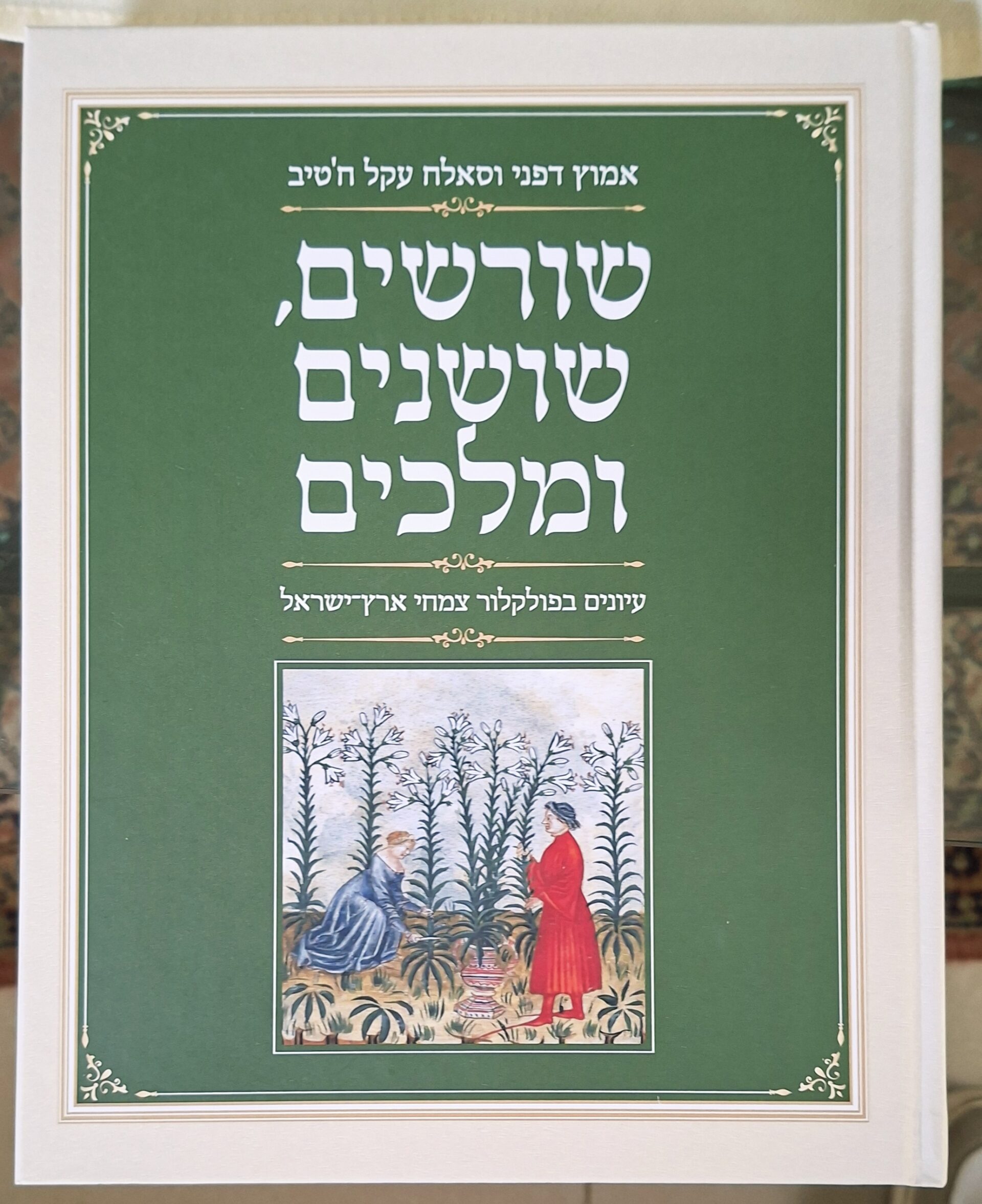
From: Amotz Dafni and Saleh Akel Khatib (2024) Roots, Roses and Kings. Pardes Publishing
Literature will be sent by contacting the authors.
Thanks: Thanks to Yehudit Ronen, Meir Shalev, and Ariel Hirschfeld for permission to quote their letters, and to Charla Oren for her comments.
To purchase the book: [email protected]
Respect and appreciation to you, dear Amotz. You have managed to deeply instill your fingerprint in the botanical consciousness of our country. Thank you for the partnership. Thank you to the Haifa News Corporation.