


Producing fire – the woolly rock (قدحة) Qadha)
In Hebrew, the root ק.ד.ח has several meanings: to make a hole in something, to set fire to, to ignite, to burn, to burn, and to have a fever (characterized by bouts of high fever). All that remains for us now is to connect the following verses: "For you have kindled a fire in my nostrils, it will burn forever" (Jeremiah 17:4); "For you have kindled a fire in my nostrils, and you will burn even to Sheol" (Deuteronomy 32:22) and a line from Bialik's poem "And a spark of old is still in the burning heart" (in the poem 'Kohav Nidech') and before us is the entire act of igniting fire - igniting (friction) and creating great heat, producing a spark and creating fire. Producing fire and igniting it create great heat, hence a possible connection between the different meanings of the root ק.ד.ח and the Arabic name for the woolly maw, to this very day. We should note that in Arabic, the root ק.ד.ח also means both 'to ignite' and 'to drill'.
Starting a fire by striking a flint was common practice in Israel as early as the early twentieth century. Amotz Cohen (the eldest son of the Motza Be'acha settlement in Jerusalem and a veteran nature teacher who was amazing at writing about the nature of the country) testifies: "About twenty years ago, while matches were a novelty in Israel, the farmers would use this wool (from the rock wool) to start a fire: they strike an iron bow on a flint bow and aim so that the flint falls on a bundle of dry wool placed next to the stone. When the flint falls on the dry leaves, they blow on them and the light becomes more and more intense. Smokers would often hold a flint fragment and a handful of wool leaves in their cap; there is no plant like this to hold the fire in" and adds (these words were written in 1932) "Today, this primitive kindling is only seen in the most remote settlements." (Cohen, 1932:170).
The Desert Wick
The name of the plant is derived from the identification of the plant as one of the sources for preparing wicks for Shabbat candles. According to the Mishnah: "One does not light either with laksh, or with chussan, or with kalach, or with the wick of Eden, or with the wick of the desert, or with the green that is on the surface of the water." Most of the sages agree that these are plants from which wicks were prepared. The prohibition on using the specified plants may stem from three factors, one of which does not exclude the other: first, that the flame is not bright, second, that the wick does not conduct the oil well, and third, that it does not last long enough. According to Rabbi Shlomo ben Shimon of Meitz (12-13 centuries): "The Sages also decreed not to light with wicks in which the light is scattered, and with oil and other things that do not follow the wick well" (Sefer Ya'raim, siman Ra'd:28). And a few years later, Rabbi Zedekiah ben Rabbi Avraham the Physician (in the 13th century) writes, "And one should light the candle during the day with a prayer that burns well and with pure and clear oil so that it follows the wick that burns well and does not have to be tilted..." (Shibli HaLekt, 62, 2).
Many researchers have dealt with the identification of the plant 'Desert wick', and in the literature there are at least ten different identifications, including: Chinese cinquefoil, white sedge, nettle, Chinese marigold, kelach, and more (see an extensive historical review by Amar and Shweiki 2003:51-69).
According to Yehuda Felix: "Of the various identifications that have been proposed for the desert wick, it seems most likely that the reference is to the fibers extracted from the plant, popularly called the 'Sodom apple'... The seeds are wrapped in fine fibers like silk. Wicks can be made from these fibers, but they do not draw the oil well. Therefore, they forbade the use of the desert wick fibers for the Sabbath candle" (Felix 1983, Tzemachei Mishna, p. 131).
Amar and Shweki prepared wicks from the long hairs of the sedge (which serve as a means of dispersing seeds over long distances) and found that the flame created was beautiful and low and burned for 4.5 hours. Their conclusion is that it is difficult to explain why the desert wick was rejected and in their opinion this is proof that this identification is incorrect (ibid., p. 57). They found that the wick of the two-stemmed sedge burned very beautifully and for a long time. The problem is that the wick prepared from this plant breaks and is not suitable for use as a Shabbat candle. In their opinion, the sedge is a good candidate for identifying the desert wick.
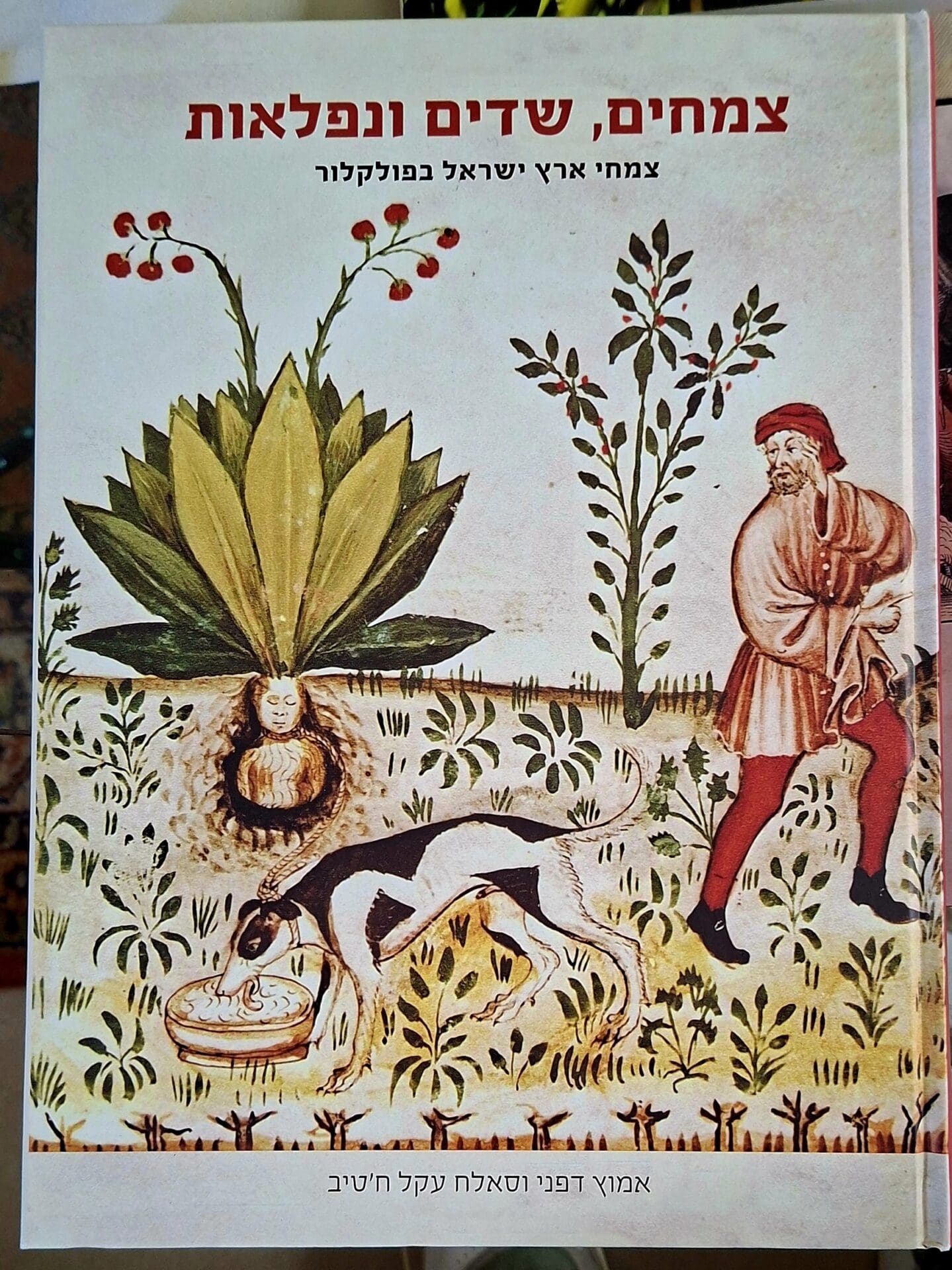
Amotz Dafni is a professor (emeritus) at the University of Haifa, a botanist and folklore researcher. Saleh Akel Khatib is a researcher of the traditions and folklore of the plants of the land. From: "Plants, Demons and Wonders" – Plants of the Land of Israel in Folklore (New World Publishing).
Did the article interest you?