


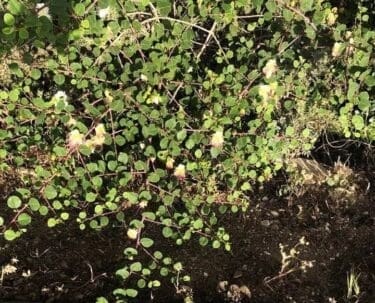
To remove leeches – Thorny arrowroot, holy raspberry and prickly ivy share the Arabic name: علِيق (علّيق) which means leech because of its use to remove leeches from the throat or perhaps because they cling to clothing or the bodies of animals in the human household such as goats and sheep. The verb عَلِقَ علِقُ علِقُ means clinging.
Thorny Sniper
The use of medical safflower to remove leeches is apparently a local use that was first documented by a Jerusalem physician, Marcus Salzberger, who quotes on behalf of Ephraim Harauveni: "Mr. A. Harauveni was the first to explain the use of the plant Capparis spinosa I am grateful to Mr. Haruveni for pointing out to me the places in Jerusalem where these plants grow. We have seen them both in a fresh state and as withered plants on old walls. Figures 1 and 2 show the two states of the plant. The branches present a structure of claw-like thorns, quite strong and directed downwards. The inhabitants select a strong branch, cut off or break all the thorns except one, and thus improvise a tool with a handle on one side and a hook at the end. "It can be easily inserted into the mouth and pharynx, and, as I am told, even into the esophagus, without causing the slightest injury. The leech is caught on the hook and releases its hold as soon as it is caught. Thus it is pulled out, just like a fish on a hook" (Salzberger 1928:29-30).
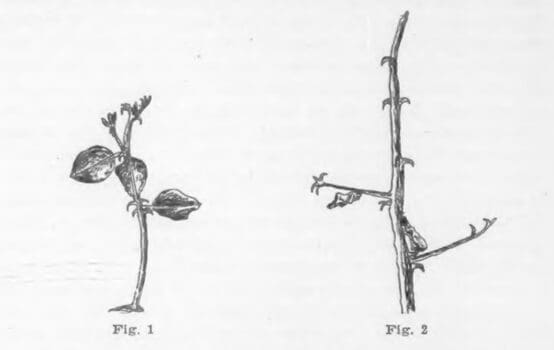
Illustration: Clover branches used to remove leeches. From: (1928:29-30 Salzberger).
And in Noga Haruveni's more picturesque description: "Among the Arabs, an initiative was developed to utilize the thorns of the snip... In their water sources, black and shiny leeches are sometimes found, which get stuck in the throat and have no greater pleasure in sucking blood. Then the friend of the leech's victim will pluck a branch of the snip... He will remove all its leaves and thorns, leaving only one or two hooks in it. The unfortunate person will open his throat, and the 'doctor for the hour' will insert the branch in his hand into it, with the tip of the hook pointed upwards. The branch will slide nicely deep into the throat, and when it comes out again, the hook will stick into the leech's flesh, and dig it out with dignity..." (Haruveni 1957:126).
Prickly ivy
We recorded a similar story for the prickly ivy in Arab al-Aramsha, on the Lebanese border: "If a person drinks water and is not careful and a leech gets stuck in his throat, he should take a branch of young and flexible ivy and remove all the thorns except for the one at the end of the stem. This branch is slid down the throat and an attempt is made to pull out the leech, hoping not to make a 'puncture in the throat.' It is highly advisable to contact the experienced local clinic and not try it on your own (Abdallah Hussein, Arab al-Aramsha, 12.3.2003). We have not found written evidence of the use of prickly ivy to remove leeches. Ibn al-Bitar (II:123) writes: "Prickly ivy is a well-known and famous plant, repelling leeches if one drinks 'its water' or if one gargles with it. "They give it to animals if a leech gets stuck in their throats." He calls the plant "shabshin shabshin." Al-Antaki (who worked in southern Turkey in the sixteenth century) also writes that prickly ivy softens and is used to remove leeches from the throat. It is boiled and given to animals to drink, so the leech is released and falls off (al-Antaki 1988: 2, 214). Ivy is known for its saponin content (Tian et al., 2017), and it is possible that it is the cause of leeches removal.
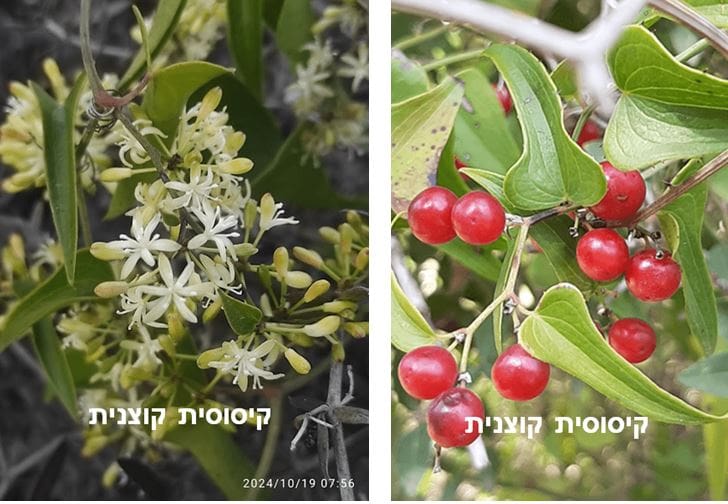
Jujube bush
A British doctor who worked in Palestine and surveyed the distribution of leech infestation in the Land of Israel and the method of treating them, comments dryly on the method of home treatment: "As for treatment, the inhabitants of Palestine use, if the leech is accessible, the female with a sharp thorn from the cedar tree (jujube bush) (Masterman 1908:184)). In light of the structure of the jujube's pointed thorns, it is reasonable to assume that the method of use was similar.
The Field Margarita
The three names of the field margarine: قاتل العلق (Qatal العلق), عشبت العلق (عشبة العلق), and 'حشہشہط العلق' (حشہشہط العلق) originate from the use of the plant to remove leeches. In this case, it is not a question of using any part of the plant, but rather an extract extracted from the plant.
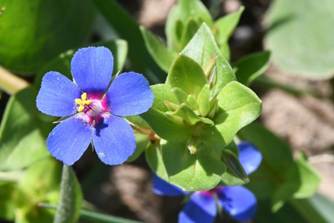
Marganit Hasade (Photo: Tzachi Paz)
The use of an extract from marigold to repel leeches is well known in classical Arabic medicine. Yunus ibn Jannah, a Jewish scholar who lived in Andalusia (990-1050), wrote, among other things, a book on the names of medicinal substances. According to him, the blue variety of marigold (to remind us that today the orange type and the blue type are included under one species, 'marigold of the field', in the past they were considered two separate species), kills leeches and is therefore called 'the herb of the leech' ( אִשִבִּת אֶל אֶל אֶל אַלַק, Bos et al., 2020:238).
According to al-Ghafiqi (a 12th-century Andalusian physician and botanist), Hashishat al-'Alak ( Hashishat al-ʿAlīq "Helianthus annuus (Helianthus annuus) is collected when it is in bloom. The leaves and flowers are ground well. Mix with vinegar and honey, apply the mixture to the bite wound and the leeches, and they will dissolve and die within an hour." According to Al-Ghassānī (1580–1610, lived and worked in Morocco), an extract from the Helianthus annuus plant with vinegar is said to kill the leeches quickly (Al-Ghassānī 1990: 241). The use against leeches in humans and in folk veterinary medicine (ethno-veterinary), mainly in India and South Asia (Pande et al., 2007:445; Maheshwari 1996: 127).
The use of field marjoram to remove leeches stems from the content of substances it contains. There is a combination of action between substances that harm the leech (phenols and glycosides) and those (saponins) that are known to shrink the host's tissues, thereby reducing the leech's ability to cling to the tissue. Many compounds belonging to these two chemical groups have been found in field marjoram (Shoji et al., 1994; Classen et al 2025).
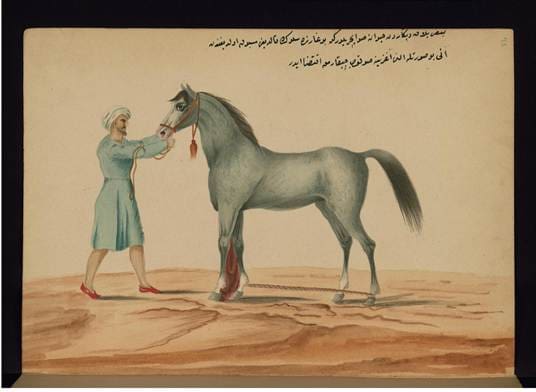
Illustration No.: Removing Leeches from the Mouth of a Horse (Ahmed 'Ata Tayyarzade (d. 1294 AH / ≈1877 AD). The manuscript is part of the collection at the Walters Art Museum, Baltimore, accession number W.661.75A.)
By: Amotz Dafni and Saleh Akel Khatib.
Amotz Dafni is a professor (emeritus) at the University of Haifa, a botanist and folklore researcher. Saleh Akel Khatib is a researcher of the traditions and folklore of the plants of the land.