


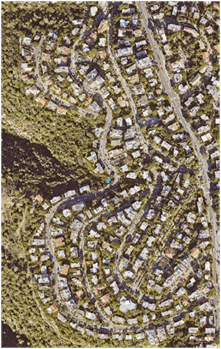
(haipo) The Shambor neighborhood in Haifa has become a battleground between residents, environmental activists and developers, over the issue of preserving the buildings and building permits. The public and planning struggle surrounding the Shambor neighborhood in Haifa has reached a boiling point. Several buildings on Margalit and Hayarkon streets are at the heart of a fundamental dispute between social activists, residents, developers and apartment owners. While environmental activists and residents claim that the neighborhood has been declared a conservation area (some of the buildings are for conservation and next to them are buildings that are in the conservation area, but are not for conservation in themselves) and therefore strict conservation rules must be adhered to, developers and contractors claim that this is an unjustified delay that prevents them from strengthening dangerous buildings and carrying out TAMA 38 projects. The municipality, for its part, is trying to balance the needs of conservation with the needs of urban development.
The struggle over Margalit 36: A symbol of broad controversy
One of the main foci of the dispute is the building at 36 Margalit Street, which has become a symbol of an environmental and planning struggle. Environmental activists claim that this is a building of architectural and historical value, and therefore should be preserved in accordance with preservation regulations. According to them, although the struggle requires them to spend a lot of resources, both financial and personal, they will not give up on preserving the character of Shambor, which they see as a Haifa gem.
On the other hand, developers claim that there is no justification for delaying TAMA 38 projects, especially when they involve old, unsafe, and sometimes even dangerous buildings. "It is impossible for residents to continue living in dilapidated buildings just because the architect who designed them was well-known a century ago," claim construction industry sources.
Landscape architect and environmental activist Hanna Yaffe claims that the case of Margalit 36 is tainted by several key failures: "The plan includes a map that omitted a grove of oak trees found throughout the entire backyard. Then, a building plan was presented that ignored all of the above, burying all the trees just to create a level garden supported by a massive wall facing the wadi. All the opposition was supported by visualizations from the opponents and photographs. Therefore, this is a matter of principle and not just in the Shambor neighborhood. Along with the committee's decision to deviate from the height that it itself defined in the neighborhood."
Many residents in the Shambor neighborhood are expressing frustration with the situation. According to them, the declaration of the neighborhood as a conservation area is not being implemented uniformly and there are loopholes in the decisions that allow developers to receive more housing units in each building. They claim that despite the economic advantage of the developers in dealing with the planning committees, they themselves will find a way to fight, including funding professionals and filing appeals to maintain the quality of life in the neighborhood. The struggle is not just about one or two buildings, but about an overall concept of conservation versus development. Residents are asking for planning clarity, uniformity in decisions, and full transparency from the municipality.Architecture
Architectural Preservation: Historical Value Versus Modern Needs
Preservation of buildings is a planning decision based on their architectural and historical value. When a building is declared for preservation, parts of it, sometimes the facade, balconies or windows, must be preserved even during renovation or reinforcement. Some residents believe that this is an important value, especially when it comes to buildings like the house on 8 Noga Street, the first in Carmelia, or the house on 5 Yitzhak Boulevard, designed by architect Shmuel Rozov.
Others, on the other hand, argue that there is no justification for preserving buildings solely because of the identity of the architect, especially when they are old, unsafe, and sometimes not even impressive in terms of design. They believe that preservation has become a tool used by environmental activists to delay projects, and that each case should be examined on its own merits.
The impact of conservation on TAMA 38 projects
One of the main effects of declaring a building for preservation is on TAMA 38 projects. When a building is declared for preservation, the possibility of demolition and rebuilding is limited, and sometimes only additional construction is required. This creates delays, planning restrictions, and sometimes also a violation of the rights of apartment owners. The complexity intensifies when residents who oppose a preservation project discover that they are also subject to the same restrictions, when they themselves seek to carry out a TAMA in the building in which they live. This creates a situation in which preservation, which was a tool for protecting the neighborhood, becomes an obstacle also for those who oppose it.
The Shambor neighborhood, which includes Yotam, Margalit, Sderot Hanadiv, Hayarkon, and the nearby small streets, was declared in 2020 as a conservation area as part of the TAMA 38 policy document. However, in 2019, a conservation survey was approved that marked only some of the buildings for conservation. The gap between the two documents created a lack of planning clarity, which led to many disputes. While some of the buildings in the neighborhood are impressive and of architectural value, others are neglected, unsafe, and sometimes even worthless in the eyes of the general public. The central question is whether there is justification for preserving the entire neighborhood, or whether a distinction should be made between buildings of historical or architectural value and those that can be demolished and rebuilt.
Apartment prices in Chambord: High demand despite controversy
Despite the controversies, apartment prices in the Shambor neighborhood are very high and range around 3–5 million NIS if not more. The neighborhood offers a mix of apartments before and after the TAMA, with even the older apartments embodying the value of the expected urban renewal. As a result, they are sold at high prices, sometimes beyond their true value.
On the other hand, in neighborhoods like Danya, Almogi, and Golda, apartment values have declined, and they are having difficulty selling. Shambor, on the other hand, enjoys high demand, and apartments, even old ones, are selling quickly relative to the rest of the city.
Residents' struggles: expensive and complex objections
Yaffe, one of the main activists in the struggle, talks about the difficulty of dealing with building plans in the neighborhood. According to her, any opposition requires a lot of work, a significant financial investment, and professional guidance. "Every plan that we encounter opposition to is a precedent for other developers," she says.
Yaffe notes that she managed to block a demolition and construction plan at 12 Hayarkon Street, turning it into a mere building addition. But any opposition involves spending hundreds, thousands, and sometimes tens of thousands of shekels on professional opinions and legal support. She criticizes the municipality's conduct, which she says does not provide a sufficient response to conservation needs.
The municipality's response: balancing preservation and development
In response to the media inquiry, the Haifa Municipality stated that it sees great importance in preserving the character of the Shambor neighborhood. It said that the conservation survey approved in 2019 and the policy document approved in 2020 created a lack of clarity, which led to the intervention of appeals committees and courts.
To settle the issue, the local committee decided in July 2025 that any request that deviates from the policy document (including the one on Margalit Street) will be required to receive the position of the conservation committee prior to a discussion in the local committee, which has the authority to exercise discretion with respect to the guidelines set forth in the policy.
The application on Margalit Street was discussed in accordance with this procedure, both in the conservation committee and in the local committee, and a decision on it will be published in the coming days. The Haifa Municipality will continue to operate in a balance between conservation needs, urban development needs, and the rights of residents, while maintaining transparency, proper planning procedures, and a substantive approach to each case on its merits.
Another Haifa problem: 'tree preservation.' The height of absurdity: while huge groves have been cut down for the sake of real estate (for example, the huge grove above Hankin Street), in private gardens, owners are prohibited from cutting down trees, including completely ordinary trees, the beautiful ones of which grow in the nearby wadi. And all because of the illogical 'tree preservation' campaign.
There is pressure from Yahav and the treasurer to "fill the municipality's coffers" because of the surge in wage costs and the rampant use of benefits and standard upgrades by the municipality's workers' committee that has added an unjustified burden of tens of millions of shekels. In the corridors of the municipality, contractors are proactively contacted and begged to begin various projects in the approved urban development plan in order to expedite levies.
The deputy mayors who fought against TAMA 38 and the destruction of old neighborhoods in Carmel like Han and Golan are now between a rock and a hard place. They are in favor of preservation and against illegal construction, and on the other hand, they are on the local committee that is measured by the number of permits and the money that comes in from levies.
The western neighborhoods of the ridge are becoming more expensive year by year. The contractors are building huge apartments at a price of 4-6 million shekels. Their goal is to "establish facts on the ground" that these prices are. The public does not want huge apartments, and does not have the money for them. But the contractors continue to flood the market with apartments that the public does not want. This causes an increase in the price of medium-sized second-hand apartments that most of the public, especially the elderly, want - 2-3 rooms, 60-80 square meters. These apartments are being snatched up for several reasons: the expectation that those buildings will pass the TAMA by investors, housing downsizers, for example from Dania who want to live in the ridge closer to cultural centers and hospitals, young families who cannot afford apartments for 3-4 million shekels but want good schools like Herzl, Ilanot and Ehud. And residents whose apartments are being demolished and instead of renting, buy an additional temporary apartment for investment.
What's happening? The developers are pushing for additional floors and apartments because of the problem of "large apartments that are not being sold." So they try to compensate for this with more small apartments. Those need parking multipliers in the parking lots because there is not enough space in the parking lot.
One thing leads to another, and so the neighborhoods in the ridge are both destroyed and crowded and are also becoming increasingly expensive due to the cartel of contractors that is building not 6 floors but 8, utilizing a slope for a parking lot and a half-floor roof (which the tenants then immediately close, because the municipality doesn't enforce anything).
It doesn't seem possible to protect the values, peace, and greenery of the Shambor and Carmelia neighborhoods. They will be built on nonstop, and there are streets that become construction sites for ten years.
Israel
The developers' concern for the safety of the buildings is touching.
The buildings, which are decades old, are standing well without mold, cracks, or decay. This is in contrast to the new buildings.
Want to strengthen? Go to Neve Yosef, Halisa, the slopes of Neve Sha'anan. Everything close to the Yagur rift. How strange that you're not worried about the buildings there.
A bunch of boundless greedy people.
You wanted Yahav, you got Yahav.
Lina has no say in the matter, the Golan bag maneuvers between presenting itself on the side of the residents and making decisions in favor of the developers. This is a winery in all applications. Check other addresses and you will see one that is being closed with developers before the appeals committee
Exactly. Yahav's goal is uniform construction of 8-9 stories throughout the Carmel area, with tiny spaces between the buildings and flattening the lot and cutting down all the old trees. What remains of the green Carmel is the planter in front of each house with 4 trees, most of which will die in another 15 years from lack of space in the planter. In 30 years, our children and grandchildren will sing the new song "The Always Gray Concrete Mountain." This is what Yona Yahav wants, and it doesn't matter whether it's Sarit Golan implementing this policy or he himself. He is the mayor and is 100 percent responsible for everything the municipality does. He can easily stop any municipal policy he doesn't like. For those who don't know, the mayor of an Israeli city has a lot of power compared to elected officials in national politics.