


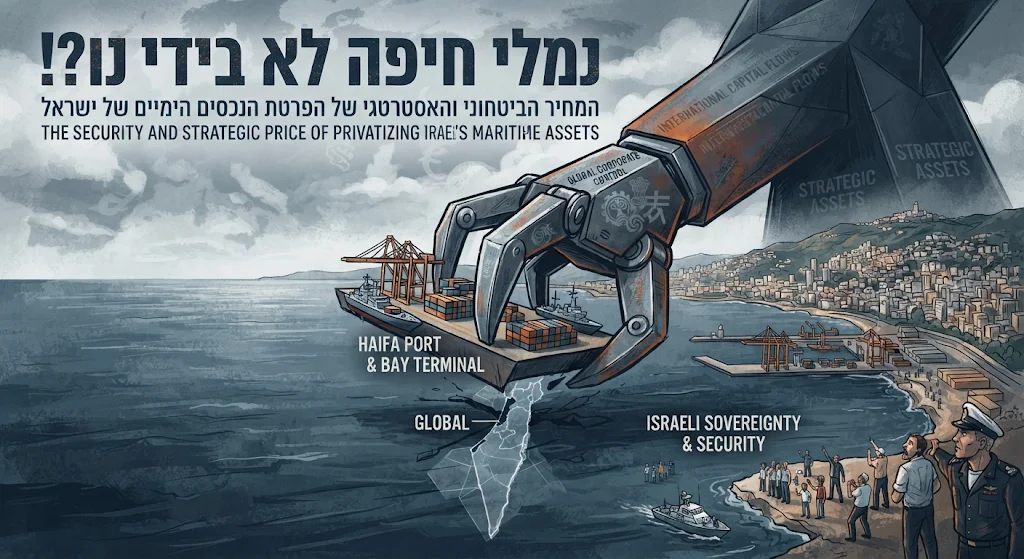
Scandal: Haifa Ports Are Not in Our Hands?! The Security and Strategic Price of Privatizing Israel's Maritime Assets
The Port of Haifa is not just a commercial complex for unloading containers and loading goods. It is one of Israel's main gateways, a vital supply artery, and an asset of economic, security, and geopolitical importance. Therefore, transferring business control of the ports to foreign-affiliated entities requires a reexamination of the strategic price the state may pay.
In 2023, the Haifa Port Company was sold to the Adani-Gadot Group, which includes the Indian Adani Corporation and the Israeli company Gadot. At the same time, the Gulf Port, which opened in 2021, is operated by the Chinese company SIPG.
This has created a situation in which two of the main ports in the Haifa area are operated by business groups that are not under direct government control. This does not mean that Israel has lost its sovereignty or its security oversight powers, but an important question arises: Did the state retain enough tools to ensure the national interest in any scenario?
Security risk: Who guarantees continuity of supply??
Israel is heavily dependent on maritime imports of food, fuel, raw materials, industrial equipment, and essential goods. In times of war, when shipping lanes can be disrupted and ports can be under missile threat, their importance becomes critical.
In such situations, the national interest is not necessarily the same as the commercial considerations of a private operator. The state must ensure the ability to prioritize essential cargo, activate emergency mechanisms, and maintain functional continuity even under extreme conditions.
The question is whether the existing oversight mechanisms, contracts, and intervention powers give the state effective and immediate control in times of crisis.
Chinese involvement and relations with the United States
The operation of the Gulf port by a Chinese company takes on additional significance in light of the strategic rivalry between the United States and China.
Washington views Chinese involvement in strategic infrastructure in other countries as a sensitive security issue. Israel, which relies on deep security and intelligence cooperation with the United States, cannot ignore this sensitivity.
This is not proof of a security breach by the Chinese company, but the proximity to the naval base in Haifa and strategic facilities requires strict supervision of the port's systems, the information collected there, and access to the facilities.
Strategic information and technological risk
Ports centralize sensitive information on ship traffic, cargo types, import volumes, and supply patterns. Such information can provide an important picture of Israel's economic and logistical activity.
Additionally, port computer and control systems are part of critical infrastructure. A cyber attack or disruption of operating systems could impair unloading and supply capacity and cause damage to the entire economy.
A port is a national asset, not just a business.
Bringing in private investors can bring capital, competition, and efficiency. However, when it comes to essential infrastructure, profitability considerations and the financial return received from its sale cannot be sufficient.
The state must ensure itself intervention powers, security oversight, protection of sensitive information, and the ability to operate the ports in accordance with national needs in any situation.
Ultimately, the question is not just who manages the port and who profits from it, but whether the State of Israel has enough tools left to ensure its strategic independence in a time of testing.
You can sell a property and receive billions in return, but can you guarantee that the security and national price of the sale will not be much higher?
If the concerns are recycled, how do you explain the fact that countries around the world firmly refuse foreign ownership of their seaports?!
What has been done in Israel, especially in light of the country's security problems and the escalation of political terrorism against it by the enemy, is one of the gravest failings. A country that arms our greatest enemy, Iran, with missiles against us sells hundreds of thousands of vehicles here through two ports it has owned for at least 25 years. Understand how far we have fallen with China.. An enemy country for everything, there is no more trouble with China, they have erased us from school maps in China, and they control two ports here and you buy Chinese vehicles.. The delusion of life.
Just because he has a post-doctorate in national security doesn't mean he knows the work of ports and regulatory and security oversight.
Proximity to security facilities? In an era of satellites with cameras that detect currency value on the ground, you don't have to buy a port to spy.
The port has no power to determine or prioritize any cargo. All concerns have been recycled since the privatization discussions a few years ago.
In short, keyboard wear and tear without foundation and without detailed knowledge.