


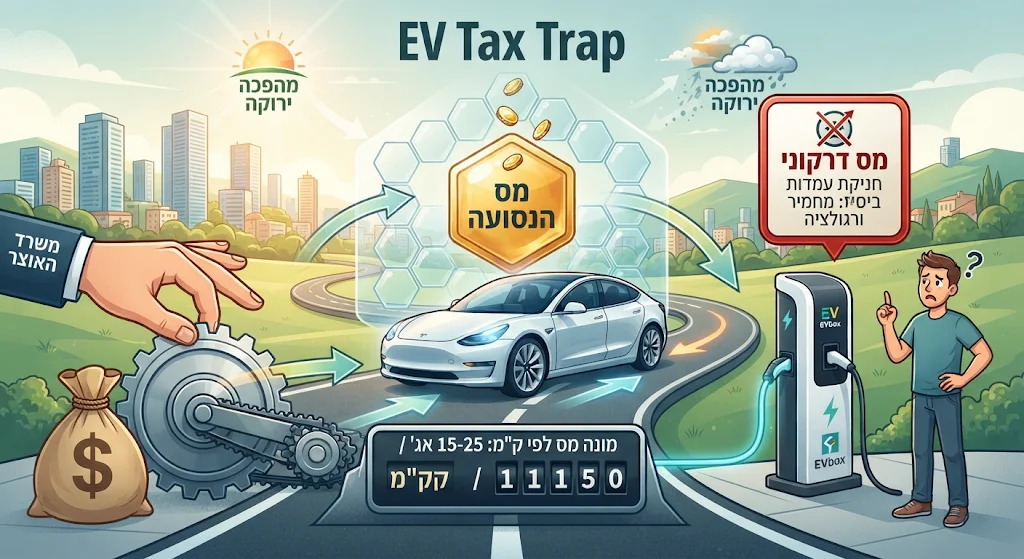
Under the bright banner of a green revolution, encouraging clean energy and reducing carbon emissions, the State of Israel has in recent years cultivated the electric vehicle market as a shining success story. Many drivers have rushed to give up gasoline and diesel engines, invested in advanced electric cars and installed home charging stations, believing that they are on the path to real economic savings.
But behind the scenes, the true economic reality is taking shape these days.
Budgetary "honey trap"
- The budget hole and loss of excise revenue – The real reason for the apparent upheaval is not environmental, but purely accounting. The State of Israel collects tens of billions of shekels (about 30 to 35 billion shekels) annually from excise taxes and VAT on fuel – an amount that constitutes a critical anchor in the treasury. As the share of electric cars on the roads increases, the revenue from these taxes is plummeting.
The Ministry of Finance is not willing to give up this income, and therefore the transition to electricity, which was presented as the entry ticket to a profitable economic era, is becoming a trap in which the state comes to collect the debt from drivers in new ways. - Mileage tax: 15–25 Agorat per kilometer – The main tool that the Treasury is taking out of the freeze is the "mileage tax" – a plan designed to impose a direct tax on every kilometer that an electric vehicle (and, in the future, any vehicle that is not powered by traditional fuel) travels on the road.
- Bullet – The original rate that appeared in the drafts of the law is about 15 to 25 cents per kilometer traveled.
Bullet For an average driver who drives about 15,000 to 20,000 kilometers per year, this amounts to an annual cost increase of thousands of shekels (hundreds of shekels per month), which in one fell swoop erases the savings promised by electric charging compared to regular fueling. - The choking of home charging stations – In parallel with the mileage tax, various government ministries and tax authorities periodically examine additional measures designed to discourage reliance on discounted home charging:
Bullet Taxation or strict regulation of electricity dedicated to charging: Attempts to link household electricity rates to the high energy consumption of charging stations in private homes and residential buildings.
Bullet Regulation and installation of complex metering infrastructures: Technical requirements that increase the cost of setting up and maintaining home stations, in order to align with the fuel tax model. - Finance Plan and Schedules (until 2028) – The travel tax outline and the counter-tax measures are not speculation, but a targeted move set out in official timetables: Bullet Beginning of discussions and initial legislation (2023–2024)The outline began to take shape in the Ministry of Finance and the Budget Division as early as the framework of the fiscal arrangements and emergency plans laws, when the proposals for imposing a mileage tax were first put forward.
A land eats its inhabitants.
Was this written by AI or a 5-year-old? I couldn't really understand.
If you've already asked the AI to write for you. At least go through it, proofread it. (BULLET) See if it's even readable.