


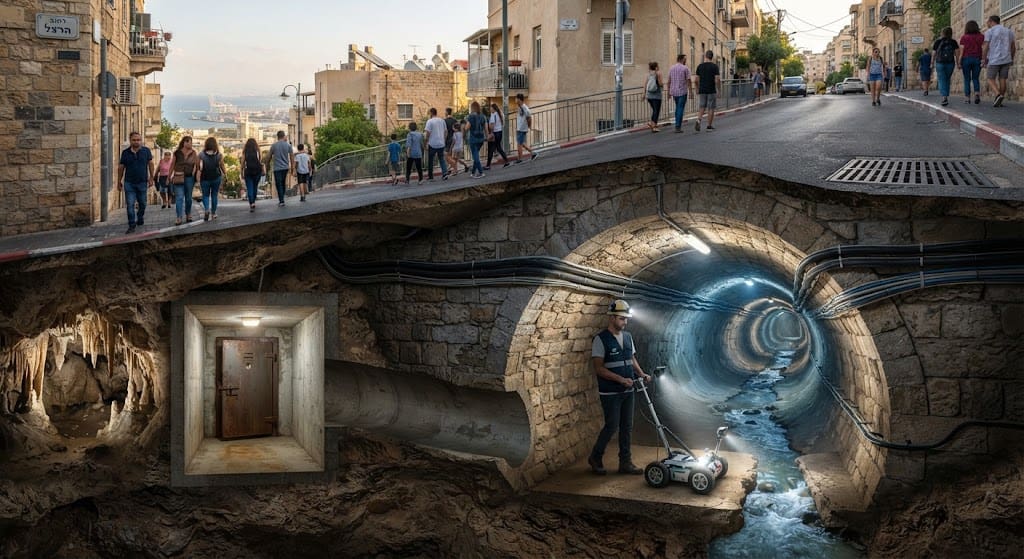
While most Haifa residents and visitors know the city through its bustling boulevards, the breathtaking view from the top of the mountain, or the historic architecture of the lower city and the Carmel, few know that beneath their feet lies an entire, winding world. Haifa is not just a city of floors, terraces, and steep slopes, it is a city of depth, where history and architecture have been carved directly into the limestone bedrock of the Carmel.
The city beneath the surface: a mosaic of eras
Haifa's network of tunnels and underground spaces presents a fascinating engineering and historical story:
- The giant shelters of World War II: During the British Mandate, when fears of a Nazi invasion in the Middle East were at their peak, twisted bunkers and shelters were carved out in Carmel. Some stand closed behind rusty iron doors in the heart of quiet residential neighborhoods.
- Natural caves and ancient worship: Beyond the importance of Elijah's Cave, the Carmel is dotted with natural karst caves that over thousands of years have become centers of worship, hiding places, and ancient storehouses.
- Carmelite: Which opened in 1959 as the first and only subway in Israel for decades, and its carving into the mountain was considered an extraordinary engineering achievement at the time.
The hidden secret beneath the Hadar Carmel neighborhood
One of the most hidden and fascinating chapters in this underground system lies between Herzl Street and Hehalutz Street in the Hadar Carmel neighborhood. Beneath the city pavement, thousands of people walk every day without knowing about the existence of an extraordinary underground channeling and drainage network, parts of which were built in the late Ottoman period and at the beginning of the British Mandate.
This system was born from a dual engineering challenge:
- Tackling the steep slope: Hadar was built on a steep slope. To prevent winter rainwater from washing away the neighborhood and flooding the lower city, the Turks and British dug deep, rounded stone canals, made of local limestone and connected by durable Gothic arches.
- A parallel and secret world: In the central part of the neighborhood, there are underground passages wide enough for an adult to walk upright. These passages maintain a constant temperature throughout the year and are insulated from the noise of traffic from above.
- Historical security use: During the events of the 30s, some of these drainage routes were secretly used as secure passageways and escape routes for members of the Haganah who moved between different positions in the neighborhood without being exposed on the street.
The drainage network today: an active infrastructure in the heart of the modern city
The historic drainage network is not a closed museum, it is an active infrastructure system that works to this day.
| Field of activity | Description of current use |
| Wastewater management | Capturing water downstream from Hadar and its controlled flow towards Haifa Bay and the sea to prevent flooding. |
| Communication infrastructure | Utilizing underground space to transmit modern cables and fiber optics without the need to dig up streets. |
| Preservation and upgrading | Incorporating modern concrete pipes and polymer sealing sleeves inside the original stone tunnels. Today, the Haifa Municipality and the Carmel Water and Sewerage Corporation maintain the system using dedicated teams and advanced technologies (such as video robots). For safety and flood risk reasons, access to the general public remains closed - ensuring that one of Haifa's engineering and historical secrets continues to operate quietly right beneath our feet. |
Today, the Haifa Municipality and the Carmel Water and Sewerage Corporation maintain the system using dedicated teams and advanced technologies (such as video robots). For safety reasons and flood risks, access to the general public remains closed.Which ensures that one of Haifa's engineering and historical secrets continues to operate quietly right beneath our feet.
Did the article interest you?