


(Haipo) – While the municipality is reexamining the city's signage policy, some are already taking action. Branches of the Be Pharm chain in Haifa have begun replacing English signage with Hebrew signage, in what appears to be the first move on the ground since the public outcry over the enforcement of the municipal signage law.
The move comes precisely during a period of uncertainty, after the Haifa Municipality announced a freeze on law enforcement and a reexamination of the sensitive and explosive issue.
The sign before the change

The sign after the change
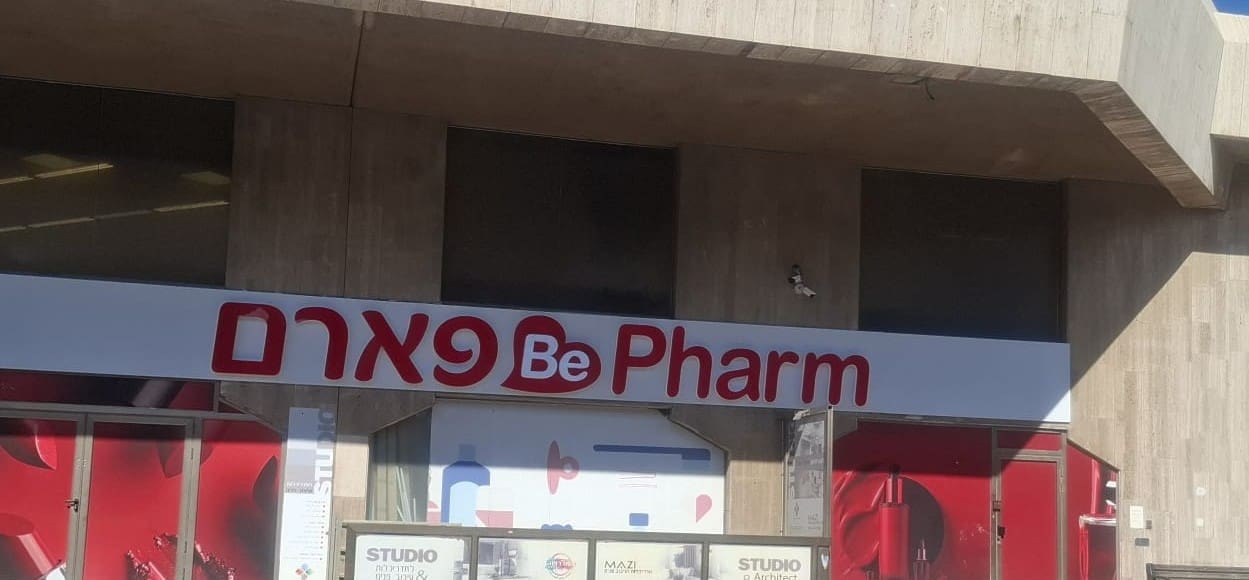
In September 2025, the Haifa Municipality announced that it intends to tighten enforcement of the 1995 municipal bylaw, which requires every business in the city to display signage in Hebrew. According to the law, every sign must be in Hebrew, or alternatively include Hebrew text in an area of at least half the size of the sign when an additional language is used.
The announcement sparked widespread public debate between those who saw the move as a strengthening of the status of the Hebrew language in the public sphere, and others who claimed that it was a violation of Haifa's multicultural character and businesses from the Arab sector.
However, despite the announcement of stricter enforcement, in early May 2026 the municipality announced that it was freezing implementation of the new policy and re-examining the issue. The decision was made after a question was submitted by City Council members Raja Zaatara and Fakhr Bayadesa in March, and was discussed at the City Council meeting in May.
The query was submitted following a number of cases that sparked a broad public outcry in the city, including the issue of the “Malal” restaurant and the “Jafra” pub, which reignited the debate surrounding the attitude toward the Arabic language in Haifa’s public space and the boundaries between law enforcement and possible harm to cultural and national sensitivities.
However, while the municipality continues to examine the issue, it appears that some businesses on the ground are already choosing to adapt to the spirit of the existing law. In recent days, branches of the Be Pharm chain have begun to appear in Haifa with new signage in Hebrew instead of the English signage that was previously posted.
For some residents, this is a necessary step that strengthens the visibility of the Hebrew language in the city, while others see it primarily as a business preparation for a changing regulatory reality. Either way, it seems that even during the freeze period, the process of change has already begun in practice.
In Haifa, a city made up of a unique human, cultural, and linguistic mosaic, the issue of signage goes far beyond language alone. For many, it touches on questions of identity, belonging, public space, and coexistence. Therefore, any decision on the subject, whether it involves enforcement, a freeze, or a voluntary change by businesses, continues to arouse great interest and be at the heart of public discourse in the city.
Unnecessary article.. Replacing the be Pharm sign has nothing to do with the signage law at all, but rather with the chain's new branding.
Besides, if the law says that half of the signage must be in Hebrew, then the new sign doesn't meet the requirements of the law either...
We are a Hebrew-speaking country. This is first and foremost