



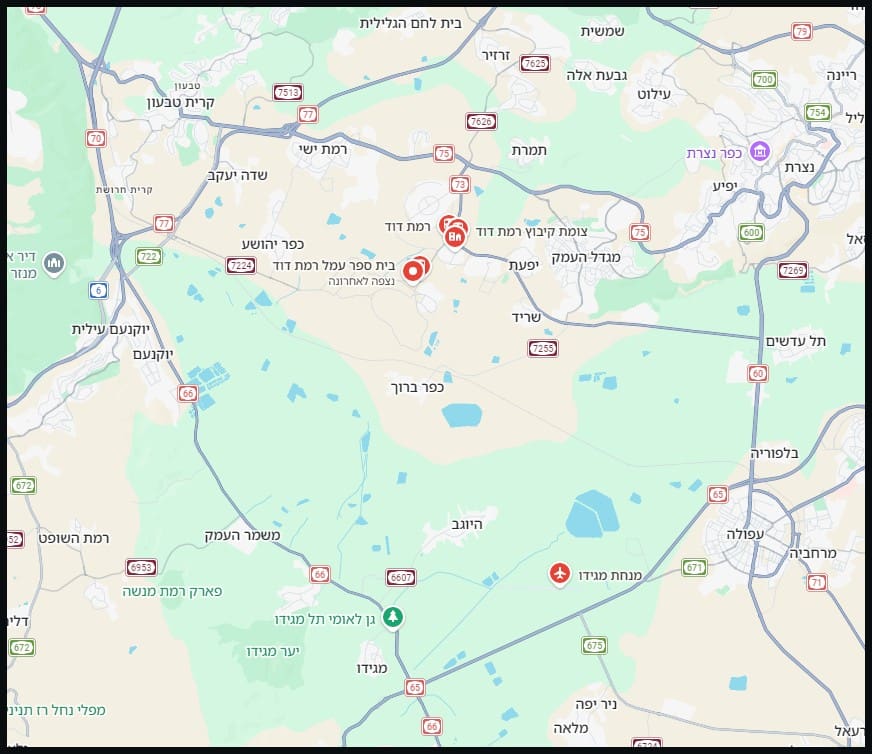
(haipo) The government's decision to approve the construction of two complementary airports, one in the north and one in the south, brings a particularly explosive issue back to the table. Will the public struggle against the construction of an international airport in Ramat David be renewed? Is this a feasible move that will strengthen Israel's resilience or a vision far from reality? Many questions remain open, and the north once again finds itself at the heart of the national debate.
Risk diversification as a security necessity
The decision to establish additional airports comes against the backdrop of the complex security reality and the lessons learned in recent campaigns. In a small country like Israel, where most air traffic is concentrated in one central airport, a significant damage could paralyze the economy, the economy, and civilian traffic. Hence the idea and even the necessity of spreading risks and establishing additional aviation infrastructure, one that could provide a response in an emergency and reduce dependence on just one airport. On the surface, this is a necessary and even essential move. But this is where the difficult questions begin.
Who will finance it and is it even feasible?
A source familiar with the details told "Haifa" that these are airports that will not be subject to the Airports Authority. According to him, the financing is supposed to come from private entities, with each of the projects expected to cost billions of shekels. The private model raises questions about whether entrepreneurs will be found who will undertake such a huge investment? And what will be the economic return mechanism? Aviation infrastructure is not just a runway and takeoff, it is a complex system of security, maintenance, logistics services, transportation connections and connectivity, customs and immigration systems, and more.
Even if funding is found, the road to implementation could be very long. Planning procedures, public objections, environmental reviews, planning changes, and the construction of complementary infrastructure could all take many years.
Will the airlines come?
Another issue, perhaps the most crucial of all, concerns commercial feasibility. International airlines tend to prefer central airports, close to large demand areas and significant population centers. This is the practice worldwide and in Israel as well. The most prominent example is Ramon Airport in the south, which has difficulty attracting significant international activity over time. Despite huge investment in infrastructure, the number of companies operating there is relatively limited, and the scope of activity is far from the original potential presented when it was established.
The obvious question is, could a similar scenario occur in the north? Will a supplementary airport in Ramat David, if and when it is built, succeed in attracting passenger traffic and airlines, or will we repeat our mistakes and build a "white elephant" similar to Ramon Airport in Eilat, which will remain mainly an emergency solution?
Back to the fight?
The North remembers well the extensive public struggle waged in recent years against the construction of an international airport in the Jezreel Valley. Heads of authorities, residents, farmers and environmental organizations warned of harm to agricultural areas, the quality of life and the unique settlement fabric of the valley.
Many in the north still strongly oppose the idea, while others believe it is a significant economic and infrastructure opportunity for the region. Now, with the new government's decision, we wonder if anyone will bother to check what the implications are for the residents of the area and whether the protests are set to return to the streets?!
And what about Haifa Airport?
Amidst all of this, the local question also arises: How will such a decision affect the Haifa airport, which has experienced a trend of prosperity and expansion in its operations in recent years?
If a significant international airport is built in the north, will this strengthen Haifa as a regional metropolis through complementary aviation connections, or will it actually overshadow it and concentrate the bulk of activity elsewhere?
Long-term vision or momentary headline?
Currently, the government decision indicates a direction, but the road to implementation is fraught with planning, economic, and public challenges. The question is not just whether Israel needs additional airports, on which there seems to be a broad consensus, but how, where, and with what model they will be built.
Is this a strategic move that will change the map of Israeli aviation, or a decision that will be shelved in light of the complexity? And is the Jezreel Valley expected to once again become an arena for civil struggle?
time will tell.
Meanwhile, in the north, they are waiting with vigilance. And at Air Haifa, they are greetings.
Haifa Air Company told me: "Any addition to aviation infrastructure in the State of Israel is welcome and the company is happy about it."
I still haven't been able to understand why they aren't building an airport at sea.
The Japanese, the Dutch, and the Chinese learned to tame the sea.
Our request is greatly appreciated.
Conquer the sea.
Very much requested
What's the problem? We have an airport in Machane. We can upgrade it to a supplementary airport.. strengthen the Upper Galilee.. and give a huge economic boost!!! All the captains.. get to work!!!
An airport in the Jezreel Valley will bring economic prosperity, high-tech development, defense industries, and above all, our children will have the chance to develop professionally and will not have to travel 6 hours back and forth to Ben Gurion Airport.
Note: The main need is security, not just civilian. ,
Most buyers maintain the value of their real estate
And of course, this is with respectable cover, climate, etc.
People only think about themselves and not the national interest. It is impossible that there will not be an international airport in the north. I am a resident of the Krayot. Recently, Air Haifa went into operation despite similar objections. As of today, the complaints have been forgotten and everyone benefits from an accessible airport.
The struggle against the Ramat David alternative will not "renew" because it never stopped.
The government of nightmares is cooking up a national disaster for us in the Valley.
"Ziklag" is a balloon, a flower crow, an empty word whose bloom is that of the monstrous fern and whose sole function: to promote the 2nd project that will destroy the valley.
We'll wave goodbye to you from the plane window as we take off above your villa, which you received on state land and sold for financial gain.
While you prevent the disadvantaged residents of Migdal HaEmek and Afula from making a decent living.
We will still return the lands you stole, we will still fly over your settlement with the yellow gate, we will still fly over your house.
Cheers! From the duty-free shop that will be established in the valley
A health suggestion for residents of the Jezreel Valley and the Ziklag area: Remove your worries. The fields will not be built, and even if they are, these are projects that will take years (if at all). Maybe our great-grandchildren will get to see them.
You're right, every word is unnecessary, it's a shame to waste time on the subject, it's all nonsense, there's no budget for such a project at all.
I wish… but the State of Israel needs Netbeg 2. And the only place where this can happen within 10 years is in Nevatim:
1. There is already designated and disturbed land – no need to expropriate it.
2. There is already an international runway and a control tower
3. There are no objections – on the contrary, all the authorities in the area are clamoring for it.
In Ramat David, the plan will be stuck for years in legal proceedings that will bury the project. There is nothing to talk about with Ziklag at all.
The subject of a northern airport will keep reporters busy for many years. It is better to write about an airport than about car accidents.