


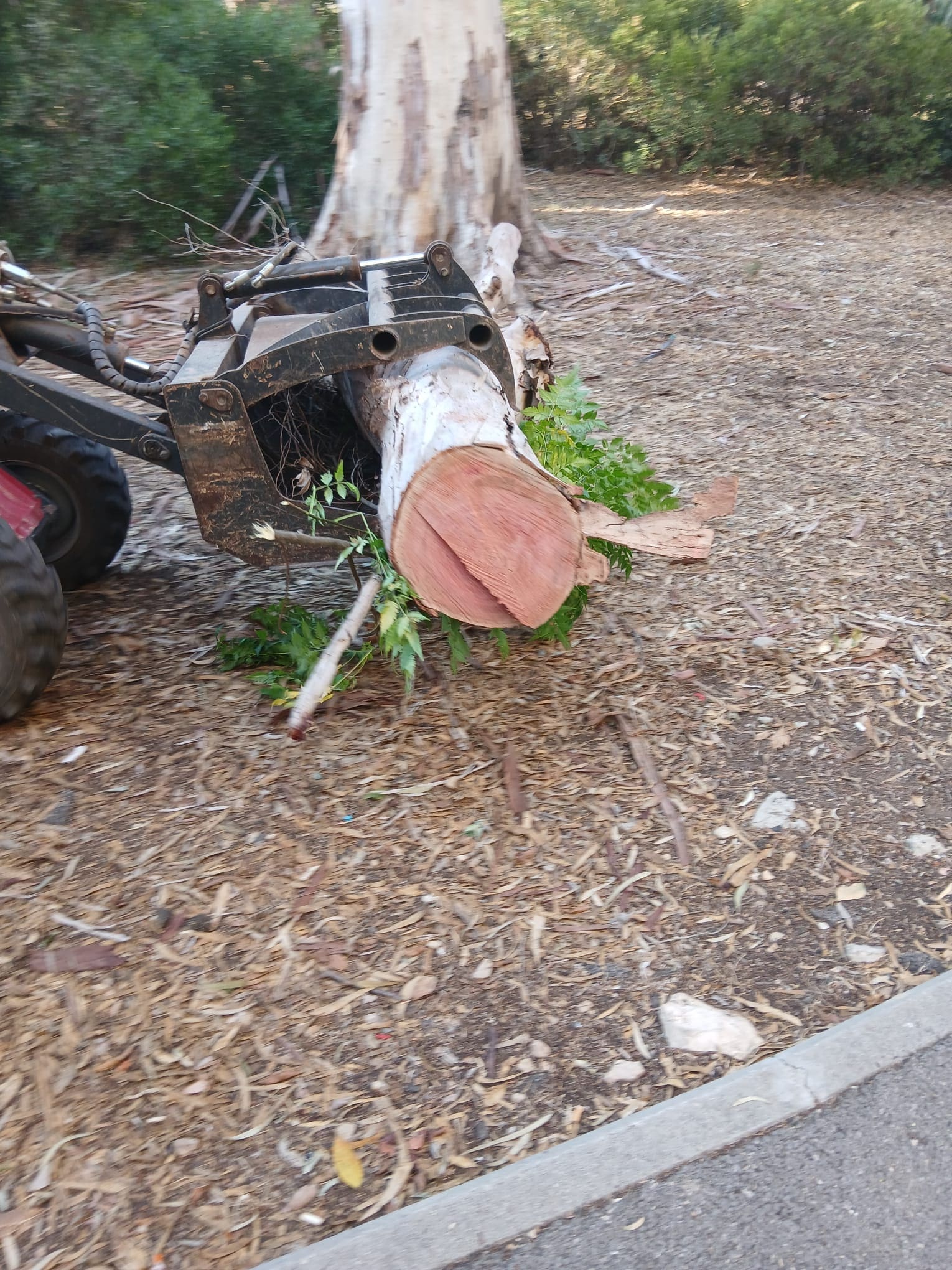
(haipo) The issue of tree felling in Haifa continues to cause public uproar. The system is repeatedly receiving inquiries from concerned residents, who claim that trees are being cut down quickly, sometimes without sufficient transparency and sometimes bypassing oversight and opposition procedures. Now, the issue has been joined by an official and detailed inquiry from City Council members, Attorneys David Etzioni and Zeev Sanenzon, a query that raises a long line of disturbing question marks regarding the procedure carried out at 50 Einstein Street.
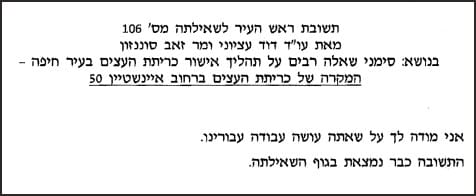
However, instead of receiving substantive, detailed, and transparent answers as expected from a public authority, the two responded with one short sentence, which they said was insufficient and even sounded disparaging: "I thank you for doing work for us, the answer is in the body of the query."
Random test that led to exposure
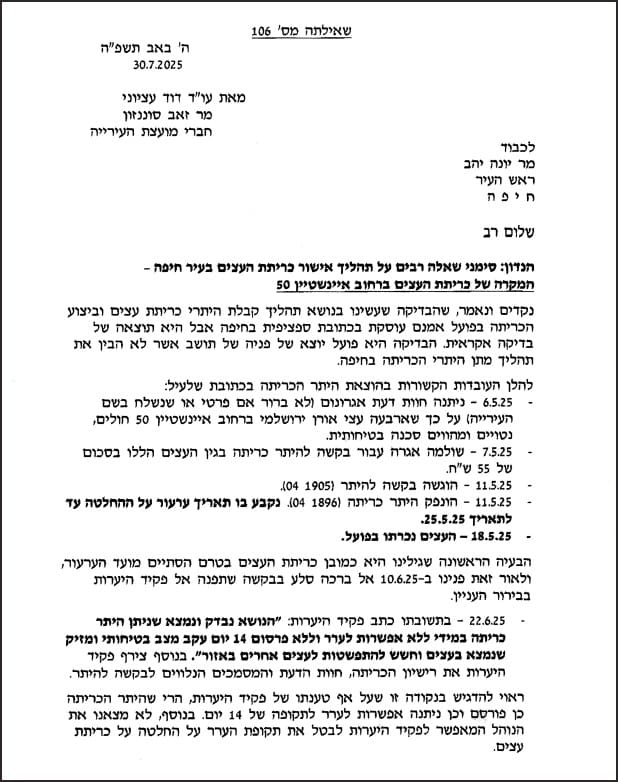
The query was not born from a proactive investigation or political struggle, but from a simple request from a resident who could not understand how a permit was granted to cut down the trees near his house. Following the request, the council members conducted a spot inspection, which they claimed was random but revealed fundamental deficiencies in the conduct. "If this is what one random inspection looks like," they said, "what happens in the other cases?"
The schedule that raises questions
The data presented in the query reveals an unusually fast and unusual timetable, which raises questions about the correctness of the procedure. As early as May 6, 2025, an agronomic opinion was issued that determined that four Jerusalem pine trees were diseased and posed a safety hazard. A day later, a fee of 55 shekels was paid for an application for a felling permit. The application was submitted on May 11, and the permit was issued on the same day, with an explicit indication of an appeal period until May 25. However, despite the appeal deadline set, on May 18, a full week before the end of the period, the felling was actually carried out, which raises the question of how the felling of the trees could have been completed before the public's right to submit objections had been exhausted.
"There is no possibility of appeal" but in reality there was?
After the felling, the council members contacted the municipality and the forestry official with clarification. In a response dated 6/22/25, the forestry official claimed that a felling permit was issued immediately, without the possibility of appeal and without a 14-day publication, due to a safety hazard and a pest that could spread. However, this is where the central contradiction emerges. According to Etzioni and Sanenzon, the permit was indeed published, and a 14-day appeal period was also specified. In addition, they did not find any official procedure that allows the forestry official to revoke the right to appeal stipulated in the law. "If the right to appeal was indeed revoked, why was this not stated in the permit? Why was an appeal period published? And by virtue of what procedure was the decision made?" they wonder.
A series of questions left unanswered
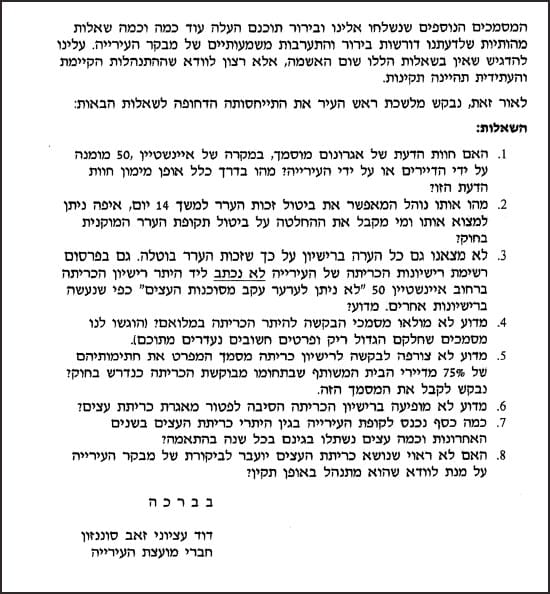
- The query submitted by the two was broad and detailed, and included essential questions:
- Who financed the agronomic opinion, the tenants or the municipality? And what is the accepted procedure?
- What is the legal procedure that allows the appeal period to be canceled, and where is it made public?
- Who is authorized to make such a decision?
- Why didn't the logging license state that there was no possibility of appeal, as was written in other cases?
- Why were the application documents not completed in full?
- Why weren't the signatures of 75% of the condominium residents included, as required by law?
- Why was the fee exemption not mentioned?
- And shouldn't the city auditor examine the entire issue of tree felling in the city?
- Relevant, well-founded, and professional questions that, as mentioned, remained without any real attention.
"A disparaging answer"
Instead of receiving details, reasons, or supplementary documents, the council members received only a one-line response: "I thank you for doing work for us, the answer is in the body of the query."
In a city where the issue of trees has become a sensitive environmental and public issue, such an answer only increases the sense of lack of transparency. It's not just about trees, it's about public trust. When there are no answers, suspicion grows.
Cutting down trees in urban areas is not just a technical matter. Trees have significant environmental, climatic and health value. They reduce pollution, cool public spaces and improve the quality of life. Therefore, the law establishes mechanisms for supervision, publication and the right to object. When these procedures are not fully implemented or when there is a feeling that they are being bypassed, not only the urban landscape is damaged, but also public trust in the local authority.
Everything must be done to prevent bodily harm and property damage in the event of a forest fire…
Thin out around buildings, leave firebreaks, and thin out bushes between the trees…
Where are the Greens of Haifa? Getting paid and napping?
Criminal municipality, what's new?
A permit to cut down trees has long since become just a V-mark.
If the tree bothers the contractor, he will pay the agronomist to recommend taking it down, and if not, then no.
This is how another Haifa asset of a city is destroyed in the middle of a forest and turned into a boring concrete wasteland, thanks to our elected officials.