


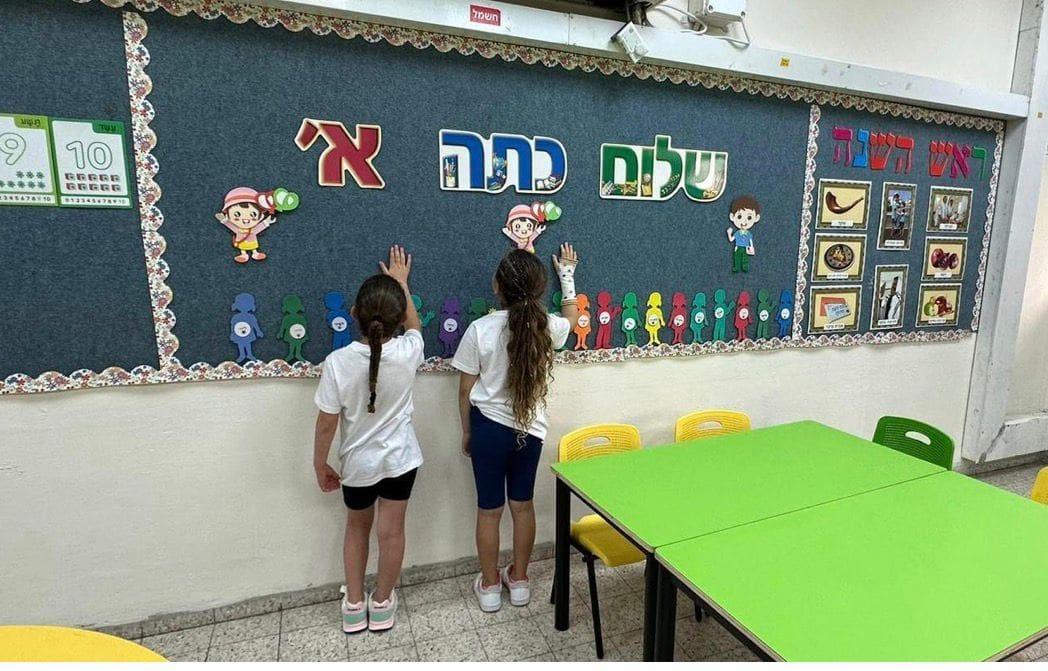
(haipo) Every morning, about 400 students arrive at Leo Bak Elementary School in Hadar, one of Haifa’s most unique institutions. Unlike other schools in the city, no fewer than 17 different languages are heard here in the hallways, classrooms, and courtyards. Some of the students are new immigrants, some are children of migrant workers, and many come from homes where parents work long hours and do not fully speak Hebrew. This reality creates a complex, challenging, and exciting learning environment, where the educational staff is required to deal daily with difficulties that do not exist in almost any other school in the city.
A multicultural school in the heart of Hadar
Leo Buck Bahadar is a school that embodies the human mosaic of Haifa. The students come from different backgrounds, speak different languages and bring with them diverse cultures. For some, school is the only place where they are regularly exposed to Hebrew, and therefore the educational staff is careful to use Hebrew during classes, to allow the students to acquire the language. The fact that many parents work long hours and sometimes do not master Hebrew, creates additional gaps that require the school to provide a broader envelope than is customary.
Significant municipal investment in a unique lunch
The municipality invests large budgets in the school to provide a solution for immigrant children and families in need of support. One of the school administration's most notable achievements is the unique afternoon school, which runs until 5:00 PM and is intended for all students in grades 1 to 6. While in other schools in the city, afternoon schools only run until grade 4, here every student receives a hot meal every day and a safe environment until the afternoon. For some of the children, this is a real lifesaver, as some return to empty homes, without a responsible adult and without a proper meal.
The transition to the Montessori method and its consequences
Last year, the school switched to a Montessori method of learning, in which the student is at the center of learning and is required to take greater responsibility for his or her own progress. Students can choose some of the topics they will focus on, with the belief that empowerment and personal choice will reduce discipline problems and violence. Teachers say that there are many advantages to the method, but also significant challenges, especially in a school where some students still struggle with the language. When a teacher asks students to speak Hebrew during class to enable basic communication, this can be misinterpreted as a political statement, even though her sole purpose is to enable proper learning.
Language difficulties that make it difficult to manage a lesson
One of the teachers says that in every class she deals with students who do not understand Hebrew at all, alongside students who prefer to speak in their native language. She emphasizes that she has no objection to using different languages, but during the class she must make sure that all students understand the instructions. She says that when she asks to speak Hebrew, some students interpret this as a cultural or political requirement, even though it is a basic pedagogical need. The difficulty is intensified when it is necessary to communicate with parents, who do not speak Hebrew and sometimes not English either, which makes it difficult to convey essential information and to cooperate.
Dealing with violence without the ability to enforce suspensions
In addition to language difficulties, the educational staff also deals with problems of violence and bullying, as in any other school. However, a unique difficulty emerges here: When a student is suspended following a serious violent incident, he often returns to school the very next day. Some suspended students arrive in the morning as if nothing had happened and sometimes provide different explanations or simply do not respond. Since the law requires the school to supervise a student who arrives at its gates, even if he is suspended, this means that the suspension loses its deterrent effect. The student is not studying in class, but he is at school, which weakens the educational message and impairs the ability to deal with serious incidents.
Another difficulty: a small yard that does not allow for organized breaks
Another significant problem is the schoolyard, which is very small and does not allow students to go out for organized breaks. The staff has had to find creative solutions, such as taking students out in small groups or using alternative spaces. This is a daily challenge, of course, since the respite that breaks provide is very important during the school day. The fact that other schools in the city enjoy green spaces and new buildings only heightens the sense of frustration and creates a feeling that students are being deprived in terms of learning conditions, although there is no deliberate intention behind this.
A sense of frustration alongside deep commitment
Despite the difficulties, it is clear that the staff is committed to the students and believes in their mission. They see the children's progress, the improvement in language, and the sense of belonging that has been built over time. At the same time, the municipality needs to recognize that the challenges at the school are particularly great and provide additional support, both in terms of staff and infrastructure.
The municipality's response will be attached to the article when received.
Did the article interest you?
"The parents do not speak Hebrew fully"...!!!
Is this a "riddle" or a "joke"...!!!
= "Beware of the "children of the poor! For from them will come Torah"!"
* Under one important condition: "Kosher Jews" with a "strong affinity" for "Judaism" & the "Jewish State"!!!!!
The "Gentiles" among us are usually less likely to connect with the "Hebrew language," if they came anyway for "unknown reasons" and/or temporarily "worked" in Israel, "experienced" from a "war zone," etc.
Since the days of the "re-establishment of the Jewish state"... and long before... "children" of all "denominations", whose parents spoke a variety of "foreign languages" in their private homes... were actually better at "absorbing" the "Tzacha Hebrew", spoken by their teachers... and on condition that they had the "common sense" to identify & identify with the right people in their environment, in everything related to "education for Zionism" and "love for the homeland" on
Full-full-full-full-full…!!!@@@😭😭😭
Is teaching a class in Hebrew a political issue? So everything is clear.
To be taught at the Dover Christian School
Non-political language!
Haifa needs to build another boarding school
And free the parents to work until "death" as long as they also pay taxes accordingly! We're tired of Haifa not enforcing laws in educational institutions because of violence and politics. Interesting.
Is there no problem with different religions?
With me – I'm sure.
We diagnosed the child as gifted with potential and they placed him there at the end on the right side.
I know!
Yes, I know every father will say that his son is the most amazing, the most beautiful, the most talented.
But in my case, they simply neglected him, and the fact that he left opened the hidden hatch for him, and Hope completed it in three months.
A school that suspends students for violence and then allows them to return the next day and does not enforce the basic rules and has no deterrence is a bad, promiscuous school, probably with weak and weakened management, probably New Age Montessori-bullshitting instead of learning and educating.
Shame on Leo Beck that these unfortunate phenomena are occurring in an institution with the name Leo Beck.
My son studied there in first and second grades, but he never learned to write a single sentence.
We transferred him to Ben Gurion Romema and in three months he made up for a huge gap and has been an intelligent and talented child ever since.
Are you sure the problem is at school?
Landed!
When you put a child in the Tower of Babel, it's no wonder that academic development slows down. At the very least, the classes should be by language and teachers who know the language.
Their time learning Hebrew.