



(haipo) The tragic death of Livne Shlavy, 42, who was stung by a wasp in the Golan Heights, shook many and raised anew the question that each of us has thought about at least once: What is the difference between a wasp and a bee? They are both small, yellow, and buzzing, but they are separated by very large differences in appearance, behavior, and the level of risk to humans.
What does a bee look like and what does a wasp look like?
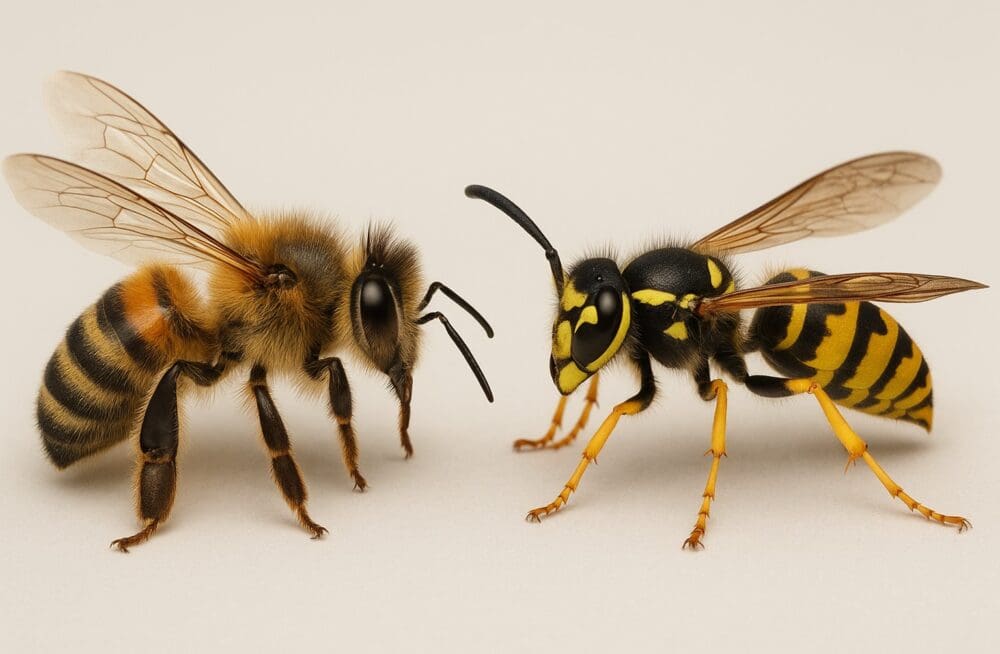
At first glance they may look similar, but upon closer inspection the differences are obvious. The bee is a round, plump, and pleasant-looking creature, its body covered in fine hair that gives it a soft, furry appearance. Its colors tend toward shades of brown, yellow, and black, and it often looks like a hard worker who has come to quietly go about its business.
The wasp, on the other hand, is slimmer and longer, has a shiny, smooth body, and a more menacing appearance. Its colors are sharp and striking - bright yellow and shiny black - and its legs are thin and long.
In Israel it is also common The Eastern Wasp, which is brown in color and has a prominent yellow stripe on its back.

What attracts bees and what attracts wasps?
Like humans, bees and wasps also choose their habitats based on "personal preferences." Bees are drawn to nature, to flowers, nectar, and pollen. They usually build their nests in green, open areas, and seek out nearby water sources. The scents of flowers and plants attract them like a magnet, and they play an important role in pollinating plants, a process essential to the survival of the ecosystem.
Wasps, on the other hand, prefer proximity to humans. They are attracted to the strong odors of food, meat, sweet drinks, and food scraps, so they often appear near garbage cans, picnic tables, and urban buildings. They also seek out sheltered, shaded places like attics, wall cavities, or air vents to build their nests.
Therefore, if you are spending time in the garden or on a picnic, it is recommended to tightly close the food and drinks, cover leftovers, and clean the place - simple steps that can reduce the visits of unwanted guests.
During what season are bees and wasps particularly active, and what characterizes their behavior?
Wasps and bees are especially active in the spring and summer. During these seasons, they build nests, search for food, and reproduce. As temperatures rise in the spring, queens awaken from hibernation and begin searching for a suitable place to build a new nest. During the season, activity levels increase dramatically: bees go out to collect nectar and pollen, and wasps begin building new nests near food sources.
In the summer, activity peaks: nests grow, insect numbers increase, and wasps focus on hunting other insects to provide protein for their offspring. With the arrival of autumn, as the days shorten and temperatures drop, activity levels decrease and the insects prepare for hibernation. In the winter itself, most of the worker bees and wasps die, and only the queens survive in hibernation until the following spring.
Nests seen in winter are usually abandoned, but in any case, it is recommended to consult an exterminator before removing them, to ensure that they are not inhabited.
Who is more dangerous, the wasp or the bee?
When it comes to the question of which of them may be more dangerous, the answer is unequivocal: the wasp.
While the bee stings only when it senses real danger and actually dies shortly after the sting, the wasp is much more aggressive. It is able to sting repeatedly, without being harmed, and its venom is more potent.
Wasps also tend to defend their nest very aggressively, and will sometimes chase a person who disturbs them for tens of meters. Therefore, when you notice a wasp nest, it is very important not to try to deal with it yourself, but to call a qualified exterminator who knows how to handle the situation safely.
How does the body react to a bite?
For most people, a bee or wasp sting causes only a local reaction - pain, swelling and redness at the sting site, and sometimes itching that lasts for a few days. This is a temporary discomfort that usually goes away without special treatment. However, a very small percentage of the population may develop a severe allergic reaction, known as anaphylaxis. In this case, the immune system overreacts to the venom, causing life-threatening symptoms such as swelling of the face and tongue, difficulty breathing, a rash spread throughout the body, dizziness and even loss of consciousness.
In such cases, seek immediate medical attention or go to the emergency room. People with known sensitivity to stings sometimes carry an EpiPen, which can be life-saving in an emergency.
Who is at higher risk?
Allergy to bee or wasp stings is relatively rare, occurring in about 1% of the population. However, the risk increases the more times a person is stung in their lifetime. People who live in rural areas, are farmers, or are beekeepers are at higher risk.
Despite the dangerous potential of allergic reactions, deaths from stings in Israel are extremely rare. Until the unfortunate case of the late Livneh Shlavey, the last documented case in Israel occurred over a decade ago.
The safest way to avoid an unpleasant encounter is to be careful and aware of not approaching nests, avoid sudden movements near flying insects, and maintain cleanliness around food.
And in the case of a bite, if unusual symptoms appear, do not hesitate and seek medical help immediately.
The death of the late Livne Shlevy reminds us all that even a small encounter with an insect can become dangerous, and that awareness, as always, is the best line of defense.
Anyone who has reacted to a sting with a general phenomenon, such as: redness, itching, a widespread rash, facial swelling, swelling of the tongue, and difficulty speaking and breathing, is recommended to be examined by an allergist. If antibodies against the venom are found in a test or blood test (EAST), it is recommended to undergo iconography treatments for up to 5 years.
Thanks for the article.
Below are some precisions.
Bees are also fiercely protective of anyone who threatens the hive. They come out in droves, chasing the aggressor for dozens of meters.
Wasps - especially the eastern ones - are most aggressive in the fall. The nest stops functioning as such, and then the individuals are really hungry and cause great suffering to the poor creatures that find themselves in its vicinity.
Bee venom causes more people to develop allergic reactions than wasp venom.
An acute allergic reaction – like what happened to our friend Livne – must be delayed by a milder allergic reaction.
accurate
🙏Useful article! = Get to know the world of "bees" and their "wasp" friends…; even if they dress up as "beautiful"… they may be exposed as "dangerous" to "man"…!!!@@@😘
But, on the "honey" – we will not give up neither on the "Sweet Rosh Hashana"... nor on the "Happy Mimouna"...!!!!!@@@@@😂
Naomi Shemer: On the "honey"☺️ and the sting…
About the bitter and the "sweet"😂…!!!!!@@@@@
There are many wasps in the Knesset…
Ha-ha-ha… This is not a “joke”-ha-ha…@🤣
A bee hurts, a wasp hurts a lot, a thing to die for.
The most painful bee sting I've ever experienced. I was stung by everyone while riding a motorcycle. I got a bee in my stomach and had to get an allergy shot because it itched like crazy, spread all over my stomach, and the sting itself looked like a gunshot to the stomach.
Almost exactly. Bees don't hibernate in the winter. They organize themselves. The wasps, depending on the species, nest in the ground, or in bamboo, on the ceiling, etc. Only in the summer area do they look for protein, as is the case with the Asian wasp, which is brown with a yellow stripe.
Sensitivity to bee stings can be separate from wasp stings. For example, I am sensitive to bees, not wasps. The sensitivity increases over the years, the more I get stung. And I am a beekeeper.
There is a wasp nest on the avenue in Kiryat Haim, opposite the mikveh and the fitness center. I saw a tree with a very strange nest on it. A post wrapped in a golden nest, like a beehive of bees. I went to Google and it says "Ran wasps" There are two infected trees and the nest must be destroyed.
Interesting, useful, and well-written article. Thank you.