


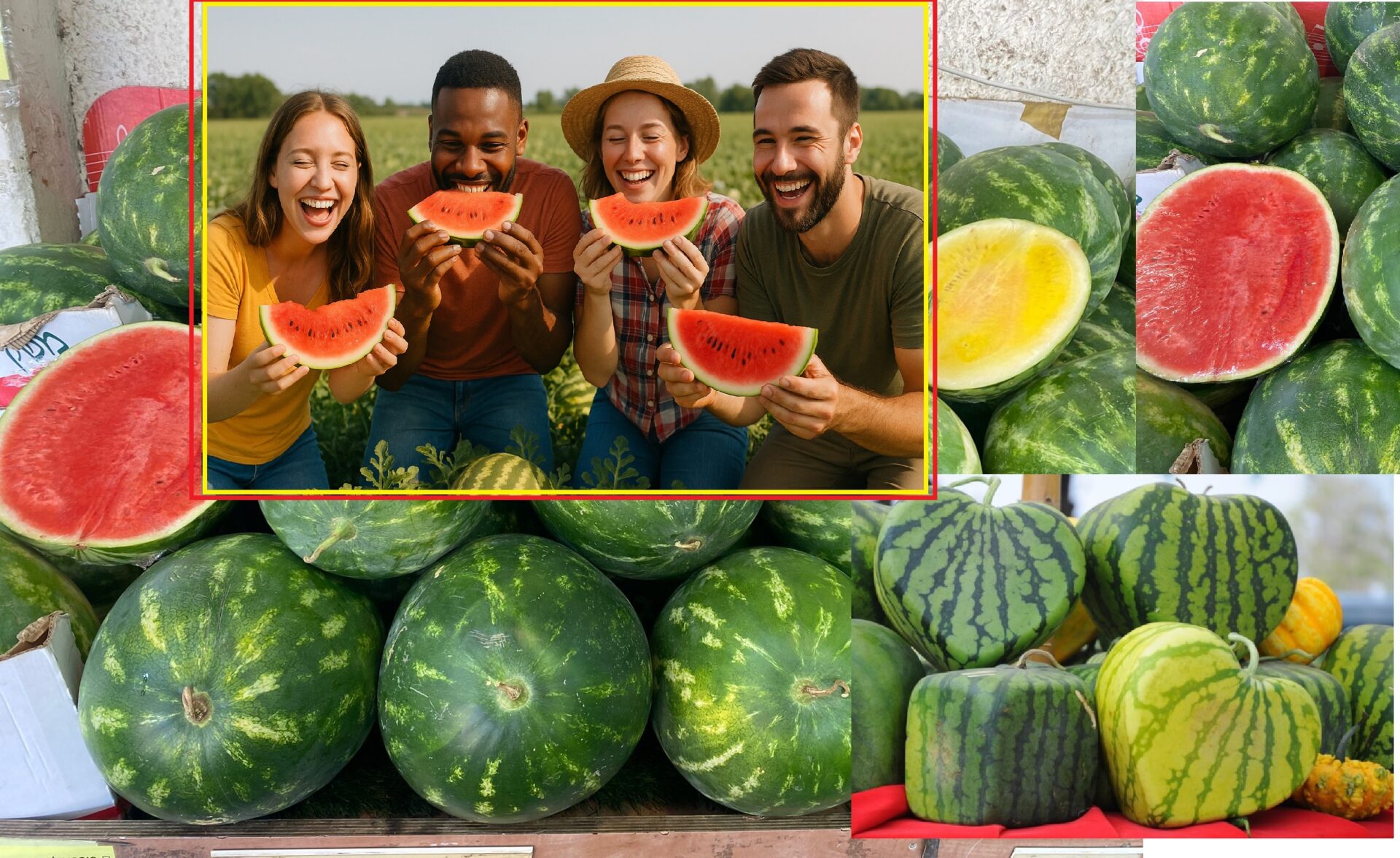
The end of summer, the watermelon season is coming to an end, but you can still savor the fruit that is full of color and freshness. When the sun is blazing and the heat is almost unbearable, it's hard to think of anything more appropriate than a sweet red slice of watermelon dripping with cool juiciness. It's a taste of childhood, of the beach, of long nights on the balcony and of a shared bowl in the middle of the table. Israelis are in love with watermelon, perhaps because for them it symbolizes everything that is good about summer: abundance, simplicity, and the ability to stop for a moment, let go of troubles and surrender to a sweet and simple pleasure.
The Israeli classic calls for eating watermelon with salty cheese. This combination came to Israel from Greek and Balkan cuisine, but here it has become an integral part of the Israeli experience. Very few foods have become as culturally iconic as this combination. Apparently, the contrast between the sweetness and juiciness and the creamy saltiness of the cheese has created a dish that is almost exclusively associated with Israeliness.
Watermelon is botanically a fruit since the fruit develops from a flower and contains seeds. However, it is also a relative of vegetables such as pumpkin and cucumber, and is therefore sometimes referred to as a "vegetable" in some contexts, especially culinary or agricultural ones.
The history of the watermelon
Researchers believe that the first watermelon was grown in South Africa, in the Kalahari Desert, more than 4,000 years ago. Its wild ancestors were very small, with light-colored flesh (white-yellow) and a bitter, not sweet, taste. In ancient Egypt, paintings of watermelons were discovered in tombs that are about 4,000 years old, including in the tomb of Pharaoh Tutankhamun. The Egyptians used to put watermelons in tombs to ensure the dead water and abundance in the afterlife. At that time, they began to domesticate the watermelon, transforming it from a bitter and small fruit into a sweet and juicy fruit.
From the Near East, the watermelon spread towards Persia (present-day Iran), and from there to India and Asia. Ancient writings from the Talmud and Greco-Roman literature mention a fruit resembling a watermelon. The watermelon reached Europe via Spain, probably by the Moors (the Muslims who ruled there in the 10th century). By the 13th century, the watermelon was already well known in Spain and Italy. In the 16th century, sailors and traders took the watermelon to America. African slaves were among the first to grow watermelons in the new lands.
While Israel remains loyal to the red watermelon with a round or elliptical structure, Japan has developed square watermelons. The square watermelon was first developed in Japan in the 70s (around 1978) by a farmer from the Kagawa region on the island of Shikoku. The goal was to find a solution for storage. Round watermelons take up a lot of space and Japanese refrigerators are small. The farmers put the watermelons in square glass/plastic molds while growing, and they took on the shape of the box. The result became a global hit and mainly a luxury attraction, with prices reaching hundreds of dollars per unit. In China, they experimented with heart-shaped molds and the watermelons did indeed evolve into the mold shape.
In recent years, melon and watermelon varieties in less conventional colors have also appeared in the fields, including yellow and orange, the product of a natural mutation that sweetens the fruit. The yellow color comes from beta-carotene instead of lycopene, which is the red color. In Israel, at least as of today, there is no documentation of widespread commercial cultivation of watermelons with yellow flesh, and the local focus is mainly on melons. However, Israeli companies in the field of hybridization and seed are focusing on creating innovative varieties.
Heart-shaped, pyramid-shaped, and other shapes have also been tried in Japan and China. The principle is the same, using special molds while the fruit grows.
Watermelons in the world beliefs and customs
In agricultural traditions inMiddle EastWell, cutting the first watermelon of the summer was a community event, everyone gathered to taste and bless the abundance.
In tradition African Ancient stories say that the watermelon came down from the sky as a gift from the gods to humans to quench their thirst in the desert.
במצרים The ancients believed that watermelon symbolized fertility and prosperity, and placed it in tombs to accompany the dead to the afterlife. Paintings of watermelon have been found in Egyptian tombs that are thousands of years old.
In a legend Turkish There is a story about a poor farmer who prayed for rain. God heard his prayer and sent such heavy rain that the seeds he sowed grew into giant watermelons that saved the entire village from famine. Since then, the watermelon has been considered a "savior fruit."
בסין Watermelon is considered a symbol of long life and blessing. It is customary to serve it during Chinese New Year celebrations or in the summer as a symbol of health, freshness, and good luck.
Folk beliefs inEastern Europe It was forbidden to eat watermelon at night because "the soul would be confused" between water and a dream. Others claimed that watermelon was a symbol of a pure heart, because its seeds were black in a red heart, just like the contrast between concealment and lying and revelation and purity.
In folk tales Persians, Red watermelon was used as a gift between lovers, as a symbol of a beating heart and emotional warmth.
בJapan
It is said that watermelon was born from a drop of dragon blood that fell to the ground. That is why watermelon was eaten in ceremonies to ward off evil spirits. There is a summer tradition there called Suikawari, a game where someone is blindfolded, spun around and tries to break a watermelon with a stick, like a "piñata". It is considered a game of luck and also a way to release bad energy.
On the website of the Vegetable Growers' Organization, an article appeared stating that in the town of Chinchilla,Australia A watermelon and melon festival is traditionally held at the end of the season. The town is located about 300 km west of Brisbane. It was recently announced that during the festival, which took place last February, a Guinness World Record was broken for smashing watermelons with a punch! The new record holder, John Ellwood, a 29-year-old local watermelon grower, smashed 40 watermelons with his head within the time allotted to him.
40 million watermelons in one summer
A summer meal often ends with watermelon as a sweet dessert. Hundreds of thousands of tons of watermelons are sold in Israel every summer. According to the Ministry of Agriculture, Israelis consume an average of 20 kg per person during the summer season. This is one of the highest rates in the world. Most watermelons are grown in the Negev, Arava, and a little in the Galilee. According to the Vegetable Growers' Organization, 180,000 tons of edible watermelons are grown in Israel every year, most of them seedless. The average weight of one watermelon ranges from 5 to 6 kg, so 20 kg means about 3–4 watermelons per person in the summer. Israel has about 10 million residents, so this amounts to about 30 to 40 million watermelons eaten in the summer.
In the early 1970s, a turning point occurred in watermelon growing, with the introduction of the technology of using polyethylene sheets. The growing season expanded to warm areas, such as the Arava and the Jordan Valley, where this technology was adopted, which led to the advance of watermelon harvesting. Watermelon, which was more associated with summer than any other crop, became available most of the year, from March to November.
According to World Bank data (WITS/Comtrade), in 2022 as well as in 2023, Israel imported only about 63,849 kg of melons and watermelons for about $49, mainly from Jordan. The quantities of imports are negligible. Almost all the watermelons eaten in Israel are grown here.
The health benefits of watermelon
Beyond being a refreshing fruit, watermelon is a source of moisture, lycopene, and vitamins.
Rich in water (90%–92%) – excellent for preventing dehydration on hot days and maintaining fluid balance in the body.
Watermelon is an extremely low-calorie fruit. 100 grams of watermelon contains about 30 calories and about 7.6 grams of carbohydrates.
Lycopene – A particularly powerful antioxidant found in watermelon in high amounts (more than in tomatoes!). Lycopene helps protect the body’s cells from oxidative damage, and is linked to a reduced risk of heart disease and certain types of cancer. Lycopene and citrulline (an amino acid found in watermelon) help improve blood flow and reduce blood pressure.
Vitamin C – strengthens the immune system and contributes to skin health.
Vitamin A (beta-carotene) – important for vision and skin.
Potassium – helps balance blood pressure and muscle and nerve function.
Vitamin B6 – contributes to brain activity and energy production.
Improving recovery after exercise – Studies have found that watermelon juice may reduce muscle pain thanks to citrulline, which improves blood flow to the muscles.
People with diabetes need to balance the amount, because despite the relatively high glycemic index, the glycemic load is low due to the high water content, so its effect on blood sugar is milder than it seems. At the same time, dietitians warn against excessive eating. Eating a lot every day can lead to excess sugar.
A pleasure for greenhouse gas emissions
Quite a few watermelons are thrown away every year because of unsold fruit or those that have opened and started to spoil. Food organizations in Israel are trying to find creative solutions, such as distributing surpluses to those in need or using natural juice.
Although there is no precise data on the total amount of edible watermelons that are thrown away at the household or retail level, the general trend of food waste in Israel is well known: a Leket Israel report from 2023–2024 reveals that 2.6 million tons of food (equivalent to 38% of total production) are lost each year, including at the agricultural, marketing and consumer levels.
Every year, huge quantities of watermelons are thrown onto the fields in Israel. This is not the fruit we slice on the table, but a unique variety called Malali, which is grown mainly for seed production. The flesh of this watermelon is considered less tasty and is therefore not sold to consumers, and the result is a huge waste, with about 56 tons of pulp simply thrown away every year. Beyond the fact that this is a loss of agricultural and economic resources, it also has a heavy environmental cost: the rotting of watermelons emits thousands of tons of greenhouse gases into the atmosphere, about 8,200 tons of carbon dioxide per year. In other words, our beloved summer fruit hides a less sweet story behind it, a story about food waste, about the gap between abundance and waste, and about an opportunity to think differently about the use of agricultural resources. Researchers are already pointing to innovative ways to leverage this loss, for example, producing ethanol (a biofuel) or important nutrients such as lycopene from the discarded pulp, but as of today, most watermelons of this variety continue to remain in the growing areas and become an environmental problem.
How to choose a good watermelon
Tap the watermelon. A deep, hollow sound indicates ripeness – if the sound is dull, the watermelon is probably less sweet.
Yellow spot (field spot) – This is where the watermelon rests on the ground. A large creamy-yellow spot indicates that it has been ripening longer on the ground, and therefore will be sweeter. If the spot is white – it was picked too early.
Color and skin – dark green color, clear pattern and a slight natural shine. Skin that is too faded may indicate immaturity.
Size and weight – a good watermelon should feel heavy relative to its size, a sign that it is full of water.
Watermelon shape – round is usually sweeter and softer. Oval/elongated tends to be more watery and less sweet.
Dry sting – If there is a small tail (sting) and it is dry – it is a sign that the watermelon was picked when it was ripe. A green sting indicates that it was picked too early.
Smooth skin – A watermelon with a few "scratches" or thin brown lines is actually a good sign – these are places where bees have touched it and the flower's pollen has been present, which is sometimes linked to higher sweetness.