

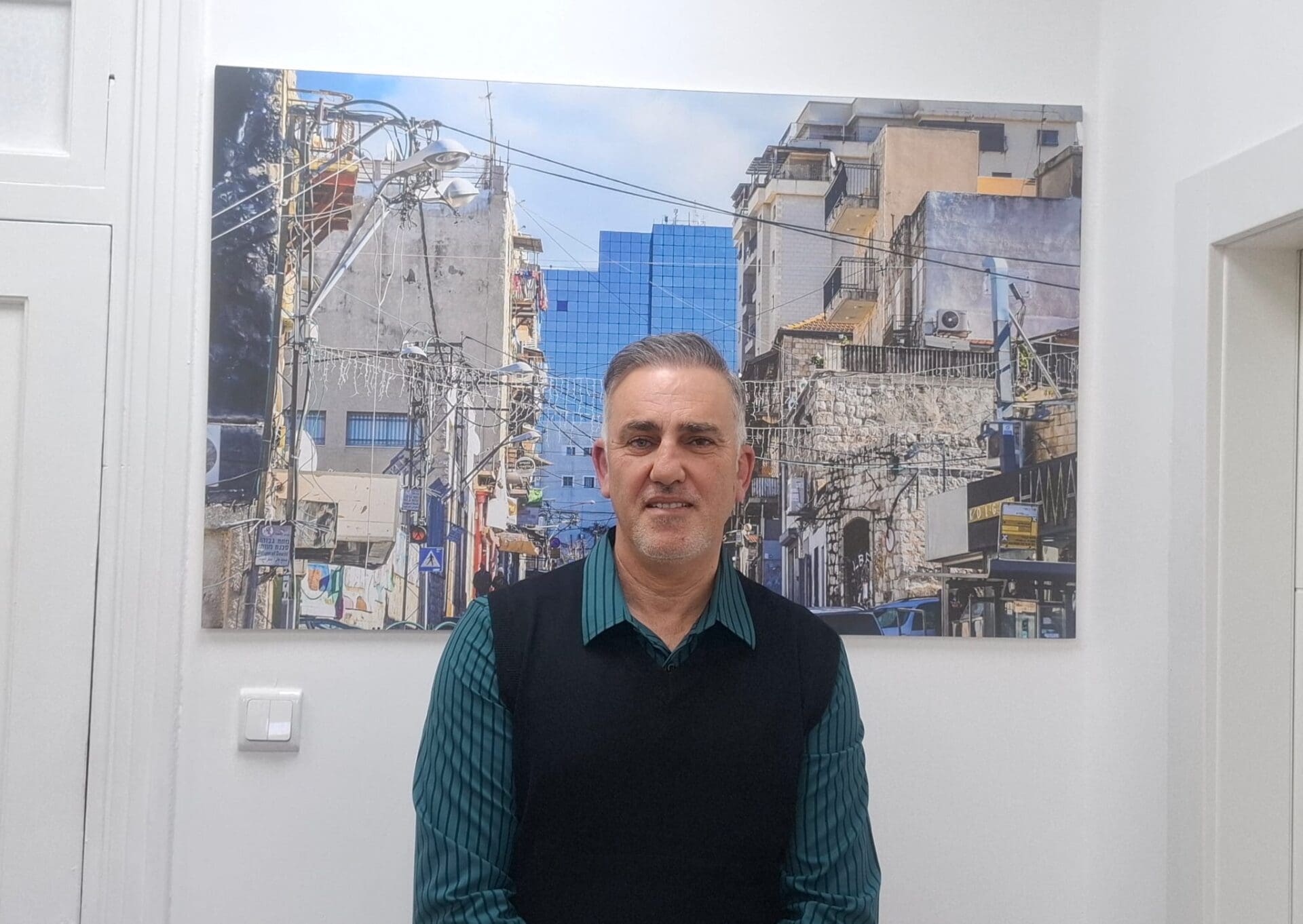
(Hai Fa – Haifa and the surrounding area news corporation) – In a special interview with Haifa, incoming Deputy Mayor Fakhr Bayadsi talks about the struggle to preserve Haifa’s multicultural character, the opposition to his appointment, the ongoing disparities in Arab neighborhoods, the challenges of personal security, violence, and the need to strengthen shared life. Alongside his criticism of the public and national atmosphere, he presents a vision for a city where Jews and Arabs do not just live side by side, but are full partners in shaping its future.
The appointment of Fakhr Bayadsi to the position of deputy mayor of Haifa is, for him, far more than a political appointment. He sees it as an expression of the city's commitment to the principles of shared life, equality, and true partnership among all its residents. However, alongside the joy of completing the process, Bayadsi does not hide his disappointment and concern about the opposition that arose around his appointment, precisely in a city that prides itself on its multicultural identity.
"From the first moment, my feeling was that this was a wonderful thing for Arab society, but it's important to me to emphasize that this shouldn't be an extraordinary event. In a city like Haifa, a mixed city where the Arab population is an integral part of the human fabric, the fact that the deputy mayor is an Arab should be something natural, obvious and elementary. It shouldn't spark discussion or opposition."
He said that the fact that the appointment was ultimately successful is gratifying, but the very resistance raises deeper questions about the state of Israeli society and the meaning of living together.
"On the one hand, I'm happy that in the end it succeeded, because it illustrates our commitment to a real, not imaginary, life together. On the other hand, it's sad and worrying that even in Haifa, the third largest city in Israel, which is supposed to be a beacon of sanity, responsibility, love and brotherhood, there are still those who ask whether this is legitimate, whether we are partners and whether we should live together."
Byadsi emphasizes that living together does not require agreement on every issue, but rather the ability to accept and respect diversity.
"Living together means accepting the other as they are, with their language, identity, values, history and heritage. There will always be things we disagree on, but it is our duty to find common ground, to seek out the things that connect us, and to work for our future and for the future of our children. We are all destined to live in the same country and the same city. We do not have another Haifa."
"It is precisely in the face of incitement and evil that we must not give up."
Bayadsi took office at a particularly sensitive time, amid security tensions, increasing racist discourse, and incitement against Arab society. He said the national atmosphere directly affects Haifa as well, and cannot be ignored.
He would like to thank the mayor for standing behind the principles of partnership even at a time when it is not easy to defend them.
"I want to say a word of thanks to the mayor for his firm stand on lofty principles. At a time when the concept of 'living together' has become a derogatory term for some people, leadership and courage are required. There are those who did not even have the courage to say those words, and there are leaders who chose to stand by their principles. I appreciate those who deeply understand the meaning of partnership."
According to him, Precisely at a time when incitement and racism are raising their heads, we must not give up on the path.
"If we truly believe that we have no future other than living together, based on respect, appreciation, equality, and justice, we must be determined. Woe to us if we give up precisely in the face of this harsh reality. In the face of evil, we must seek the light, and in the face of everything that divides us, we must find what we have in common. This is the engine that gives us the strength to continue."
He describes Haifa's human mosaic as its greatest asset: "The magic of this city is not just nature, the sea and the mountains. The real magic is its human mosaic. It's the Haifa DNA, people who live together and look out for each other. The city has gone through quite a few crises, but it has always had the ability to heal itself. We need to strengthen our social immune system. The most dangerous thing is when the immune system attacks itself, and we must not reach a situation where we start attacking each other."
"I represent all residents of Haifa, regardless of nationality"
One of the main questions addressed to Bayadsi is whether he sees himself as a representative of Arab society only or as a deputy mayor representing the entire Haifa public. His answer is unequivocal:
"I represent all of Haifa society, without hesitation or thinking twice. I receive inquiries from residents and various neighborhoods, and it is truly impossible to separate the needs of Arab society from the needs of Jewish society. Ultimately, quality of life, education, infrastructure, security, and the environment concern us all."
According to him, the Arab community in Haifa no longer lives only in the neighborhoods where it was concentrated in the past, but is now also scattered in many mixed neighborhoods. This requires the adaptation of municipal services to the changing demographic reality, including educational institutions, kindergartens, transportation, and the educational continuum.
"We have a responsibility to ensure that educational institutions are appropriate for where residents actually live, including kindergartens and ensuring educational continuity for Arab society. At the same time, there are issues that affect us all. Polluting factories harm the health of all of us, war and defense are important to everyone, and infrastructure, culture, and public space are also a common concern."
He mentions the opening of public protected spaces during the war as an example of municipal responsibility that does not distinguish between population groups.
"When we opened protected spaces together with the Security Department, we ensured the safety of everyone, regardless of color, race, or nationality. This is what a city that understands its responsibility to all its residents should look like."
Reducing the gaps in Arab neighborhoods: "There has been years of neglect here"
Alongside the concept of overall urban responsibility, Bayadsi does not ignore the large gaps that exist in Arab neighborhoods, which he says have suffered for years from neglect in the areas of infrastructure, education, transportation, accessibility, and public space.
"There are very large gaps here, and great neglect. It is impossible to ignore the fact that for years many Arab neighborhoods have not received the appropriate response in the areas of infrastructure, education, transportation, schools and the establishment of kindergartens. We must act on two levels: to reduce the gaps in the Arab neighborhoods, and at the same time to ensure the benefit of the entire city of Haifa."
Bayadsi notes that he sees an advantage in that he came to the position with familiarity with the area and the needs of the residents.
"A little over two years of work and familiarity with the neighborhoods, meetings with residents, schools and community centers allow us to identify needs and promote real solutions. We need to work on both daily service and long-term planning."
Among the issues he seeks to promote are urban renewal projects, infrastructure improvements, transportation and parking solutions, the establishment of educational institutions, and the development of public space.
In the Halisa neighborhood, he said, significant urban renewal is needed, alongside the development of public spaces and public institutions, long-term rental housing solutions, and providing a response to the neighborhood's young people and families.
In the Abbas neighborhood, serious attention is needed to the parking and transportation shortages, traffic jams, and the damage to the quality of life. According to him, if planning processes are not started now, it will not be possible to reach solutions in the future.
Wadi Nisnas also faces complex challenges, especially with regard to protection, public shelters, and urban renewal, partly due to the fact that a significant portion of the buildings in the neighborhood are designated for preservation.
"There are things that can and should be done immediately, such as restoring infrastructure, roads, sidewalks and public buildings. We have managed to advance road and infrastructure layering work on streets in Arab neighborhoods, alongside preparing plots of land, building synthetic sports fields, summer renovations in schools and strengthening community centers. At the same time, we must begin planning the major projects today, even if their fruits will only come in years."
Bayadsi also notes the promotion of the rehabilitation of Wadi Nisnas and the commercial center in Halissa, alongside the need to establish a new Arab school in western Haifa.
"The distribution of resources must be fair and proportional. Immediate needs must not be neglected, but future planning must not be given up either. Even if others reap the fruits of the planning we begin today, we must do it for the sake of future generations."
Culture as a bridge between communities
One of the areas in which Bayadsi seeks to expand his activities is culture in Arab neighborhoods and throughout the entire urban area. He says that in recent years, community centers have become significant centers of cultural and social activity, intended for all populations and all ages.
"We prefer fewer one-off events and more workshops and ongoing activity. Today, community centers are the beating heart of the neighborhood. Young people, children, women and adults come to them. They are open to all populations and allow for real encounters between people."
He notes the collaboration with the Cultural Department, community centers and Beit HaGefen, as well as with Arab cultural associations and local organizations.
He said that in November and December, more than 45 to 50 joint events are planned in cooperation with Arab associations, Beit HaGefen, the Equality Administration and the Haifa Municipality, in addition to Christmas and the holiday season events.
"We promote events in the fields of theater, plays, shows and concerts, and also collaborate with churches and cultural associations. It is important to us to give a platform to local artists and cultural entrepreneurs, both from Haifa and beyond. Almost every artist who approaches us and requests cooperation receives an opportunity to promote their work."
Bayadsi emphasizes that culture is much more than entertainment or a community event. "Every book we launch, every show, every cultural event is a success and a victory. They illustrate language, identity, heritage, and shared existence. The more we succeed in connecting with populations, respecting them, and giving them space, the stronger we strengthen the entire city."
Later, cultural events are also planned in open spaces, including the beach and the Mother Garden, with the desire to expand the activity and make it accessible to a wider audience.
Personal security: "Residents want to feel safe first and foremost"
One of the central and worrying issues raised in the interview is the issue of violence and personal security. Byadsi does not hide his concern about the increase in violence in Arab society and its implications for Haifa.
"Unfortunately, the wave of violence and murders in Arab society did not pass over Haifa. The city paid a heavy price and is still paying it. The police have a great responsibility here, which is responsible for the fight against illegal weapons, the eradication of violence, and phenomena like protectionism, which terrorize business owners."
However, he emphasizes that the municipality also has a central role in improving the sense of security in public spaces, neighborhoods, streets, beaches, and around educational institutions. According to him, the entry of municipal policing into Haifa is a significant bright spot, especially against the backdrop of residents' feelings of insecurity.
"I think the municipal police are a bright spot. In many cases, we have seen them arrive first at events and provide a response to residents. From my own personal experience, in dealing with problems of drugs, violence and hardship in the Herzliya neighborhood and the Hadar area, I have seen their contribution."
He also mentions dealing with the phenomena of improved vehicles and noise, problems related to hostels for street dwellers, drug use, and public order disturbances. However, he makes it clear that municipal policing cannot replace the police.
"Municipal policing cannot and should not replace the police. We need more significant cooperation between the elements, but the responsibility for combating crime, violence, and illegal weapons lies with the police. We must demand that government ministries allocate the necessary resources and act decisively."
Bayadsi wants to emphasize that security needs vary from neighborhood to neighborhood. The needs in Halisa are different from those in Ein Hayam, and the needs in the French Carmel are different from those in Hadar.
"We need programs tailored to each neighborhood, which will include patrols, police presence, and response to local problems. I receive inquiries from residents in French Carmel who request more police presence, following cases of car fires, assaults, and violent incidents. People want to live with a basic quality of life, and the first thing is to feel safe."
He also warns against the penetration of violence into educational institutions: "When we begin to see signs of violence in schools as well, it is worrying and requires serious attention. The general climate affects us all, and violence must not be allowed to erode the educational systems as well."
According to him, Haifa is a city that hosts a large number of visitors and tourists every year, and therefore the responsibility for security does not lie solely with the city's residents.
"Haifa is home to about 300 residents, but the city also hosts many visitors and travelers. We need to ensure the safety of residents and visitors, prevent vandalism, noise, damage to public space, and takeover of public areas. Ultimately, residents want something basic first and foremost: personal security. Before talking about luxury, people want to know that they can send their child to public kindergarten and feel safe."
"Partnership is not only around the dining table, but also around the decision-making table"
When talking to Bayadsi about the path to strengthening shared life, he repeatedly returns to the responsibility of leaders to shape public discourse and the reality on the ground.
"People who lead a public have a very significant role. Just as parents serve as models for their children, so too should leaders serve as examples. Those who believe in living together should live it out in practice, and not be content with slogans, gestures, or festive events."
According to him, we must stop treating the partnership as a merely symbolic meeting.
"True living together means accepting the other as they are, and not trying to fit them to our own standards. It means partnership in decision-making, mutual respect and appreciation. Partnership is not just about sitting together around the dinner table or participating in holiday feasts. It is also about sitting together around the decision-making table and being true partners in shaping the future."
Bayadsi sees the holiday season as a special opportunity to strengthen the connection between communities, and invites all city residents to take part in holiday events.
"The holiday season is an opportunity to open our hearts, to demonstrate our shared existence and brotherhood. We need to invite everyone, look out for each other, respect each other, and find the things that connect us."
"We don't have another Haifa"
At the end of the interview, Bayadsi seeks to convey a message of shared responsibility and hope, even in a complex and tense period.
"The city of Haifa has many challenges. We have gone through difficult times, but if we want a better future for all of us and our children, we must work hard. Everyone has something to give and everyone has something to contribute. We must not neglect the city and we must not give up on living together."
He emphasizes that Haifa's success does not depend on one person or one group, but on the joint effort of all its residents and its leadership.
"We need to work together, keeping in mind the lofty goal of preserving shared life as a supreme value, alongside preserving democracy and the character of the city. This requires joint effort, cooperation and a lot of goodwill. I believe that the path is difficult, but in the end we will succeed. Haifa's success is the success of all of us."
We don't have another Haifa. The question is not only what city we want to leave to our children, but also what kind of company we choose to be on the way there.
Attorney Bayadsi,
How is your public integrity consistent with your regular votes on the local committee to approve applications under the destructive and dangerous TAMA 38 – approvals that deviate from the provisions of the law, while they all rest on a false foundation that was placed on the committee's table time and time again and you ignore the facts?!
Why are extremist parties allowed to have a platform here on the site?
They have their own websites and in their own language, why should we hear them here?
The city of Haifa has been declining in recent years.
In addition to migration from the Galilee villages to the city, there is the fear of events involving the Guardian of the Walls.
And now they won the elections and want Palestine.
There is no peace and no coexistence.
Maybe they will finally stop cutting services to residents and spending the astronomical amount to finance the "holiday of holidays" and invest in residents again?
It's a disgrace what's happening in this city.
Well, as usual... he says "we live together and Haifa belongs to everyone" and in the same breath he only talks about Arab society.
Enough already, this isn't funny, how stupid do you think we are?