



(Hai Fa – Haifa and the surrounding area news corporation) – Sudden paralysis of half of the face can occur within hours and change a person's daily routine in an instant. Bell's Palsy, also known as Bell's Palsy or facialis, is one of the most common causes of the phenomenon. In most cases, it is a temporary condition with a good chance of recovery, but early diagnosis, proper treatment, and eye protection may be critical on the road to recovery.
Media personality Avri Gilad's revelation that he woke up to find half of his face paralyzed brought facial nerve paralysis back to the center of public discourse. Gilad is not the first to reveal his struggles with the condition. Culinary artist Michal Anski also shared in 2019 that she experienced sudden paralysis of half of her face during a flight, and singer Anna Zak shared in 2021 that she had been diagnosed with Bell's palsy.
Behind the individual cases lies a medical phenomenon that is not as rare as one might think. It may occur in women and men, young and old, sometimes without any early warning signs. Although in many cases a full recovery is possible, the sudden onset of facial paralysis requires urgent medical examination to identify the cause and rule out more dangerous conditions.
The numbers behind facial paralysis
Bell's palsy is the most common cause of sudden facial nerve paralysis. According to statistics, approximately 20 to 40 cases per 100 people are diagnosed each year. Estimates also indicate that the cumulative risk of developing the syndrome over a lifetime is approximately one in 60 people.
The syndrome affects women and men equally, and can occur at any age, but its incidence is particularly high among people aged 15 to 45. It accounts for about 60% to 75% of cases of unilateral facial nerve paralysis. There are also groups in which an increased risk has been observed, including pregnant women, especially in the third trimester, and women in the postpartum period. People with diabetes and high blood pressure are also at increased risk. In addition, a link has been described between the onset of the syndrome and upper respiratory tract infections.
What is the facial nerve and why does damage to it change a person's appearance?
To understand this phenomenon, you need to know about the facial nerve, also known as the seventh of the 12 cranial nerves. This nerve plays a central role in daily functioning. It is responsible for activating the facial muscles, allowing us to smile, close our eyes, raise our eyebrows, and express emotions.
But its role is not limited to facial expressions. The nerve is also involved in the sense of taste in the anterior two-thirds of the tongue, in the function of the tear and salivary glands, and in regulating the response to noise through a small muscle in the middle ear.
Every person has two facial nerves, one on each side. They emerge from the brainstem, pass through canals in the skull bone, and branch out into branches that reach different areas of the face.
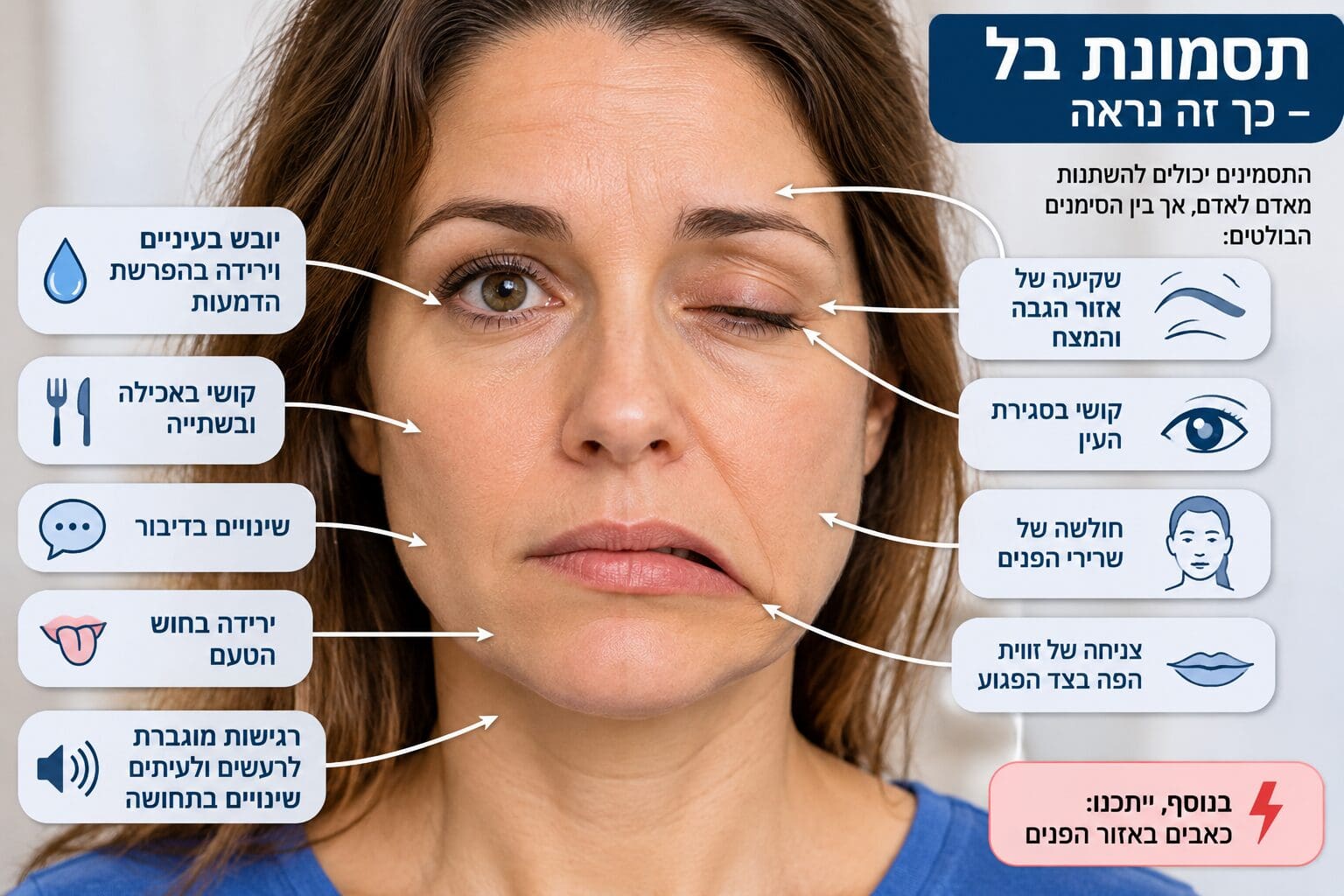
When the nerve is damaged, the ability to transmit commands to the muscles is also affected. The result may be weakness or paralysis of half of the face. In some cases, the patient has difficulty closing the eye, smiling, speaking, eating or drinking. Others complain of dry eyes, a decreased sense of taste and even unusual sensitivity to noise.
Why is this happening?
One of the main mysteries surrounding Bell's palsy is that in most cases, no single cause can be identified, which is why it is called idiopathic palsy, meaning a paralysis of unknown cause.
The leading medical theory is that in some cases, it is the reactivation of a dormant virus in the body, primarily the herpes simplex virus. According to the hypothesis, the reactivation of the virus causes an inflammatory process and swelling of the facial nerve. Because the nerve passes through a narrow bony canal, the swelling can create pressure and impair its function. However, it is important to emphasize that this causal relationship has not yet been conclusively proven.
Another cause of facial paralysis is the herpes zoster virus, which causes shingles. When the infection affects the facial nerve, the condition may manifest as Ramsay Hunt Syndrome. In such cases, blisters can sometimes be identified in the outer ear area.
In addition to viral causes, there are other causes of facial nerve paralysis, including Lyme disease, which is transmitted through a tick bite, other infections, inflammatory and autoimmune diseases, injuries to the head and face, tumors that press on the nerve, and even injuries during surgery.

What are the warning signs?
Facial nerve palsy usually develops within hours to days, sometimes reaching its peak severity after a few days. In most cases, the damage is on one side of the face.
The symptoms of facial nerve palsy may vary from person to person, depending on the severity of the injury and the location of the nerve affected. Among the most prominent signs are drooping of the corner of the mouth on the affected side, weakness of the facial muscles, and difficulty smiling symmetrically. In many cases, difficulty closing the eye, drooping of the eyebrow and forehead, and dry eyes due to decreased tear production also occur.
In addition, paralysis can make it difficult to perform daily activities such as eating and drinking, cause changes in speech, and a decreased sense of taste. Some patients also experience facial pain, increased sensitivity to noise, and sometimes changes in sensation. The severity of symptoms varies, and not all patients experience all of them.
One of the most disturbing symptoms is the inability to close the eye completely. This may seem like a minor symptom, but in fact it can become a significant complication, as the eye loses some of its natural protection against dryness and damage to the cornea.
Not all facial paralysis is Bell's syndrome.
One of the most important issues in diagnosis is the distinction between peripheral paralysis of the facial nerve and central paralysis originating in the central nervous system. In peripheral paralysis, the damage is to the facial nerve itself or its pathway. In such a situation, the entire half of the face may be affected, including the forehead and the ability to close the eye.
In contrast, in central paralysis, the damage is in the area of the brain responsible for facial movements. In typical cases, such as a stroke, the lower half of the face on the side opposite the location of the brain injury is primarily affected.
This distinction is especially important because sudden facial paralysis can be a sign of a stroke. Therefore, one should not assume that Bell's palsy is present based on facial appearance alone. Sudden onset of facial weakness, especially if accompanied by weakness in an arm or leg, slurred speech, confusion, or visual disturbances, requires immediate emergency care.
How is the phenomenon diagnosed?
Diagnosis is based primarily on a medical examination and assessment of symptoms. The doctor checks facial muscle movement, the ability to close the eyes, raise the eyebrows and smile, as well as general neurological function. In appropriate cases, an ear, nose and throat examination is also required, among other things to identify blisters in the ear area that may indicate a herpes zoster infection.
Special importance is given to eye examinations, because the lack of blinking and proper eyelid closure may endanger the cornea.
The course of the disease also provides important information: typical Bell's palsy usually develops within hours to days. When the paralysis progresses slowly over weeks or months, or when additional symptoms appear, more in-depth investigation is needed to rule out other causes, including tumors.
Why are the first three days so important?
Despite the frightening appearance, the encouraging news is that in many cases there is a good chance of recovery. According to medical data, approximately 70% of patients are expected to recover fully, when the appropriate treatment is given in a timely manner.
The standard treatment for Bell's syndrome includes the administration of steroid medications for a period of about ten days, as determined by the doctor. The treatment is particularly effective when started within 72 hours of the onset of symptoms.
The reason for the importance of early treatment is the desire to reduce the inflammatory process and swelling around the nerve, thereby improving the chances of recovery. In certain severe cases, or when there is a well-founded suspicion of a viral infection, the doctor may decide to combine steroids with an antiviral drug, such as acyclovir.
At the same time, physiotherapy and facial muscle rehabilitation treatments can be combined, depending on the patient's condition and the stage he is in. It is important to emphasize that drug treatment is not suitable for every condition of facial paralysis, so the cause must first be diagnosed and action must be taken according to the doctor's instructions.
The danger that must not be ignored
One of the most important aspects of treating facial nerve palsy is protecting the eye on the affected side. When the patient is unable to close the eye or blink properly, the cornea is exposed to air and dries out. Without proper treatment, corneal ulcers and infections can develop, and in severe cases, vision can be damaged.
Treatment includes the use of tear substitutes in drops or gel, as directed by the ophthalmologist. Sometimes it is also necessary to close the eye with a patch or other means, especially while sleeping. In cases where it is not possible to protect the eye with simple means, there are additional medical and surgical solutions, including temporary suturing of the eyelids or implanting a small weight in the upper eyelid, which helps it close using gravity.
When the paralysis doesn't go away
Although most patients improve, there are cases where recovery is only partial or paralysis persists for a long time. One possible condition is residual paralysis, in which some facial muscles do not return to normal function. This can lead to facial asymmetry, impaired smile, and difficulty performing daily activities.
Another complication is called facial synkinesis. This is a phenomenon in which, after the nerve has recovered, involuntary and uncoordinated activity occurs between different muscles in the face. For example, a person who tries to smile may find that the eye on the affected side closes at the same time. Alternatively, while closing the eyes, an involuntary movement may occur in the mouth area.
The phenomenon may develop several months after the onset of paralysis, and affect both function and appearance. Beyond the physical damage, there is also an emotional and social cost. A sudden change in facial appearance may affect self-confidence, communication with others, and the feeling of comfort in social gatherings and at work.
What treatments are available for those who do not recover?
When paralysis persists for months without satisfactory improvement, advanced treatment and rehabilitation options are available. One option is Botox injections into the facial muscles. The treatment may reduce involuntary contractions, relieve tension and pain, and improve facial symmetry and movement.
In some cases, surgical intervention is considered, including surgeries to release contracted muscles, nerve transfer, or nerve grafting, which aim to improve facial muscle function. There are also static surgeries to improve the appearance of the face at rest, such as eyebrow lifting and supporting the corner of the mouth and cheek, as well as dynamic surgeries designed to restore movement to the face through nerve transfer or muscle grafting.
The choice of treatment is made individually, depending on the severity of the injury, the duration of the paralysis, and the condition of the nerves and muscles.
When is it important to return for a medical examination?
Medical follow-up is an integral part of the recovery process. Worsening of symptoms after approximately three weeks, the appearance of additional neurological signs, or the lack of expected improvement require a renewed medical evaluation.
Patients who do not experience adequate recovery may require follow-up at a clinic specializing in facial nerve rehabilitation. This may involve neurologists, ophthalmologists, plastic surgeons, physiotherapists and speech therapists experienced in facial rehabilitation. The goal is not only to restore the ability to smile, but also to improve eye and mouth function, reduce involuntary movements and restore as much quality of life as possible.
Facial paralysis is not necessarily a permanent condition, but it should not be ignored.
Bell's palsy is a medical condition that can appear suddenly and significantly affect a person's functioning, appearance, and mental state. Along with the initial concern, it is important to remember that in many cases it is a transient condition, with good chances of recovery, especially when appropriate treatment is given in the early stages.
However, not all facial paralysis is Bell's palsy, and the diagnosis requires a medical examination to rule out dangerous conditions, most notably a stroke. Protecting the eye and monitoring the recovery process are also a key part of treatment.
The cases that have been revealed to the public, including the struggles of Avri Gilad, Michal Anski, and Anna Zak, illustrate how the phenomenon can surprise anyone, regardless of age or status. The important message is simple: the sudden onset of facial paralysis is not something to wait for. Rapid diagnosis, timely treatment, and appropriate rehabilitation can make all the difference on the way back to normal.