


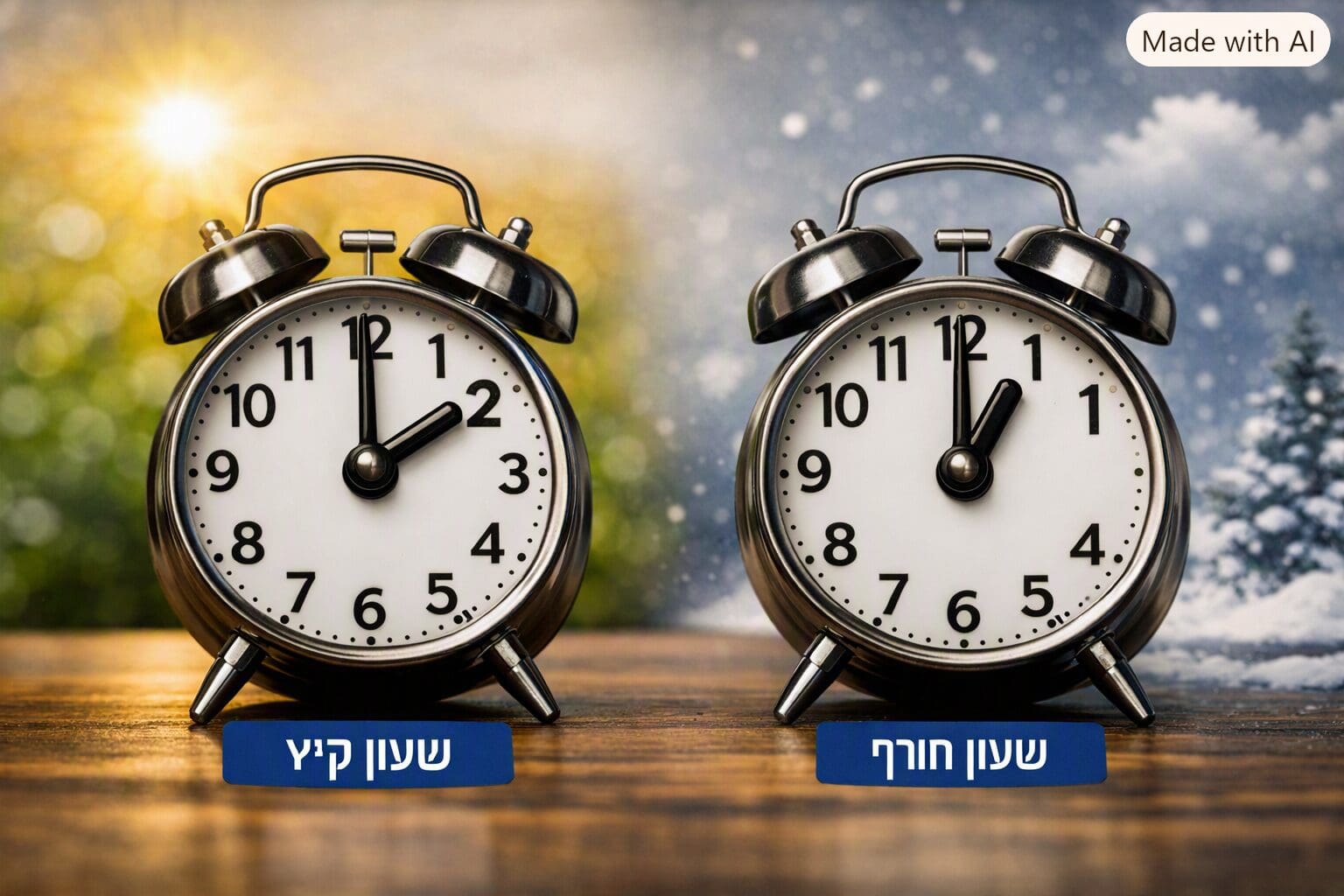
(haipo) – This weekend, On the night between Saturday, 10/24/26 and Sunday, 10/25/26, Israel officially switches to winter time. At 02:00 the clock will move back to 01:00. It may seem like a small change, but in reality it affects our routine, health, and general well-being. Here's a full overview to help you get organized.
Why do we switch to winter time at all?
The transition between daylight saving time and winter time is designed to adjust the hours of light to the daily routine of the seasons. While daylight saving time extends the hours of light in the evening and allows for better use of the day, winter time returns the hours to a more natural state, with an earlier sunrise and an earlier sunset.
The logic behind the change:
- Adjusting the hours of light to the activity hours of the majority of the population
- Energy savings (although the impact is currently less significant)
- Maintaining natural sleep cycles during the dark seasons
Benefits of switching to winter time
- An extra hour of sleep: Many feel relieved by the extra hour.
- Better adaptation to daylight hours: Morning feels more natural when the sun rises early.
- Improved feeling of alertness in the morning: Especially in children and adolescents.
Disadvantages and effects on the body
- Fatigue in the evening: Early darkness affects the hormone melatonin and causes a feeling of early fatigue.
- Decreased mood: For some people, the transition to winter is accompanied by a feeling of seasonal depression.
- Temporary disruption of sleep routine: The body needs a few days to acclimate to the change.
How to adapt to the transition smoothly
- Being exposed to natural light in the morning
- Maintain regular sleep hours
- Avoid caffeine in the evening
- Do light exercise during the day
Summary
The transition to winter time is a natural part of the annual cycle, but it is definitely noticeable. With a few small adjustments, you can get through it easily and start the winter season feeling good and balanced.
Did the article interest you?
It's not like we can tell the sun: Okay, shine until 7-8 pm, we want more daylight hours... We have no control over that. Changing the clock, honestly I don't understand why we need two clocks a year.
This change is really unnecessary, it's been dark since 4:30,
Not to mention the confusion it creates on the first day.
Why do we even need to move the clock and shorten the daylight hours? Just a completely unnecessary activity. Nonsense about adjusting to the winter season. We need daylight hours as late as possible.
God forbid. This is a disaster in every way. Even in October, it only starts to get light after 6 am. It would definitely be better, and certainly from a health perspective, to have standard time (winter) all year round.
😍 In "Israel", which is sunny & bright most of the year, you can postpone the "clock change" until the end of NOVEMBER... for 3 winter months only!
* From MARS/MARCH towards spring – the "summer hour" is more suitable, which brings with it a real feeling of a long day & is beneficial for the personal and national "mood" and certainly for "action":
Economic! Social! And affects "well-being"
"Mentally"!!! = Why do I/we have "depression" now??? 😭 Can I postpone!!! 😭
The article is interesting, but it lacks an important distinction between winter time and simply changing the clock twice a year. Winter time is actually the standard time, and it allows for earlier exposure to light in the morning, which is important for regulating the biological clock. On the other hand, summer time allows you to enjoy daylight in the afternoon and evening. The claim of energy savings is also not unequivocal. It turns out that studies have found that there is barely a 0.34% saving in electricity during summer time. Therefore, the real question is not whether we gained one hour of sleep, but whether the benefit of changing the clock twice a year justifies the temporary disruption to our daily routine… That's it. I'm going to bed.
Everything you have noted is written down,
Read and understand.
Just about every word