


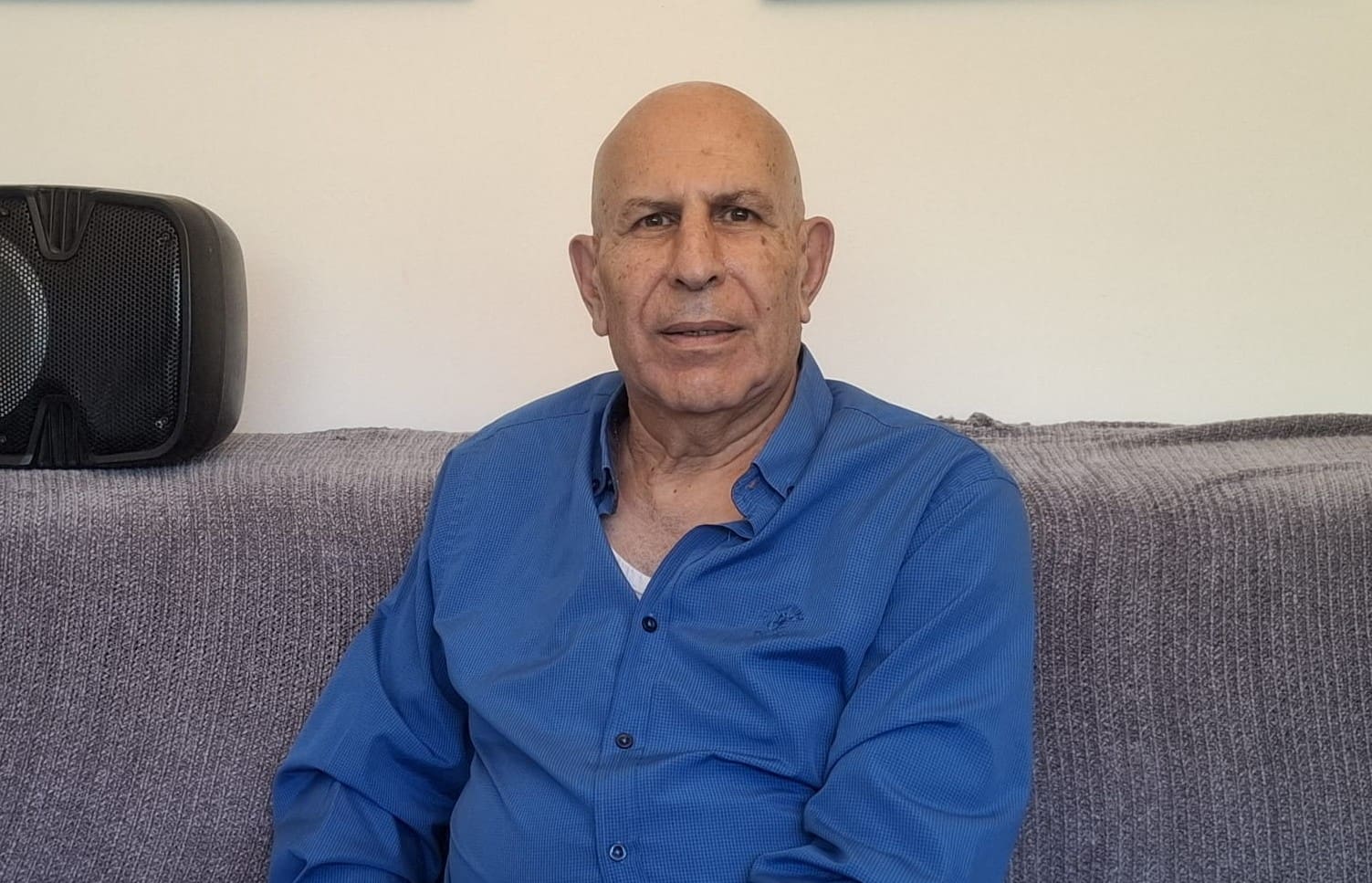
(haipo) "I say I won, because it was a privilege to accompany these families": Menashe Shemesh, a former senior official in the defense establishment and someone who acted as an escort on behalf of the Israeli government's Kidnapped Administration, closely accompanied the Haifa families throughout one of the most difficult and turbulent periods the State of Israel has known.
In a special interview with Haifa, three years after the October 7 disaster, he returns to the first days of chaos and uncertainty, to the difficult moments alongside the joyful news when the kidnapped returned home, to the deep connection he formed with the families and to the personal price he paid. Menashe talks about a mission that began as a temporary assignment and turned into three years of life alongside pain, hope, loss and faith. "Time does not heal," he says, "the families still need the state, and they still have questions that have no answers."
Menashe Shemesh's message to the Israeli government: "Recognize family members as victims of hostilities" ► Watch
There are people who entered the October 7 story to fulfill a role, and there are people who entered it and stayed. Menashe Shemesh was one of them. In the first days after the October 7 attack, when the entire country was trying to understand the dimensions of the disaster, hundreds of families were left facing questions that no one knew how to answer: were their loved ones alive, were they kidnapped, were they murdered, and where are they? Amidst the chaos and confusion, a basic and human need arose for someone to be there, someone to answer the phone, come, listen, check on what the family needs and give them the feeling that they are not coping alone. Menashe was one of those people.
Three years later, he is still there. Menashe accompanied the Ditza Haiman family from Nir Oz, the Katzir family from Nir Oz, and the Maxim Harkin family, and was present at their side in moments when hope was almost impossible and also in moments when the phone rang and brought the news they had been waiting for so long. Alongside the moments of joy, there were also moments that could not be embellished: death, captivity, loss, waiting, and above all, uncertainty. In this reality, Menashe was not just someone who played a role, he became a person who was there, who knew the pain, who listened even when there were no answers, and who continued to accompany the families long after the official mission had ended.
"In the first days, the families cried out: No one is contacting us"
"In the first days of the war, there was a cry from the families," Shemesh recalls. "No one is contacting us, no one is talking to us, no one is treating us." In those days, he says, it was not yet clear even the extent of the disaster - how many people were missing, who was murdered, who was kidnapped, who was alive and who had not yet been located. Amid the chaos and the state's attempt to pick up the pieces, an urgent need arose to establish a mechanism that would give the families an address, support and assistance.
After Gal Hirsch was appointed by the Prime Minister as the coordinator of the prisoners and missing persons, he approached Maj. Gen. (retd.) Meir Klipi and asked him to establish an organization that would focus on the families of civilians. Thus, the organization was born. "with you", led by Klipi and assisted by his deputy, Reserve Brigadier General Avigdor Klein, who gathered around them senior reserve officers, veterans of the security establishment, Mossad, Shin Bet and IPS, professionals, business people and citizens from the private sector, and especially people who came out of a genuine desire to volunteer and help. "It wasn't a recruitment drive in the usual sense," explains Shemesh. "People just came, people wanted to help."

From family to family: "From the tip of the toenail to the tip of the hair on the head"
The goal was clear. To provide families with a solution for every possible need, small or large. "The scope of our work was to provide them with a solution from the tip of their toenail to the tip of their hair on their head," says Shemesh with a bitter smile. "Really in all civil areas: education, welfare, health, emotional support, handling financial matters and bank accounts, without any restrictions." In practice, this meant being much more than lenders.
The "Ityakam" people became intermediaries between the families and the systems, taking care of a child who had to transfer schools, finding a solution for an adult who was unable to cope with the reality that was forced upon him, dealing with financial difficulties and connecting family members to medical and psychological help. Even with the banks, Shemesh says, doors sometimes opened: "We had the open hearts of the banks. There were banks that were willing to forgive even loans that were given to the kidnapped or the family members."
But alongside everything that could be solved through connections, bureaucracy, money or support systems, there were also things that no one could fix. The families faced a pain that could not be filled with a form, procedure or decision. A pain that had no immediate solution, and no timetable. Thus, alongside the practical tasks, the people of "Ityakam" were required to simply be there to listen, arrive, answer the phone, and sometimes even sit with the family in silence, when there was no answer to give.
One of the families that Menashe Shemesh accompanied closely was the Katzir family from Nir Oz. For Shemesh, the Katzir family was no longer a family he accompanied as part of his job, it became a part of his life, and he was with them in the most difficult moments.
November 24, 2023: The phone they've been waiting for
On November 24, 2023, Hana Katzir returned from captivity, and at the same time, Ditza Heiman also returned. "These were moments of joy that are simply indescribable," says Shemesh. "I say that I was privileged, because it was a privilege in general, to accompany these families and see dear people returning alive." He remembers the excitement, the anticipation, and the feeling that after long weeks of fear and uncertainty, a moment of good news had finally arrived.
"Anyone who hasn't experienced this cannot understand what it's like to be with a family and see the person they've been waiting for so long return."
"January 2024 was one of the most difficult moments of the crisis"
In January 2024, the hard news came that Elad Katzir had been murdered in captivity. For Menashe Shemesh, who had been by the family's side the entire way, it was a personal and professional breaking point. "It was a very significant and powerful crisis point," he recalled. For the first time, someone who had been there to support the family, understand it and give it strength, realized that he himself also needed someone to support him.
"In these moments, the 'With You' organization was able to make available to us people who specialize in providing emotional support, psychologists and professionals who held us and helped us stay above water." Because even those who come to support others, even those who try to be the anchor in the most difficult moments, are ultimately human. They too have a heart, and they too become attached. During the months in which they accompanied the families, the connection had long since exceeded the limits of the role and the families' pain had largely become their own pain as well.
"At a certain point I was already assimilated into the families"
As the months passed, Shemesh says, the line between his role and his personal connection with the families became increasingly blurred. "At a certain point, I was already assimilated into the families." He was there for holidays and birthdays, for the children's transitions between schools, at bar and bat mitzvahs, when a child entered first grade, and also at moments when the families had to deal with a reality that can't really be explained in words.
"You are with them in the moments. Every moment is a moment." Thus, almost without him realizing it, families he had known following the tragedy of October 7th became an inseparable part of his life. What began as a mission became such a deep human connection that it did not end even when the official mission ended.
Maxim Harkin's family: "We haven't heard anything from him"
Another family that accompanied Menashe Shemesh throughout the period was the family of Maxim Harkin. At the beginning of the war, it was not even clear what happened to him. "At the beginning of the war, he was declared missing, then on October 22, we received the message that he had been kidnapped and that he was alive." But from that moment on, a long and agonizing period of silence began. "We heard nothing from him, we knew nothing, we really didn't hear anything." The family members were forced to live day after day with the most difficult questions: How is he? What is he going through? Is he alive? Is he injured? Is he getting food? Does he know that they are looking for him? Then came the videos.
For the family, each video became a moment in which they tried to find a small sign, a clue, something to hold on to. "Based on their intuitions, based on how they knew him, they knew where he was staging himself and where it was real." Every movement, every expression, every word, and every second in the video became a source of information for them, an attempt to understand what was really going on with the person they loved so much.
The hope that almost came true – and then crashed
There were also moments when the Harkin family allowed themselves to believe that this time it was really happening. A deal that seemed close, conditions that had been set, and the feeling that this time the way home was already within reach, "Maxim was going to come back." The family had already begun preparing for his return. "They actually bought him clothes, got ready to receive him, wanted to give him a serious welcome." But then the deal didn't come to fruition, and the hope that had come so close was shattered. "And that was a very big crisis for the family."
The clothes were ready, the house was ready for his return, but Maxim was still not there. For the family, this was not just another disappointment, but a crash of hope that had almost become reality. A moment when it seemed they could finally breathe, and then they were forced to return to waiting, to uncertainty, and to longing.
"I hold the opinion that the abductees could have returned long before"
When asked about the way the state handled the issue of the abductees, Menashe Shemesh does not hide his position, but emphasizes that this is his personal opinion, born from the years in which he was close to the families. "I absolutely hold the opinion that the abductees could have returned long before the date they actually did." He said that it was difficult for him to see how a political debate was taking place around the issue of the deals, while at the same time entire families were waiting for their loved ones.
"It is impossible for ministers to boast that they have thwarted deals while at the same time, we see the loved ones of the family members, dying and screaming in Hamas videos, however staged they may be." For him, behind the political and security debate stood, first and foremost, people, civilians who were taken from their homes and families who were forced to live for months and years with pain and uncertainty.
"What happened was that a very large number of civilians, dead and alive, were kidnapped, and the state should have stood up and given justice. Not done politics on their backs," says Shemesh. From his perspective, the state's responsibility towards its citizens does not end even in times of war, but rather is tested even more intensely then. "Citizens are not supposed to be the silver platter on which the state is served to us." For him, this sentence is not a slogan, but a conclusion born from a daily encounter with families who paid the heaviest price of the war.
Three wars and one family at home
Throughout the entire period that Menashe Shemesh was at the side of the families of the kidnapped, his private life also continued to run, but by no means as usual. Three military campaigns passed during the years in which he tried to be there for the families, and at home his three children, Linoy, Maayan and Eliran, were waiting for him. "I am a single father of three children," he says, admitting that the personal cost was heavy.
"Everything I did for these three years and continue to do, unequivocally, came at their expense. It was about the time with them, about the attention they needed." But he immediately wants to emphasize something else: "And for a moment they didn't let me feel like I was missing them. They supported me the whole time," Maayan was a fighter in the Border Guard, Linoy was a student, and Eliran was about to be drafted. Despite the workload and the distance, the children didn't ask their father why he wasn't home anymore, they understood where he was and chose to support him.
"My Linoi was part of the family"
Linoy, Menashe's eldest daughter, was 21 years old at the beginning of the war. From the very first days, she was not content with supporting from afar, but wanted to take part. "From the first day, she even volunteered to come with me to the 'Itacham' forums." She was exposed up close to the stories, pain, and daily reality of the families, and became particularly attached to the Harkin family.
"She was part of the support they received." Behind this simple sentence lies an equally moving human story: a young daughter who entered with her father into one of the most painful places in Israeli society, not to receive anything, but to be there for others, to listen and give a little strength to the families who were waiting for their loved ones.
"I couldn't have done this without my children."
"October 7th turned me into a different person," says Menashe Shemesh. The three years he spent with the families of the kidnapped changed him, he says, and made him a more sensitive and attentive person. "I became a more sensitive person than I was." But for him, this sensitivity didn't just remain a feeling, it became a way of acting.
"The families were not in a position where they could say, 'I need this.' They were not in that position at all." That's why he learned to work with the "push" method: not waiting for the family to ask for help, but identifying the need and offering a solution himself. "Not waiting for them to ask, coming and saying: There's this, let's do this. There's this possibility, let's try." Over time, he learned to read people, understand silence, recognize distress and know when not to ask and when to insist. He emphasizes that even in the midst of all this, he couldn't have done it alone: "Without my children, I couldn't have done it."
"I cannot forgive those responsible for what the families went through."
Alongside the sensitivity that was born in him, anger also remained. Anger at the failures, at those who, in his opinion, did not take responsibility, and especially at the fact that families who were so severely affected are still forced to deal with the consequences and fight for their rights. "I cannot lie to myself and deny that there is no room in my heart to forgive anyone who was responsible for what these families went through." He says it quietly, but the message is clear: "They didn't have to go through this."
For him, responsibility is not just a political question, but also a deep moral question, a responsibility towards parents, children and families whose lives have changed in an instant. "A normal person, a person living in a sane country, should not go through something like this, and if he does go through something like this, someone needs to be held accountable for it."
"Time does not heal"
Three years have passed since October 7. From the outside, it sometimes seems that time allows the wounds to heal, that the abductees who returned are home, that the murdered have been brought for burial, and that some lives have managed to return to their normal course. But Menashe, who has been by the families' side throughout the period, sees a different reality. "Time does not heal," he says. For the families, the pain is not measured by the number of days that have passed since that morning, but by the lives that have changed since then. Some have lost a loved one, some have returned from captivity, and some are still dealing with trauma, questions, and memories that will not let go. "The families still need the state," he says, "and they still have questions that have no answers."
"People are still traumatized. They need to fight for their rights today."
Three years have passed, but for many families the trauma is still alive and present, "People are still traumatized. They need to fight for their rights today," says Shemesh. According to him, there are family members who experienced the disaster directly, but are still not recognized as victims of hostilities. "There can be no situation where a family member is in Haifa and his family member is in Nir Oz, or in Tirat Carmel, and the state does not recognize him." And there are, he says, even more difficult cases: "There are people who experienced the loss of their family members live, on video, and the state does not recognize them as victims of hostilities. This is something that the mind cannot tolerate." For him, recognition is not just a bureaucratic matter, it is a recognition that the harm to the family was real, deep and ongoing.
"The families want to move on and they can't"
One of Shemesh's main demands is the establishment of a state investigation committee. Not only to understand what happened on October 7, but to allow the families to face the question that has haunted them since that morning: "Why?" Why was my child there? Why wasn't he saved? Why didn't they arrive in time? Why wasn't there a warning? Why wasn't the state there? And why did things turn out the way they did? "It's an open wound for them," he says. According to him, from the very first days the families didn't always receive reliable and clear information about the fate of their loved ones and what was happening.
"They come and sell them stories. From the first day of the war, the families did not receive reliable information about what was happening." He says that sometimes personal and political connections were required to receive information or treatment. "We had to use various political connections to receive more real information and treatment." As far as he is concerned, such a situation cannot continue, "there needs to be an organized and meticulous response."
The circles that have closed and the circle that is still open
Will an investigative committee close the circle? "I believe so," replies Shemesh. But he is quick to clarify that no committee will be able to turn the wheel back, "the disaster cannot be undone, the wheel cannot be turned back," the murdered will not return, the months in captivity will not be erased and the trauma will not disappear. Still, there are circles that can be closed. "Kidnapped people who were killed and murdered and returned to their graves in Israel, the circle is closed." The living abductees who returned home also closed another circle, each with their own story and coping.
But then Shemesh arrives at the circle that remains open: "the circle of what exactly happened."
"What happened there?" he asks again. "Why did my child, why did my dear one, have to be exposed to what was exposed?" Whether he was in Nova, on the kibbutzim, as a soldier or as a civilian who went out to save lives. The families, he says, still need a qualified answer. "As of today, no one can give a verified answer, everyone gives their own answer, from their own perspective." From his perspective, the families deserve more, "a qualified answer. Like, for example, what happened after the Yom Kippur War."
"I'm still there"
At the end of April 2026, Shemesh finished his official role in the family support system, but for him, the end of the role did not mean the end of the relationship. "According to the choice of the families, at least one of them, I continue to accompany and provide them with a solution on a voluntary basis." After three years of being there during difficult moments, you can't simply close the file, put down the phone and say that the role is over. A relationship formed during such a turbulent period did not disappear with the end of the appointment.
"I'm going back to Nir Oz"
The conversation with Menashe took place on the eve of the anniversary (October 6, 2026), and he already knows where he will be on October 7, "I intend to go down to Nir Oz with the Katzir family." He will come to be alone with Rami, Elad, and the family members at the same place where one of the most difficult chapters in their lives began for them.
Rami was murdered on October 7, Hana was kidnapped and returned, Elad was kidnapped and murdered in captivity, and his body was exhumed and brought for burial in Israel. For the Katzir family, life changed forever. And Menashe, who was there in the first moments, will be there now as well, not as a superior or as a person, but as a person.
"I want to say thank you to my children"
Towards the end, we ask Menashe what he would like to say to his family, to his children, after these three years. His answer is short: "First of all, I want to say thank you to my children."
Thank you for your understanding, your patience, for letting him be there for others, even when the price was their time, their attention, and his presence at home. And most of all, for never making him feel like he was abandoning them.
And what does he say to the families? That the state must continue to be there. Not only when the cameras are on, not only when the headlines are big, and not only when the pain is at the center of public discourse, but also now, after three years. Because the trauma didn't end the day the kidnapper returned, it didn't end the day the murdered person was brought to the grave, and it certainly didn't end when the news moved on to the next topic.
Unity – but not just as a word
The word "unity" may sound almost trite today. Menashe knows this too, "I also have this message, which is quite trite, a matter of unity." But for him, behind this word stands a simple demand: that the state be with the families, that society be with the victims, and that the state systems not leave people alone in the fight for the rights, recognition, and care they deserve.
Three years after October 7, Menashe Shemesh looks back and sees a time that changed him. He sees the people he met, the moments when a door opened and a kidnapper returned, and the moments when the phone rang and brought unbearable news. He sees children who grew up in a reality no child should ever know, parents who grew old in a matter of months, and families who were forced to become fighters overnight not only for the lives of their loved ones, but also for the right to receive information, recognition, treatment, and answers.
He also sees himself: a person who entered the mission voluntarily, out of a desire to help, and never imagined that this mission would become three years of his life.
"I say I won," he repeats.
Perhaps this is one of the most surprising words one can say about such a difficult time. But for Menashe, the privilege wasn't in the events themselves, it was in being able to be there in a moment when a family needed someone, in a moment when a child needed an adult to hold their hand, in a moment when a mother needed someone to answer, in a moment when there was hope.
Because sometimes, faced with a disaster that has no way to be fixed, the most humane thing you can do is simply not to leave those left behind, not to run away the moment hope is broken, to be there with them and stay.
Three years after October 7, Menashe Shemesh is still there. And until the circles close, he will continue to be.
Excellent article Menashe Shemesh, you are the man and the legend. Only those who know you closely know what you did for the kidnapped and the families. May there be many more like you in Israel, dear man.