


I feel like he shouldn't move to a smaller class next year, to fourth grade, like they recommended at school. But he's so slow and doesn't read without a score anymore... How will he manage? Tell me, who will see him? How will I do this to him? That's how to separate him from his friends..."
Mom's stomach says.
I hug her. She cries. I whisper to her that only now is he starting to be free, meaning free for "institutional learning."
Eight months have passed.
"You have cherry tomatoes," he says, "you should have tied them to a stick, a fat skewer like that. 'Look at that.'"
He brings me a plank he found. "I'll show you. You stick it in the ground, tie it with string and that's it, that way it doesn't come out on the ground and rot, it can't touch, do you understand? (Scans the garden) There are problems here, listen. How do you water here?"
Me: "By pipe, from Zhovtsi how?"
He: "Cherry tomatoes don't get watered with a hose, it suffocates them. Do you see your cup? (The one with the morning coffee that I'm still savoring) Give me a second to see it from the inside (checking the volume) Oh, two cups like that, every day right on the seedling, that's enough."
He continues to watch, the little gardener (what else is wrong with my garden?… That's how I am between us), pulling out weeds. "Listen, it's already starting to take over your garden, you have to pull them out." He goes to the cauliflower, cuts off a piece. "There's a problem here," he says gently, "You didn't water it enough, it's dry, you see, and also black, don't eat it… But listen, (tearing off a piece of parsley), your parsley is really beautiful. It's probably because it's in a really good place and gets enough water. There's kohlrabi… and this plant, what's its name?" He smells it. (Finally, I, the novice gardener, know something) "Oh, it's fennel." "Yes, exactly," continues the gardener with the mohawk haircut, "They're really fine… I can come help you in the garden if you want. I love it."
"Sure, thank you very much, sweetie, that will help me, a garden day has been scheduled."
He went through 3 difficult years. His mother also reported from the teacher that he 'just sat in class and did nothing' and gave up on "learning."
After a month with me, he agreed to write a word for the first time without me spelling it out for him. In class, he still won't agree to read "because without punctuation it's hard."
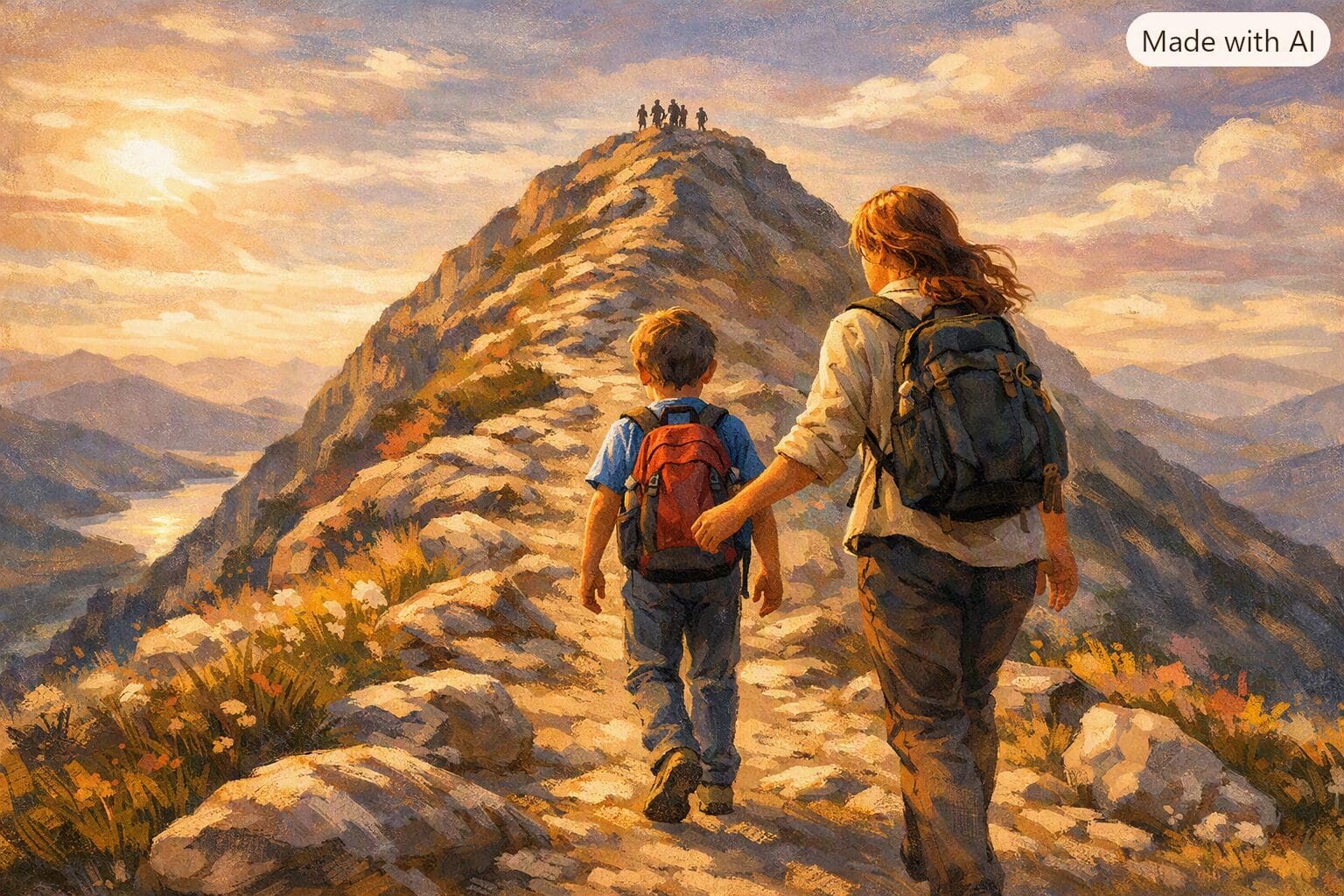
We talked about the image of climbing a mountain. Well, the boy is tied to the ground. He laughed, understood, calmed down a little. "How are we going to jump to the top of the mountain when we have to go up the path in slow, winding turns?" (I still remember how my father used to say: serpentines)
Now we are at the white table in my place by the garden. He is bent over, writing slowly, concentrated, an amazing writer.
"Am I slow?"
"What do you think?"
"Yes. The teacher tells me a lot, you need to be faster."
I look at his beautiful fingers: "I see that you don't give up, you make sure to work with a ruler, to be precise, to finish to the end. You do the titles in colors and decorate them. I enjoy working with you, I didn't just ask you if you would agree to let me show your notebook to the boy who follows you."
He lowers his sweet head, the cropped Mohican.
"Yes, okay."
I see the wound. To be enough, to be enough, to be enough, not to be so slow. The wound that opens up there in the educational institution every day.
"I'm hot." He says, turning on the fan, "I'm first, right? What, didn't you clean up this morning?"
"No, take ablution." I hand him the bundle of dried sage stems.
He takes the lighter, concentrates, lights it, slowly goes around each corner, "That's it." Turns it off.
This responsible little guy did his daily routine at nine in the morning.
Me: "Now the article?"
He already knows: "Take out the camera?" Laughs.
I made up a game for him. You take a picture of a word in "as if" with 4 fingers forming a square, hide it with your finger, and then write it.
"Take a piece of paper, I'll dictate to you, you'll dictate to me."
When I write, I make mistakes on purpose and he corrects me, "You're doing it on purpose, right?" He smiles his one dimpled smile. "Of course on purpose." That's how I am. And he: "Well, I don't care."
This method works amazingly. I tell them in advance: "I'm writing and there's a chance I'll make mistakes. If you find out, you get points based on the number of mistakes you identified. If you miss, I get the points."
They are madly focused on identifying the mistakes. Fun.
And for me, without laughter, there is no serious learning.
I take my favorite book off the shelf, the one that the Ministry of Education did not approve.
"I'm marking faintly with a pencil, okay?"
He marks eight lines for me to read to him, and four for himself.
I read mine and he, the one "in control of the situation," reads at a leisurely pace and with emphasis.
I make sure to read clearly and not mechanically. Diction makes me flourish because it is the embodiment of satisfaction, the "need to be enough" and the lack of meaning.
And when there is no meaning, there will be no true motivation to learn.
On the next page he already marks me 6 or even 4. On his own initiative, clearly on his own initiative.
My starting point is always: They, the children, are the ones who lead, guide, control the pace of their progress. Completely. I am the apprentice. All the time, all the time, all the time.
When they are in doubt, they consult me because they really want to hear my opinion. It's not that I made the decision and they have to accept and implement it.
The request for help and support comes from them.
I read, enjoying it: "Did we understand what we read?" (a question I ask a lot).
He nods. "Have I made progress?"
"What do you think?"
"Because, I don't hate reading anymore, but only with punctuation."
"Hey sweetie, remember where we are?"
He laughs, "On the way to the top of the mountain."
"exactly."
He already divided the last page into 5-5, without me saying anything. I wanted to kiss him.
We read in a booklet about an imaginary school on a cloud. When he finished reading, he drew and wrote about a school he had made up, one with a big, big garden, no desks, and a playground and a grocery store. At the end, he wrote in pencil in a strange handwriting: "And it doesn't have to be enough."
Wow, creepy and exciting!!
How fundamentally wrong today's approach to education is!!!
Then they don't understand why it's so hard to work in this system and why there's a shortage of teachers and educational staff. Because children go crazy in school because it's simply not adapted to our times! And then no one wants to work in education because it's too hard to deal with over 30 crazy children
How many times have we completed material for my son because he didn't have time to copy from the board and it was already erased 🤦♀️ How fun that there is a different approach to learning, it's a shame that the Ministry of Education doesn't understand this 😔