


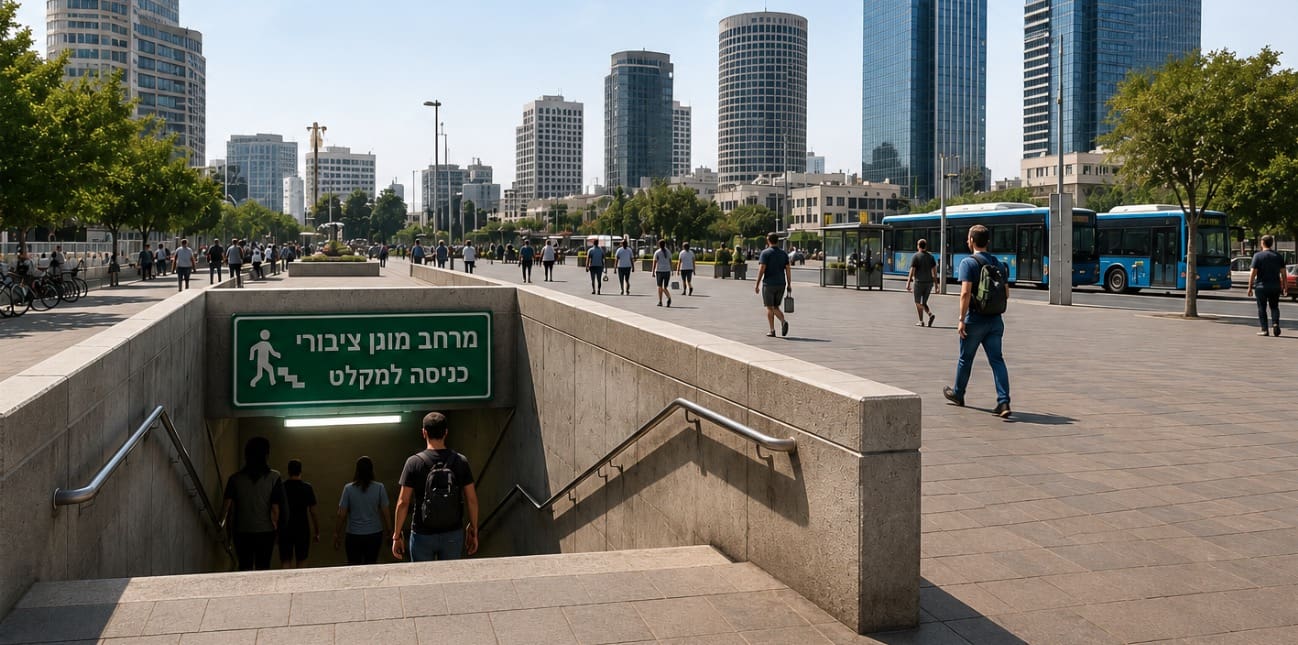
While the public debate in Israel focuses on personal and national security, one critical issue remains off the radar: *TAMA 40. The vast majority of the Israeli public is not at all aware of the existence of the plan or the strategic implications inherent in it. The raw data presents a worrying picture: Israel employs approximately 4.39 million workers, with professional estimates suggesting that approximately 25% to 30% of them reside in old buildings that are not equipped to provide standard protection (a shelter or standard shelter).
[*] TAMA 40 It is a national master plan that aims to regulate and promote the use of underground space in Israel, including for protection, infrastructure, transportation, and urban services. The plan is intended to enable more efficient planning of the land and underground, especially in dense areas.
The gap between home and public space
The current security concept assumes that the citizen is at home. However, in times of war, millions of citizens are on the roads, in employment centers or on public transportation. In the absence of a broad network of public shelters, a huge "protection hole" is created. For the sake of comparison, while in Finland there are shelters designated for 85% of the population at all times, and in Switzerland the quota reaches 100%, in Israel the rate of those protected in the public space does not come close to these numbers.
The questions that remain open: engineering security
Establishing a network of public substations requires in-depth engineering and economic analysis. Before making a decision, the following indicators must be examined:
- Full mapping: There are tens of thousands of underground parking lots in Israel. The question is, how many of them actually meet the Home Front Command's protection standards and are capable of serving as an approved shelter in a real-time situation?
- Shielding gaps: Based on CBS data and past State Comptroller reports, thousands of public protected spaces are currently missing in crowded areas. What is the exact number required to reduce exposure by 50% within 5 years?
- Economic feasibility: What is the cost of hardening an existing underground parking lot so that it can withstand the loads of the surface? Estimates speak of an additional cost of approximately 1,500 to 2,500 NIS per square meter in new construction - is the state willing to subsidize this, or is this an increase that will increase commercial real estate prices by approximately 5%-8%?
Strategic evolution instead of a response to failure
It is not correct to define the situation as a "failure," since the state did not predetermine the construction of public military bases as part of a strategic obligation, and therefore there was no conscious choice to abandon existing solutions. However, the very fact that this issue is absent from the national discourse is the central failure.
Changing thinking requires a shift from protection focused on the private home to holistic protection of the public space. TAMA 40 is not just a building plan; it An issue of national security, urban planning and economics. We must ask: Will we continue to gamble on the safety of millions of citizens outside their homes, or will we invest in infrastructure that will ensure the resilience of the home front in future wars?
In the long term, it is likely that apartment prices will rise, but not uniformly..
If TAMA 40 requires the establishment of public protected spaces, strengthening underground parking lots, and increasing the level of protection in employment, commercial, and residential centers, this may make certain areas more attractive to buyers and investors. Several mechanisms can increase the value of apartments:
A greater sense of security
After the wars of recent years, protection has become a significant real estate consideration. Just as a military base increases the value of an apartment, a residential environment where there are public protected spaces available may also be more sought after.
Improving urban infrastructure
If the plan includes the construction of secure parking lots, new public centers, and upgraded infrastructure, the real estate value of the entire area may increase.
Advantage for northern and southern cities
In cities like Kiryat Shmona, Haifa, and Ashkelon, where the rocket threat is perceived as more significant, additional public protection may reduce the "risk premium" that the market embodies in prices.
On the other hand, there is also an opposite factor: The cost of construction will increase. If developers are required to add significant protection to new projects, some of the cost will be passed on to home prices. In that case, home prices may rise not because the property is worth more, but because it is more expensive to build.
Therefore, the impact may differ depending on the type of property:
- New apartments in projects that will be built according to the new standard may become more expensive.
- Old apartments in areas where public protection facilities will be built may enjoy an increase in value.
- Old buildings without protection and without a public solution in sight may actually be relatively damaged.
From an economic perspective, if TAMA 40 becomes a reality, it is likely to create a phenomenon in the real estate market similar to the one created by the MMAD after the Gulf War: what was previously a nice addition becomes, over time, a basic requirement. When security becomes a sought-after feature, the market tends to price it in property prices.