


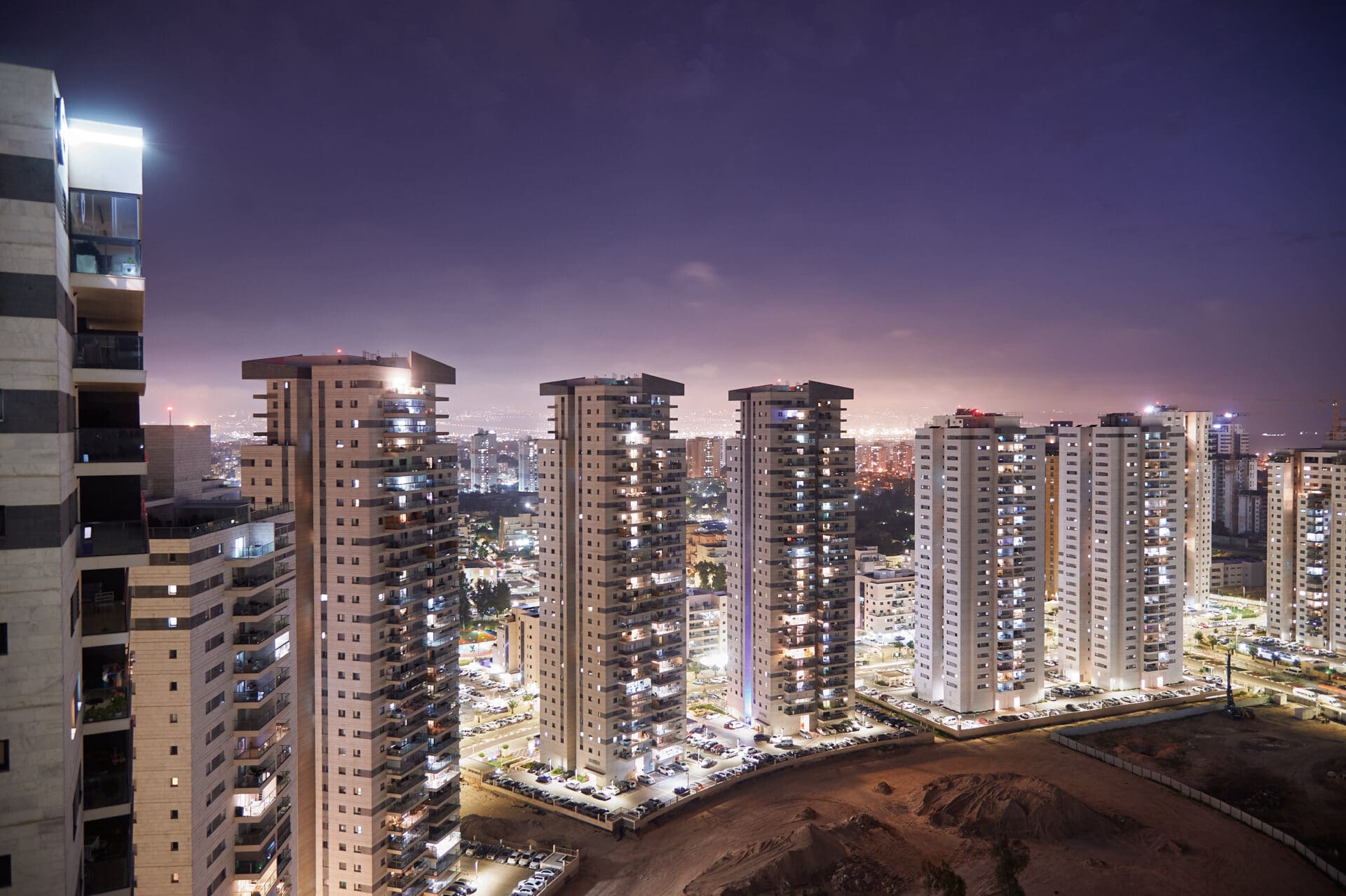
(haipo) – Three years have passed since the war that broke out on October 7, 2023, and in the Israeli real estate industry it is already difficult to distinguish between its direct effects and the new routine that was created in its wake. What began as an acute crisis on construction sites and in the transaction market has become a profound process that changed the way projects are managed, the behavior of buyers, and the perception of housing in Israel. Some of the solutions born from the state of emergency no longer look like a temporary response, but like the new rules of the market.
The shortage of workers changed the rules of management
The war caught the industry at a challenging time: high interest rates, a slowdown in transactions, and a declining market. Within days, this was joined by the call-up of reserve forces, the evacuation of settlements, the stopping of Palestinian workers from entering, and severe disruptions at construction sites. According to the Bank of Israel, at the beginning of the war, about 143 residents were evacuated by government decision, and another 100 left on their own initiative.
One of the most significant shocks was the shortage of manpower. Projects slowed down, schedules lengthened, and construction costs rose. Only in 2024 did recovery begin: foreign worker quotas were expanded, Israelis entered the industry, and construction sites resumed activity. The number of construction starts rose from 65.5 thousand in 2024 to about 80 thousand in 2025.
But returning to work did not return the industry to its old routine. Sagi Lancher, CEO of Yanov, He explains: "Since October 7, real estate project management in Israel has changed fundamentally. The shortage of manpower, disruptions in supply, and rising input prices have forced us to rebuild work methods and introduce much more flexibility into planning and execution." He says that even after a certain recovery, productivity has not returned to previous levels and schedules remain challenging.
Financing operations have become a key tool — and also a risk
Along with the difficulties at construction sites, developers have had to deal with more cautious buyers. 20/80, 10/90 and similar financing schemes have become common, allowing buyers to pay a small portion at the time of signing and the majority of the amount near delivery.
These routes encouraged transactions in a period of high interest rates and uncertainty, but they also created risk: buyers committed to an apartment without knowing whether they would be able to complete the payment upon delivery. The Bank of Israel warned, and in March 2025 imposed restrictions on some of the transactions.
At the same time, the gap between the pace of construction and the pace of sales widened. At the end of 2025, in approximately 44% of banking exposure to residential projects, engineering execution progressed faster than sales, leading to an increase in the inventory of unsold new apartments.
The MMAD has become a central consideration: Protection changes the perception of housing
One of the most notable changes in the last three years is the new emphasis given to protection. A study by the Bank of Israel found that in the rental market, the premium for apartments with a security deposit increased significantly, especially after the missile attack from Iran in May 2024. In the sales market, the impact was more moderate, but noticeable.

Gali Apple Castel, which deals with real estate marketing, Describes a sharp change in buyer behavior: "Immediately after an escalation, accessible protection becomes a threshold condition. Customers are willing to compromise on size, height, proximity to the center, and even budget. In periods of calm, price gaps also restore some of the demand for apartments without a security guard."
According to her, the protection did not eliminate other considerations, but set a new level of stability in the concept of residence in Israel.
Urban renewal as a component of national resilience
The new emphasis on protection also affects the way we look at older buildings and urban renewal projects. If in the past the emphasis was on improving the property and adding apartments, today protection is a central part of the discussion.

Rafi Kashkash, VP of Development at Cyrus Capital, Explains: "The three years of war have proven that urban renewal is not just a real estate matter, but an essential part of national resilience. Battalions save lives, but also allow the home front to continue to function during prolonged fighting."
The connection between rehabilitation, protection, and renewal was also expressed in legislation: In March 2026, the War Damage Rehabilitation through Urban Renewal Law was approved, designed to accelerate projects in damaged areas.
The gap between tools and execution: The planning system is still slow
Attorney Ido Shmueli Points to a gap between the legislation and the ability to implement it quickly. According to him, even after the law was approved, complexes in Bat Yam have not yet gone through an orderly process for clearing rubble and starting construction.
"The system is not prepared to respond quickly enough in emergency situations," he says. "A single coordinating body is needed that will provide a unified and binding address for residents who have lost their homes."
Partial recovery — and a market that looks different
In May-June 2026, there was a moderate recovery in the number of transactions, the workforce in the industry recovered, and construction volumes remained high. On the other hand, the stock of unsold apartments is still large, and the Bank of Israel reported a 1.5% annual decline in apartment prices in September.
The industry is no longer in the state of emergency of the first months after the war, but it has not returned to its starting point either. Project management has changed, financing operations have become a central tool, and protection has taken on new weight in buyers' considerations and in urban planning.
Three years later, some of the solutions born out of the crisis are no longer seen as emergency measures, but rather as part of the new routine of the Israeli real estate market.