


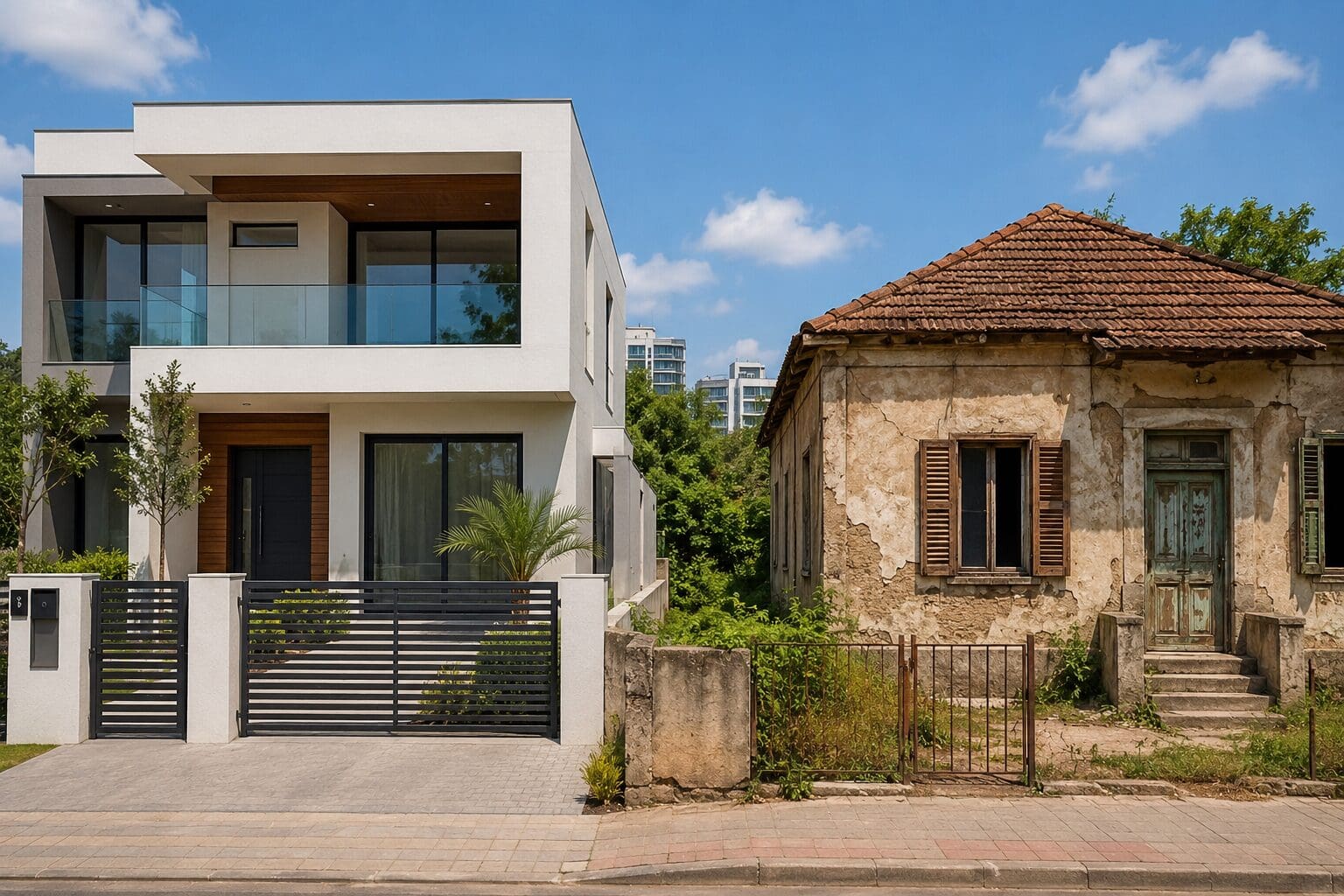
At first glance, the market seems clear: a new apartment from a contractor is the more expensive choice, and an old apartment is cheaper. But in practice, the opposite and surprising phenomenon occurs: sometimes a new apartment can cost less than a well-renovated old apartment, while at the same time becoming more expensive over the years.
The first reason is the old apartments that have been upgraded. An old apartment that has been renovated to a high standard is no longer “old” in the eyes of the market. A new kitchen, upgraded bathrooms, quality flooring, electrical and air conditioning systems, and sometimes even custom design and carpentry, all of these can amount to an investment of 300 to 600 thousand shekels or even more. Therefore, the seller is not pricing just the walls, but the entire investment that made the apartment ready for occupancy, and the price increases accordingly.
At the same time, new apartments from the contractor are sometimes offered at promotional prices, marketing discounts, or convenient financing models such as 80/20. That is: 20% payment at the beginning and 80% upon receiving the key at the end. This creates a situation in which a new apartment can be cheaper than a renovated old apartment, at least in the initial purchase phase.
But here's where the full picture comes in: ongoing costs. A new apartment almost always comes with higher fixed expenses:
- To a higher house
- External management company
- Maintenance of elevators and underground parking lots
- Security systems, electric gates, gardening and cleaning
- Building Repair Fund
In older apartments, on the other hand, the house committee is usually lower and sometimes there is no management company at all. Therefore, over time, the monthly expense can be significantly lower.
Here comes another paradox: an “expensive” apartment can actually be cheaper over time. A new apartment is more expensive to buy, but it sometimes has the advantage of modern construction, fewer malfunctions, fewer renovations, and new infrastructure that lasts for years. On the other hand, a cheaper apartment may entail plumbing, electrical, moisture, and repeated renovations over the years that add up to tens and hundreds of thousands of shekels.
That is, there is confusion between two completely different types of costs:
One-time purchase cost versus long-term living cost.
This also leads to a common mistake made by apartment buyers: focusing solely on the purchase price. In practice, the real difference between apartments is not just how much you paid on the day you signed the contract, but how much you will pay each month, and over many years of living there.
The main recommendations before buying an apartment
To truly understand what is better, it is important to not only look at the present moment but also Long term of 10 to 20 years:
- Don't just compare purchase price – The price of the apartment is just a starting point. It does not reflect the true cost over time.
- Calculate for a long term of 10-20 years:
- The real calculation should include:
- Mortgage and interest over the years
- House committee and management company are combined
- Maintenance and repairs
- Future renovations
- Changes in value and comfort over time
3. Check fixed monthly costs
- house committee
- Management company
- Building maintenance
- Insurance and repair fund
In a new apartment, these can be significant expenses that accumulate to large amounts over the years.
4. Consider future costs and renovations
In an old apartment there is a higher chance of:
- Kitchen and bathroom renovation
- Plumbing and electrical repairs
- Moisture and structural problems
These are costs that accumulate over time.
5. Also calculate “cost of living”
- Additional vehicle or transportation
- Time on the road
- Everyday comfort
- Environmental quality of life
Sometimes this is the largest expense item, even if you don't see it immediately.
The bottom line
There really is no such thing as an absolutely “cheap” or “expensive” apartment.
There are apartments that are cheap to buy and apartments that are cheap over time.
And the biggest mistake is to think that the price of the apartment tells the whole story, without considering what happens over the course of 10 to 20 years of living in it..
Also at Stephen Wise in Haifa, residents will fight and cancel the eviction and construction raid
The proliferation of defective new construction has made it a risky gamble. Even in "luxury" buildings like TAMA 38, horror stories are heard about a building that looks beautiful on the outside - but is full of construction defects on the inside.
The defects are created in new construction due to attempts at rapid construction, poor-quality concrete, lack of supervision over the amount of iron and concrete, intentional damage during construction (such as intentional blockage of the pipes, dampness, employing unskilled professionals).
Another common type of defects are planning errors. The contractor was supposed to build a certain height, but in each apartment he built 10 cm less (i.e. he saved concrete on his own initiative), errors in the location of a railing that ends at the window, errors in cladding that is glued incorrectly or in saving on glue and flying off in the winter, roofs that are not sealed and leak.
All of this awaits the happy buyer who paid a huge fortune for a new apartment and it begins to wear out, sometimes immediately, and sometimes the more substantial defects, such as cracks and falling tiles, are discovered only after a few years when the warranty period ends and the tenants are forced to sue or spend tens and sometimes even hundreds of thousands of shekels to repair the defects.
However:
Second-hand apartments in a building that is cared for and maintained greatly reduce the risk of material defects. It is true that an old building will also suffer from malfunctions, dampness, old roof sealing, crumbling plaster and cladding. But if a building has lasted for decades and appears to be in good condition and has no material defects, then there is certainty here. And if it has also undergone a comprehensive exterior and interior renovation of the apartments and the facade, there is definitely an advantage to second-hand.
Another advantage in the last war is a shelter. In new apartments there is no shelter, there is only a fire escape, which has become a very significant disadvantage. Today, a few months later, the lessons have been learned and most buyers want an underground shelter in the building and are not satisfied with just a fire escape.
An important thing that was not mentioned is that old apartments usually have few apartments and tenants in small buildings. This is a unique product that was built in the 50s and 60s when the population was small, and today a modern building with 8 tenants will have apartments that are very expensive and impossible to buy for the majority of the population in terms of frequency and price.
And most tenants today sign contracts with developers for building permits and clearances because "it doesn't cost me anything and the contractor pays me rent and I'll have a dimension and the price of the apartment will go up and I don't pay anything," etc., etc. But they don't take into account the additional tenants that the developer incorporates into the price (which is sometimes in multiples of 5 or even 6 apartments for each housing unit) that they receive rent and dimension and all the extras and the congestion and traffic jams. And we haven't even talked about the mix of uses and a mixed population that suddenly enters the high-rise buildings, and maybe that's not always suitable for everyone.
Therefore, in my opinion, wise tenants who have the ability or possibility to invest and improve a building at their own expense with a concrete shell, dimensions, an elevator, and disabled access, in the long term, although again this is not an exact science and the other considerations that have been raised must be considered, maintain an apartment value that will continue to rise because small buildings will be a rare commodity in future generations. They also maintain a pleasant quality of life and not in an environment of thousands of families and cars, sometimes with the view of the balcony of the neighbors in the next high-rise.
But how can you estimate the frequency of renovations that may occur over the years in an old apartment? Are there any statistics on this?
Then estimate an average renovation price...
In short, it is difficult to calculate…