


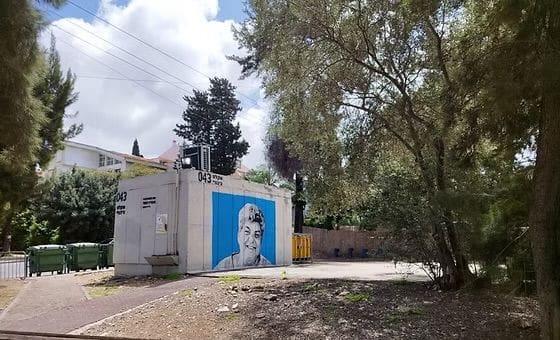
At the age of 16, I was active in the Haifa Municipal Youth Council. Our center of activity was the public shelter on Moriah Street. We would hold regular meetings there once a week, and come there whenever we needed to meet, organize events, or simply be together. Sometimes we would spend long hours at the shelter. This was in the mid-1990s, a few years after the Gulf War.
This week, as I began researching the issue of civil defense in Haifa in preparation for a new tour I'm leading as part of Jane's Walks 2026, this memory suddenly came back to me.
And not just him.
I remembered the branches of various youth movements, the city meetings, and the entire lives that took place inside the public shelters at the time. In retrospect, it became clear to me that the shelters were not just emergency infrastructure. They were part of the everyday urban space, a place for meeting and activity, part of the city's social fabric.
Today it is hard to imagine that.
Since the 1990s, after the Gulf War, Israel has gradually moved from a model of collective protection to a model of private protection. Starting in 1992, every new apartment is required to include a shelter. In recent decades, the state has relied almost entirely on shelters, leaving many to huddle in shelters — if at all.
At the same time, the public shelter gradually lost its status as an urban-community asset, both in routine and emergency situations.
The condition of the city's public shelters deteriorated as public and community activities ceased to take place in them. Unwanted elements entered them, and to prevent vandalism and crime, the municipality was forced to lock many of them over the years.
Over the years, the shelters became "hidden spaces." Until the war, most residents did not even consider them part of the urban public space that belonged to them. At the time of the truth, intensive maintenance and renovation activities were required, both by the municipality and by civic organizations, to provide minimal conditions for residents to stay there.
These facts raise broader questions about our attitude to and responsibility for public space. If the shelters had continued to function routinely as youth centers, hubs of community activity, and meeting places, they might have been kept well-maintained and in the public consciousness over time.
One city, three levels of protection
“Protected Space: The Public Space Between Routine and Emergency” — that’s what I called the tour I’m leading this year in Haifa.
The idea was born from long walks through the city streets during the last war, “Harry’s Roar”, Israel 2026. The more I walked in the city, the more the issues began to become clearer to me: What happens to those who are outside their homes during an alarm, on the street, in the garden, on their way to work or with children at the playground? Are there protected spaces for passersby, and how long does it really take to get to them?
In a time of emergency, it turns out that the city's protection positions are very clear:
Some people are protected inside the apartment — with an emergency medical service available and immediately available.
Some people are dependent on a shared shelter in a building or on a floor.
And there are those who rely on public shelter — or on a random space that happens to be on the road.
And these gaps are not theoretical. They are entirely geographical.
According to data based on the Building and Apartment Registry, approximately 77%–80% of apartments in Haifa do not include a separate utility room.
The vast majority of the urban fabric in Haifa was built before 1991, and most apartments in older neighborhoods do not have a building permit.
In contrast, newer neighborhoods, such as Ramat Hanasi and Neot Peres, have already been built around the concept of private protection. There, almost every apartment has a private security unit, and reliance on public space in times of emergency is significantly reduced.
The gap between those who have and those who have not
The MMAD is an effective and necessary solution. But the more people rely on it, the wider the gap between those who have it and those who have not. This creates a situation in which Haifa is not only a city with a complex topography, but also a city with different layers of security.
As protection becomes more private, dealing with the emergency also becomes more private and isolated.
What happens to the city when people are afraid to leave the house?
Another layer that emerged from the strolls and conversations is how safe people generally feel about being in public spaces during a time of war.
Young children, teenagers, and many adults are limiting their movement or staying home for entire days, wanting to stay close to a protected space. The streets, playgrounds, and parks are no longer perceived as safe enough places.
Local and urban commercial areas emptied out almost completely at certain times. People avoided going there. Over time, lists began to form and spread on social media: where there were safe cafes, which playgrounds were near a shelter, and which places were considered “safer” to stay.
The possibility of maintaining urban life
Amidst all of this, a broader question arises - not just of personal security, but of the very possibility of maintaining urban life.
What happens to our mental and communal resilience in times of war, when we are denied the basic opportunity to go outside? To walk down the street, take the children to kindergarten, meet people, see some greenery, or simply perform daily activities?
During times of war, a social crisis develops in which people seek out themselves, society, and a civic space where they can share thoughts and concerns, and hold a joint and critical discussion about the methods of action and the conduct of the establishment. There is great civic value in shared protected spaces during times of emergency.
Recent research in the field of community resilience shows that social infrastructure such as parks, community centers, and meeting spaces are an integral part of communities' ability to cope with crises. Yet, many public spaces in Israel are still not planned as part of the urban protection system.
The public shelter as an urban space
There are currently about 174 public shelters in Haifa. Some were built as early as the 50s and 60s, for an entirely different urban reality and threats. Some are newer and are integrated into schools and public institutions; others are hidden under buildings or on neighborhood streets.
But the interesting question is not just how many shelters there are, but what role do they have in the city today?
Are they just an emergency solution?
Or can they be part of an active urban life even in everyday life?
Defense infrastructure doesn't have to be just an emergency solution. It can also be infrastructure for public life in the city, if it is designed that way.
More diverse protection solutions, tailored to different residential areas, will allow people to operate in the city even during an emergency. Not only to stay at home, but to feel safe at the office, in the park, or while walking in the neighborhood.
Not only to know what the protection options are in the area, but to feel that the entire city is planned so that it is possible to operate in it both routinely and in emergencies. To continue to maintain an urban routine.
The tour does not seek to provide answers.
He wants to open a discussion.
A walking tour of the streets of Neve Sha'anan, Ziv Center, and Ramot Remez - we will examine what a city looks like during an alarm, who remains outside the protection system, and how urban planning actually affects the sense of security, traffic, and life itself.
Because perhaps the significant urban question is not just how to protect ourselves, but what kind of routine we want to continue to exist even in times of emergency.
What do you want from the public?
400 senior employees at the municipality are robbing 200 million shekels a year.
Thousands of millionaire retirees are robbing 350 million shekels annually.
Every year, the Haifa Municipality transfers more and more development, construction, and maintenance budgets to finance salary expenses that only increase because of the municipal employees' committee that is squeezing out more and more benefits and standard upgrades, also at the expense of other municipal employees in corporations and contractor workers, whom the Histadrut and the municipality are depriving.
And the municipality for thousands of missiles in Lebanon, the second with the same mayor, abandons the protection for 20 years. No public shelters are being built. The crowded streets will not allow for timely evacuation, and ambulances are stuck for a long time because of traffic jams in the densely populated neighborhoods.
Invite the mayor and municipal officials for a tour.
Of course they won't come, and of course they know the situation and they don't care.
Excellent article and important questions. Thank you Orly! And thank you for the meaningful and relevant Jane Walk that you will lead this year as part of the Haifa Jane Walks!