


(haipo) – Podcast with Moran Tapiro in the studio: A plan to build breakwaters on the southern section of Kiryat Haim Beach in Haifa (a beach nicknamed "Tail Beach") is causing a stir among the surfing community and residents of the area, who fear harming a unique natural resource. On 3/18/26, a critical discussion was held in the District Planning and Building Committee, Haifa District, regarding the plan, which 304-0860023At the heart of the controversy is the southern beach of Kiryat Haim, which boasts rare surfing conditions and international recognition. Surfers say the current planning ignores the needs of users and the sporting, cultural and community value of the place.
Watch the podcast where I hosted Moran Tapiro in the live studio here
A rare beach of international value
The southern shore of Kiryat Haim, opposite the Home Center complex, is considered one of the most unique surfing sites in Israel and even in the world. In winter storm conditions, rare waves are created there, attracting surfers from all over the country and even abroad. This is a "perfect" wave in professional terms, one that surfers are willing to fly half a world away for. The proximity of the waves to the judging stations and the audience allows for high-level competitions, which led to international recognition and the site being chosen to host the Windsurfing World Cup (PWA World Tour) in 2027.

Design that does not consider the needs of surfers
Despite the importance of the beach, surfers and residents claim that their needs were not taken into account in the planning process. According to them, the planners were not at all aware that this was an active surfing beach with sporting significance, and were even surprised to hear this. The surfers' voices are hardly heard in the process, and this raises questions about the degree of public participation and the actual understanding of the area. The central demand is for a more holistic view, which considers not only the infrastructure but also the culture and existing uses.

Breakwaters and a plan that could damage the coast
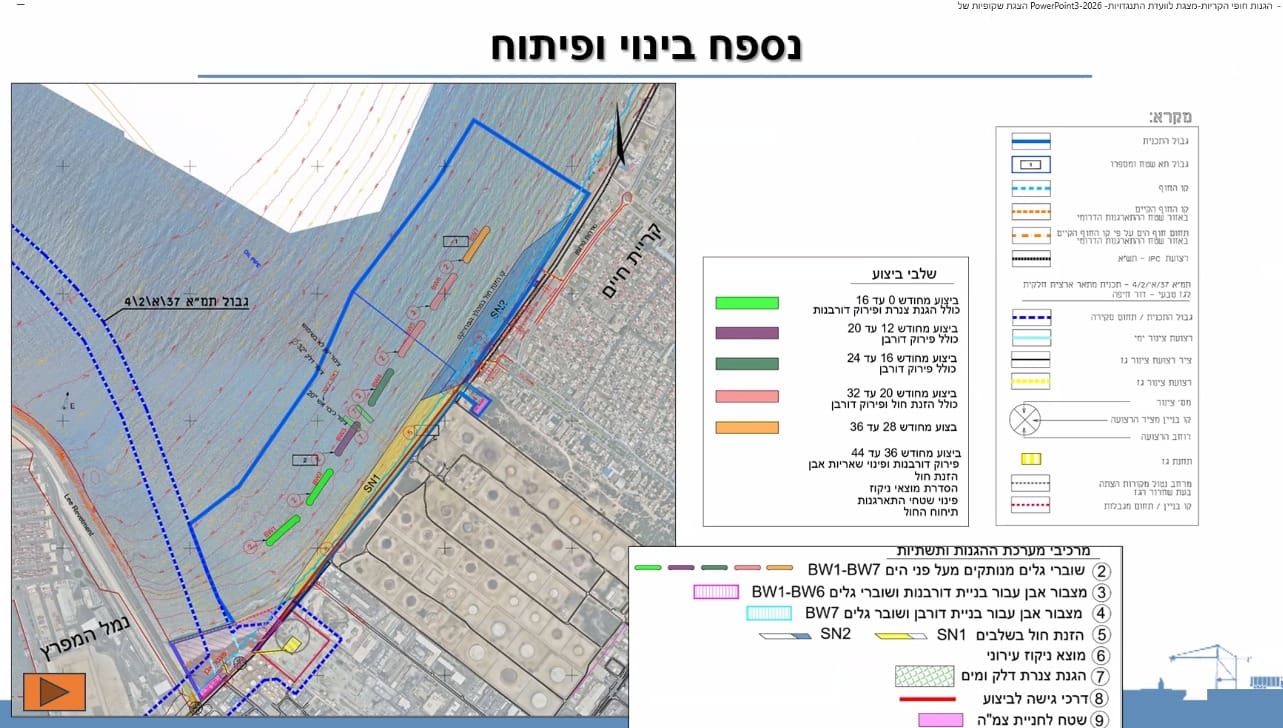
The main issue is the construction of breakwaters, mainly Two marked in glowing green In the southern section, the construction of which could "eliminate" surfing on the beach. While the five northern breakwaters (on the right side of the diagram) are not seen as problematic, the southern ones are the ones that are critical to the surfing beach, since they are planned exactly where the activity takes place on stormy days, including the holding of competitions. In addition, there is a plan to lay Stone piles on the sand (marked in red on the left), although surfers say there is no erosion problem in the area. These measures, along with blocking the sand strip during the construction period, are expected to significantly harm beach use.


Planning alternatives that were not examined in depth
According to the surfers, various planning alternatives were presented, including the use of submerged breakwaters that could preserve the sand shelf without damaging the waves, but these were rejected by the planners. The proposal of the surfers and environmental organizations (Zlul and Adam Teva Ve Din) is to begin the work from the north and erect 5 breakwaters in the area most sensitive to sand packing and leave the southern section unchanged at this stage of the plan, meaning not to approve it at all at this stage.
The proposal is to conduct a separate planning, with a subsequent re-examination, or alternatively, to propose a sunken solution that will not harm the sport of surfing on this beach. This is, they say, a small section of a broad plan, and therefore it is necessary to make adjustments to the plan in a way that takes into account the needs of surfing and without harming the entire project.
A call for cooperation and a change of attitude among planners, while being open to cooperation with the user community.
Moran Tapiro: The main demand emerging from the field is for cooperation between planners, surfers and residents. There is a call to sit together, to understand in depth the surfing culture and the importance of the coast, and to formulate a solution that does not require dramatic change but rather specific adjustments. Along with developing ports and infrastructure, the activists remind us that cities live thanks to the people in them – sports, the community and nature. The hope is for a change in the planning approach, one that will combine development with conservation and ensure the future of the unique coast.


I suggest that all opponents meet with the senior and experienced marine engineer, Dov Rosen, and even hire his services, because professional work is required here to find more suitable alternatives. He also raised concerns about the solution of the breakwaters in front of the Kiryat Haim beach.
In the past, before any new port was built and its construction was done at the expense of Kiryat Haim Beach. I enjoyed spending a lot of time at Kiryat Haim Beach, opposite Kiryat Yam Beach. It looks like a trash can all winter long, full of garbage and uncultivated land. How sad!