


(haipo) – Construction begins: New data from the Central Bureau of Statistics presents a complex picture of the real estate market in Haifa in 2025 and early 2026, a picture that becomes even more dramatic against the backdrop of Operation Roaring Hari and the fear of escalation with Iran. While construction starts in the city are declining, sales of new apartments are weakening and sales of second-hand apartments are actually increasing, the current war is adding a layer of uncertainty that is freezing transactions, delaying construction initiatives and deepening the economic damage to the industry. The data indicate a volatile market, in which the public is hesitant to make major decisions, and developers are dealing with increasing costs and significant delays.
Haifa ranks 13th in construction starts: a 10% decrease compared to the previous year
According to CBS data, Haifa ranks 13th in the country in terms of construction starts in 2025, with only 1,607 new apartments that began construction during the year. This is a decrease of about 10% compared to 2024, when 1,783 construction starts were recorded. The gap between Haifa and the largest cities in Israel is significant: Tel Aviv leads the table with 7,072 new housing units, followed by Jerusalem with 6,868 units.
The most surprising figure is the surge in relatively small cities like Ofakim, Kiryat Gat, and Netivot, which show a higher construction rate than Haifa. This trend reflects the continued expansion of the southern periphery, due in part to affordable housing projects, land availability, and lower construction costs.
Sales of new apartments: a sharp drop of 37% in Haifa
In parallel with the decline in construction starts, Haifa recorded a significant decline in new apartment sales. Between November 2025 and January 2026, only 270 new apartments were sold in the city, a 37% decrease compared to the period August–October 2025, when 430 apartments were sold.
The decline reflects a nationwide slowdown, but in Haifa it is particularly noticeable due to a combination of high land prices, complex projects and buyers waiting for more stable market conditions.
Second-hand apartment sales: Haifa ranks second in the country
On the other hand, the second-hand market in Haifa presents the opposite picture. In the period November 2025 – January 2026, 960 second-hand apartments were sold in the city, an increase of 17.5% compared to only 817 apartments sold in August–October 2025. This places Haifa in second place in the country in sales of second-hand apartments, after Jerusalem.
The increase is explained, among other things, by the fact that second-hand apartments are immediately available, do not depend on construction progress, and sometimes allow greater flexibility in price and negotiations.
The impact of the war: a sharp decline in transactions as early as February
Operation Roaring Hari, which began on 02/28/2026, had an impact on the market as early as February, even before the operation expanded. Initial transaction data indicates a significant decline in activity, stemming from security tensions and the expectation of escalation with Iran.
When the economy enters a state of instability, many buyers and sellers prefer to wait. Buying a home is an irreversible decision, and when there is concern about continued fighting, people prefer to postpone major decisions.
Guestfreund Survey: 72.5% of Real Estate Professionals Report Postponing Purchases

Council member, appraiser and chairman of Yaffe Nof Company Dr. Assaf Gastfreund conducted a survey among real estate professionals in Haifa, aiming to examine the impact of Operation Roar of the Eagle on market activity. 72.5% of respondents indicated that the security situation is causing households to postpone purchase decisions.
The figure is not surprising: in the first week of the operation, many residents in Haifa and the surrounding area avoided leaving their homes in order to stay close to a protected space. At the same time, apartment owners who do not live in them were in no hurry to get to the property to show it to potential buyers.
Income impact: Many families in Haifa are dealing with a decrease in income
Aside from the security fear, there are many residents in Haifa whose income has been affected by the war. Self-employed people in affected industries, workers who have gone on unpaid leave, or parents who have been forced to stay home with children, all of these are postponing major financial decisions. When income is affected, purchasing an apartment falls to the bottom of the priority list. Families are focusing on financial survival, not real estate investments.
“A shock of economic uncertainty”
Gastfreund explains that one of the key economic phenomena during wartime is not physical destruction, but uncertainty. According to him, the real estate market enters a state of waiting: transactions are postponed, developers stop construction starts, and buyers are afraid to make commitments.
In Israel, an average of about 7,000 real estate transactions are carried out per month. A 20%–30% decrease in the volume of transactions, as is currently happening, means 3–4 billion shekels of transactions that are not carried out. Some of them will be carried out in the future, but some are canceled altogether. The meaning: less income for developers, less taxes for the state, less work for subcontractors and less movement in the entire economy.
Damage to the entire industry: brokers, appraisers, mortgage advisors and developers
Thousands of people work in the real estate industry in and around Haifa: brokers, appraisers, mortgage advisors, investor lenders, and developers. When the number of transactions decreases, many of them are directly affected.
Brokers, for example, only make money when a deal closes. A sharp drop in deal volume means a dramatic drop in revenue. If it's a short-term operation like the one with Kalavi in June 2025, the damage is limited. But Operation Harry's Roar has been going on for three weeks and there is no end in sight.
Magdalene data: dramatic drop in March
A check on the Madelan website shows that in February 2026, approximately 120 new and second-hand apartments were sold in Haifa. In contrast, only 12 apartments were sold by March 11. It is possible that there are transactions that have not yet been reported, but the gap is huge and indicates an almost complete standstill. A slowdown was also recorded in February, even before the outbreak of the operation, due to the expectation of war with Iran.
Possible price increase: high construction costs and project delays
The war with Iran is also expected to affect the prices of new apartments. Contractors are reporting labor shortages, delays in the supply of raw materials, increased transportation and insurance prices, and additional protection costs. All of these are driving up the cost of construction.
Since developers are obligated to repay bank credit, they cannot sell apartments at a price that will cause them to lose money. Therefore, the additional costs are likely to be passed on to buyers. This means that apartment prices may rise precisely at a time when the public expects stability.
Second-hand market: Slowdown in demand but not necessarily a drop in prices
The second-hand apartment market in Haifa is also affected by the war. Many potential buyers are sitting on the fence, but many sellers are not willing to lower the price. The result is a decrease in transactions, but not necessarily a decrease in prices.
At the same time, delays in new construction could reduce the supply of apartments in the coming years. This situation could increase demand for second-hand apartments in the future, leading to an increase in prices once the market stabilizes.
If Hezbollah does not prevail in Lebanon, all prices in Haifa and the north will reflect a strong and acute loss of confidence, because this time it is truly an understanding that the situation will only be many times worse if we reach another round.
Even Diaspora Jews who bought luxury apartments understand that this is a leper country that is in a war that will probably never end. The entire market in Jerusalem is based on foreigners, everything has collapsed. Foreigners who planned to move to Israel because of anti-Semitism in the world are turning back and looking for another place. A couple fleeing New York gave up on Haifa and bought in Florida. Who wants to spend 20 years of retirement in a shelter with missiles flying?
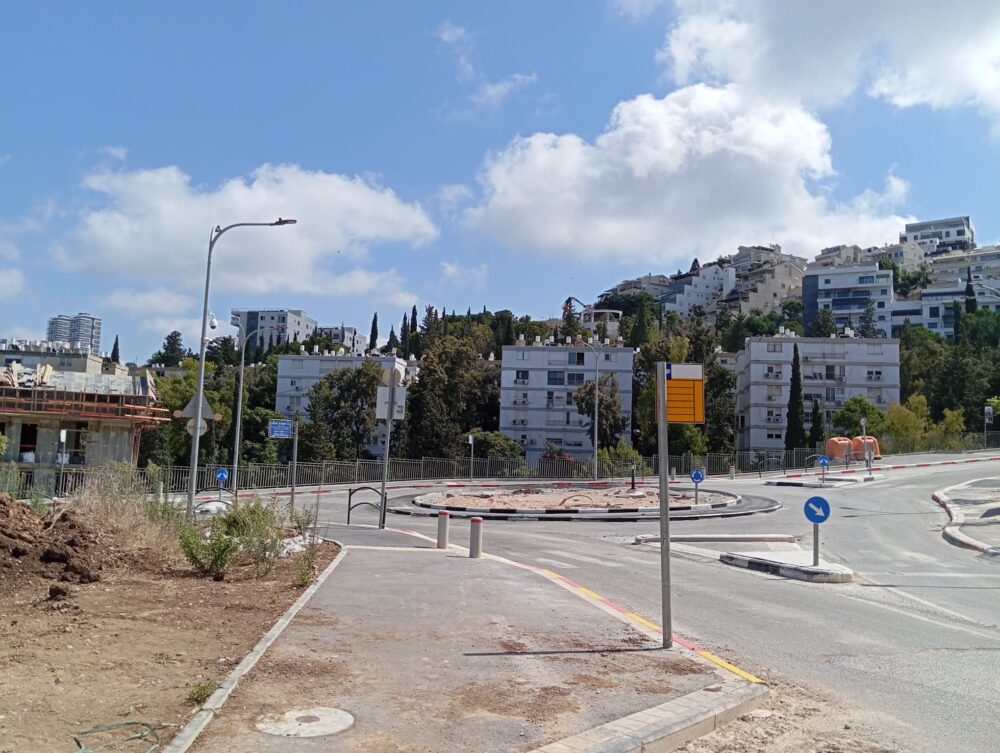
The building in the picture has been waiting for construction clearance for more than a decade and it's stuck at the municipality, so there's no need to say it's because of the war because it's really, really unrelated.
The stagnation in the real estate industry in Haifa did not begin with the war — that is simply a convenient argument that allows one to evade the truth. The sharp decline in sales of new apartments is the result of a continuous, multi-year failure, not a one-time event.
Has anyone bothered to seriously examine the negative migration from the city? Haifa is losing residents at an alarming rate – and not by chance. This is a city that is gradually emptying of its residents, partly due to a leadership that has lost the public's trust and is failing to create an attractive urban environment.
The issue of construction quality is also not being given real attention. Many projects within the framework of TAMA 38 suffer from serious planning and execution construction deficiencies. In practice, potential buyers are deterred – and rightly so – from a market where product quality has become a systemic problem.
And what about the economic fundamentals? Has a real examination of supply versus demand been conducted? Has the possibility that the real estate market in Haifa has reached saturation been examined? The answers to these questions are uncomfortable – and therefore simply not asked.
A significant portion of the apartments were purchased for investment, under the mistaken belief that real estate prices always rise. In many ways, the local market is reminiscent – in miniature – of the "subprime" crisis in the US in 2008. Even then, the warning signs were ignored – until the entire system collapsed. There is no reason to assume that Haifa is immune to this scenario.
Similar, that is – insolvency and bankruptcy – at least at the level of the entrepreneurs and the companies operating in it.
And alongside all this – it is impossible to ignore the conduct of the local planning and building committee. An unprecedented flood of housing units was approved within the framework of TAMA 38, most of them in violation of the provisions of the law, the TAMA provisions, and the building regulations. The result: a flooded market, poor planning, and a direct violation of the public interest.
When building permits are issued on such a large scale, without careful
About the law, about the authority to issue and sign building permits, about the quality of execution, and in the absence of any professional urban planning program – it is no wonder that the market is losing stability and trust. This is not a specific failure – it is a wrong policy.
Anyone who wants to understand the real estate situation in Haifa needs to stop looking for convenient excuses and start dealing with reality: a continuous planning, managerial, and economic failure that has led the market to a dead end.
Every word of a loyal reader is etched in stone. The decline in apartment sales began long before the war and has other reasons.
Flooding with housing units, without being accompanied by an appropriate addition of public spaces – public buildings, green spaces, commerce and services – and without expanding infrastructure, widening streets and connecting neighborhoods confined to more than one exit, is not planning but cumulative burden. Such a policy reinforces and perpetuates the image that has stuck to Haifa as a "sleeping city."
We must ask honestly: What young family would choose to settle in a city that lacks diverse employment centers, cultural and recreational life, and a lively and vibrant urban space?
Haifa was once called "Sleeping Beauty." Today, unfortunately, all that remains is the title "Sleeping." The space is becoming barren of the greenery that characterized it, the lines of the slopes are blurred under high-rise and aggressive construction, and massive development walls that do not fit into the environment are harming the city's unique scenic qualities.
Development while ignoring the city's unique identity only weakens it. An example of this is handing over the planning of Haifa's building plan (before submission) to architects from the lowlands who are accustomed to planning in flat cities without natural data like Haifa has.
The loyal reader's response examines the ongoing failures in an uncompromising and in-depth manner.
In the real estate industry in Haifa.
There are so many problems in the real estate sector, if there are potential buyers, they are aware of all the problems.
these.
Construction is unrestrained, sometimes at a very low level, without apparent proper supervision by the authorities.
The issuing of permits.
Ruthie Blumenfeld reminded us all that in the past
Haifa was called "Sleeping Beauty", and today
Only the "sleeping" Haifa remains.
Haifa, which was once the beautiful and unique city
Most of all, she changed her face – for the worse.
As usual, as in most real estate sections, they are looking for the coin under the lamppost, meaning they only examine the real estate market and the stakeholders around it and do not even raise their heads to examine the situation from a broader perspective. I will give just one example that only smart mayors understood and knew how to leverage: without jobs, there will be no positive migration to the city and there will be no increase in demand for apartments. Add to that excellent education, places to relax and suddenly everything will be clear why this is the picture in the real estate market...food for thought!