


(haipo) In an era of giant screens, bright colors, and constant traffic, the driver is no longer alone on the road. Alongside him, ever-growing advertising signs compete for his attention. Is the price of our safety?
Watch the video and imagine for a moment that you are the driver trying to read the signs:
When the eye deviates, the risk soars
Billboards are designed to attract attention. This is the heart of the advertising industry's economic model: maximum exposure, penetration into consciousness, and influence on behavior. But on the road, that precious attention is primarily required for the task of driving.
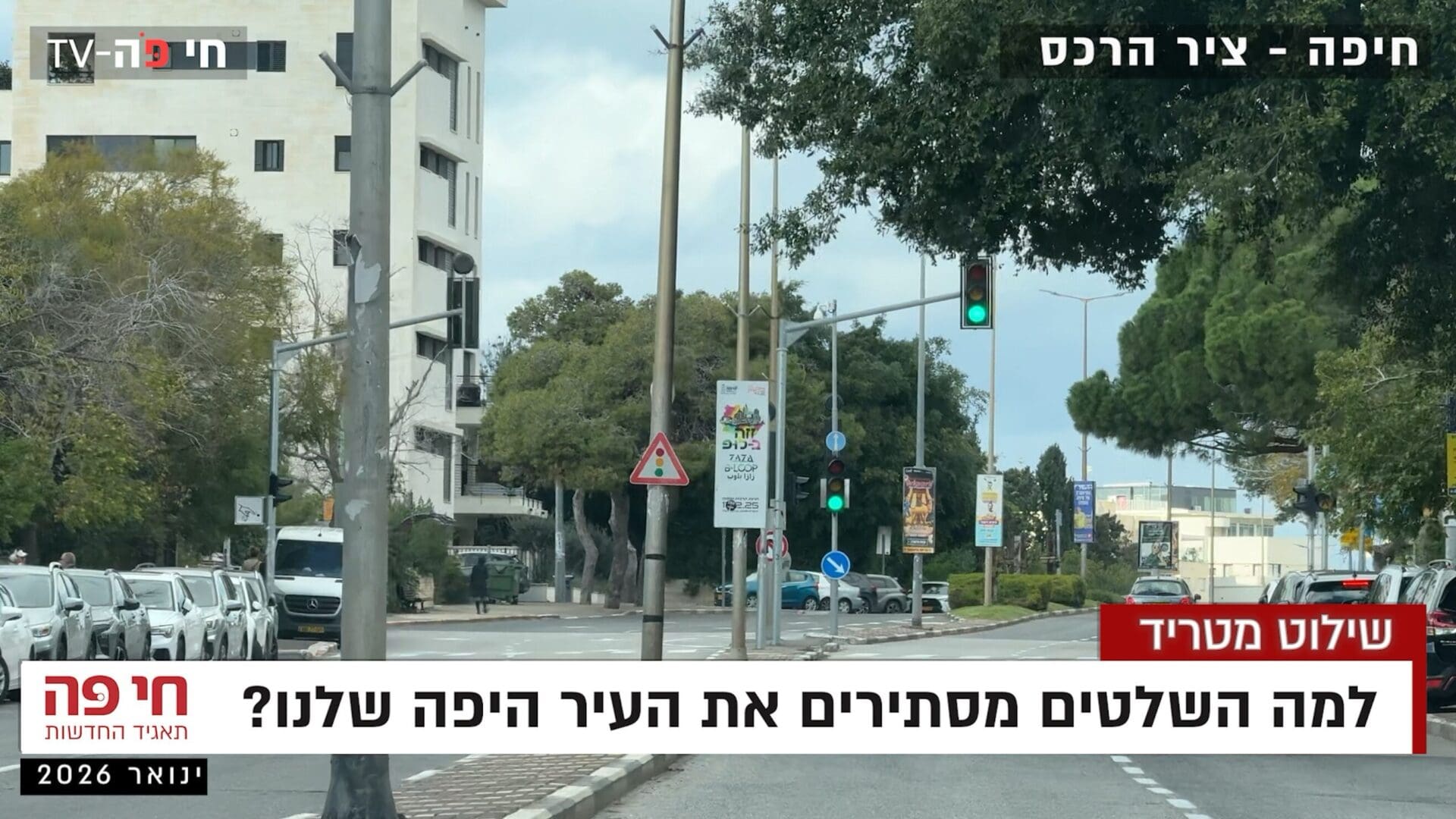
Today, along urban and interurban roads, advertising signs are placed in a huge variety of formats: flags and posters on lampposts, installations on sidewalks and traffic islands, signs at bus stops and on pedestrian bridges, and especially on huge, illuminated and bright electronic screens, which combine movement, bright colors and emotionally charged content. Haifa is no exception to this landscape. From Savyonei Danya to Carmel Hatzrafati, along the boulevards and main thoroughfares, it seems that there is not a single post left vacant.
Billboards cover almost every street corner and intersection, along with giant screens on buildings and shopping malls. This visual clutter is not just an aesthetic issue, it distracts drivers, creates visual congestion, and harms both safety and the unique urban landscape.
3 seconds – travel of approximately 42 meters without full visual control
What they all have in common is clear: They are designed to attract the driver's gaze. And when the gaze is diverted for even three seconds, the risk of an accident increases significantly. At a city speed limit of 50 km/h (about 14 meters per second), looking away for three seconds means driving about 42 meters without full visual control. This is enough to miss a braking vehicle, an oncoming pedestrian, or a sudden change in road conditions.

Aesthetic hazard:
The city of Haifa is a beautiful city. It has a view of the sea, mostly trees, and a spectacular view.
Travelers on the ridge route mainly see signs in front of their eyes.
And if this hazard isn't enough, many residents report that they are unable to read what is written on the sign at all, due to the speed at which the vehicle passes by.
And how much does the production, hanging, and frequent replacement of the signs cost the taxpayer? We don't know, but it's quite a bit.
What does the law say about advertising signage?
The Traffic Ordinance and its regulations are primarily aimed at maintaining a clean road environment and the integrity of road signs. The regulations prohibit placing signs similar to road signs near the road or adding advertising additions to them. However, they do not directly and comprehensively address advertising signs that are not road signs, except for the prohibition on impairing the visibility of the road sign.
In contrast, the Roads (Signage) Law and its regulations apply to interurban roads. The law, which was enacted in 1966, was born from both safety and aesthetic considerations. Even then, the Minister in charge warned that advertising signs, which by their nature attract attention, may distract the driver from the road ahead. The law prohibits the placement of advertising signs visible from the interurban road, with limited exceptions, such as business name signs or safety signs, and in accordance with size and content restrictions.
However, in 2008, the Ayalon Highway area was excluded from the law, a step that significantly damaged its effectiveness. At the same time, modern electronic signage technology now allows for the placement of huge screens with high lighting intensity, visible from a distance of over 100 meters and even from an intercity road, even if they were placed in an urban area. This has created a reality in which the law is having difficulty keeping up with the technological pace.
Four types of distraction and one major risk
The research literature defines "distraction" as the shifting of attention from activities essential for safe driving to a competing activity. Researchers distinguish four types of distraction:
Visual distraction – When the gaze is diverted from the road.
Auditory distraction – Response to sound stimulation.
Cognitive distraction – A thought that is unrelated to what is happening on the road.
Biomechanical diversion – A physical action that distracts the hands from driving tasks.
Billboards operate primarily on a visual level, but often also on a cognitive and emotional level. A colorful, bright, and emotionally charged advertising message is not only perceived by the eye, it requires mental processing. This creates an additional burden on the driver's attention system. When this burden is combined with signage congestion, a well-known phenomenon documented in professional literature, the level of risk increases, especially on complex and "demanding" road sections, where high concentration and quick response are required anyway.
What do the studies say?
A large-scale study by the National Highway Traffic Safety Administration (NHTSA) and colleagues (Klauer et al., 2006), based on approximately 43 hours of natural driving by 109 drivers in their personal vehicles, indicated a significant contribution of distraction to safety incidents. Distraction was found to be involved in 78% of collisions and 65% of "near misses." It also emerged that looking away from the road for more than two seconds doubled the incidence of risky situations, on all types of roads and in all traffic conditions.
An official NHTSA report from 2019 noted that 8.7% of fatal traffic accidents in the US were related to reported driver distraction. However, researchers emphasize that this is likely an underestimate, due to underreporting and variations in police reporting methods. The implication is clear: distraction is not a marginal phenomenon, but a fundamental and influential factor in the occurrence of traffic accidents.
Even "safety" signs are distracting
A fundamental point that emerges from the professional document is that there is no fundamental difference between a commercial advertising sign and a sign carrying a "safety" message, as long as both are designed with eye-catching means, strong lighting, bright colors, alternating movement, and emotional elements.
Even a message urging drivers to fasten their seat belts or check tire pressure, if displayed on a bright and dynamic electronic screen, may attract the driver's gaze and divert his attention from the road. In other words, good intentions do not eliminate the mechanism of distraction. Therefore, there is no reason to exclude "safety" signs from discourse and regulation, since in terms of the impact on visual attention, their risk potential may be similar.
A strong industry versus public interest
It should not be ignored that this is a large and powerful economic sector, with advanced resources and technologies, whose stated goal is to attract attention. But equally, the state and local authorities have a responsibility to maintain safety, the landscape, and public space. Changing legislation is a complex and lengthy process, involving many factors. Therefore, the need arises to create balancing tools: establishing "do's and don'ts" rules, increasing awareness among sign approvers and enforcers, and implementing up-to-date professional principles in licensing processes.
The conclusion: a balance of interests is necessary
Drivers are human. The human attention system is limited, vulnerable to external influences, and sensitive to salient stimuli. Billboards, especially electronic ones, are designed precisely to exploit these mechanisms.
When the gaze deviates even for a few seconds, the risk increases. This is not a call for the complete abolition of outdoor advertising, but a clear recognition that it is a risk factor that must be managed with caution, with judgment, and with a proper balance between economic interests and human lives. Ultimately, the question is not how many eyes see the sign, but how many of them return to the road in time.
The Haifa Municipality gave a response:
"The Haifa Municipality sees utmost importance in maintaining the safety of road users and improving the quality of public space. As part of this concept, and with the aim of balancing the economic benefits of advertising with the aspects of safety and urban visibility, the municipality recently turned to the Office of Transportation Engineers to receive a professional opinion and formulate a regulated procedure for placing billboards and digital advertising screens. The municipality is currently examining the professional recommendations document, and will later examine its future methods of action."
Did the article interest you?
Excellent article, Samar, and congratulations for giving such an important platform to this very disturbing phenomenon.
The truth is, in the Haifa Municipality there is no single body that encompasses all the activities related to road safety. There are safety units, safety headquarters, the Roads Department, the Traffic Division, and more… And so it is with each one dealing with their own small part without an overall vision. All that is visible are the erased crosswalks, the broken roads, the faded and unnecessary traffic signs that have been placed, vegetation that hides crosswalks, vegetation that grows on paths and roads, and so on and so forth….
Ugliness. Advertising taking over public space. Nowhere in the world is there such density on the roads, huge garbage cans on the sidewalks, signs on every post. And on the sides, neglected gardens with broken walls and the smell of cat urine at the entrance to the buildings
Disgusting. New construction has no front garden and the trees that provided shade on the sidewalk are being cut down to make way for more parking in every building. Haifa is very ugly, that's the truth.
Right. The carnival along the highway is dangerous to drive. Roadside garages are the most dangerous of all. We are a nation whose attention span is on steroids anyway.
Absolutely true, unnecessary overload of designs gives me a headache. People no longer pay attention to writing. For example, I walked around there and didn't look to see what was written. I also ignore it. My safety on the road is more important to me. I'm sure that many people behave like me, making nonsense.