


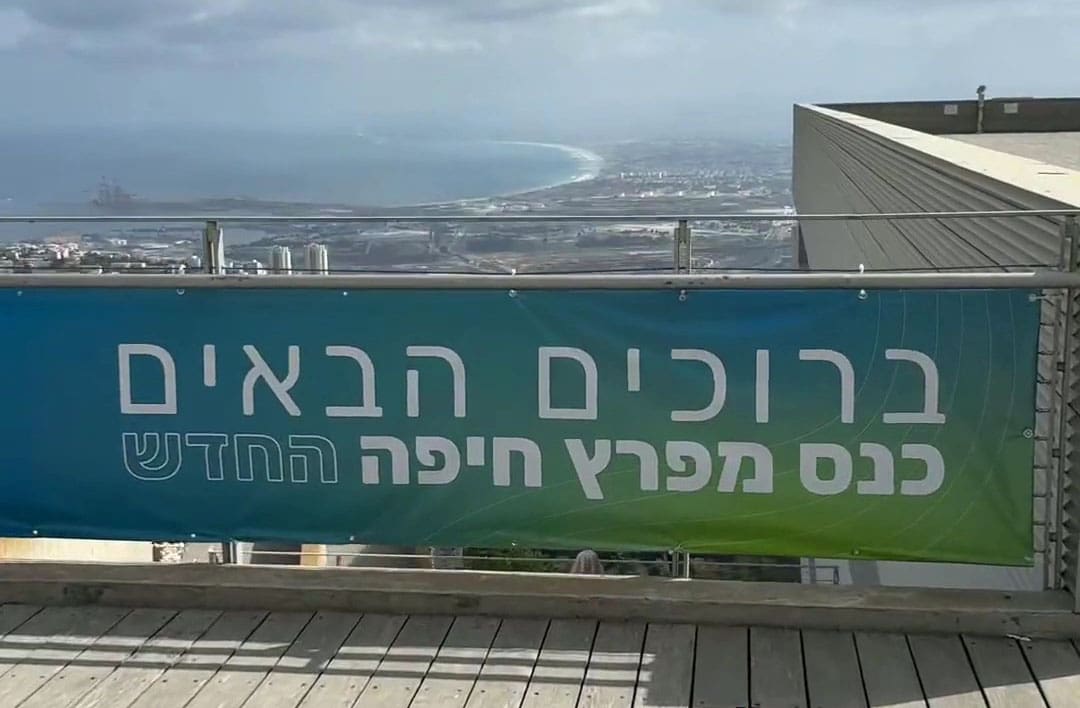
(haipo) – The third conference on the strategic plan for the development of Haifa Bay was held at the University of Haifa on 28/5/25. The conference was attended by senior government officials, mayors from the region, and professionals, who met to discuss the future of the bay. The opening remarks and panels dealt with weighty issues – from the issuance of municipal bonds, through transportation infrastructure, to land rehabilitation and adapting the area for future construction.
Rami Rosen – Director General of the Ministry of Environmental Protection
Rami Rosen, Director of the Ministry of Environmental Protection
Shlomi Fogel – Owner of Israel Shipyards
Shlomi Fogel from Israel Shipyards explains that it is important to build a very strong product that will be called a gateway to the Middle East, which will also help decision-makers in Jerusalem. To give capabilities and options to international companies that will be here on this issue. Whether it is ports, ships, trains, insurance companies that will be able to insure the goods, and start moving all the goods eastward, and from east to west.
Dr. Lihi Berman Shahar, CEO of the Association of Cities for Environmental Protection
In a panel that dealt with the planning challenges in Haifa Bay, titled "How can 100000 housing units be accommodated between Haifa Nesher and the Kiryat Shmona?" Dr. Lihi Shahar Berman, CEO of the Haifa Bay Environmental Protection Cities Association, addressed the issue of public trust. In her remarks, she emphasized three things that need to be done to gain the public's trust.
Noam Ponia – Director of the Contaminated Lands Division at the Ministry of Environmental Protection
The struggle for the future of Haifa Bay: Closing the Bay as a main anchor
The issue of closing the refineries was at the heart of the discussion. Prof. Avi Simhon, chairman of the steering committee and head of the National Economic Council, made it clear that "the attempt to prevent the closure of the refinery will not succeed." According to him, the public understands the damage caused by the polluting industry, and professional reports support this step. He added that instead of the refinery, a new employment complex could be established for tens of thousands of workers, and that this is not just an environmental issue but also a security one - the Ministry of Defense has supported the move in the past.
The security aspect that didn't start last October
Prof. Simhon rejected claims that the security situation after October 7th requires leaving the ZEN intact. He emphasized that Hezbollah and Hamas are not a new threat, and that even in today's tense reality, there are more appropriate and safer energy alternatives. According to him, the Ministry of Defense even supported closing the ZEN for security reasons, while understanding that the facility's continued operation could pose a strategic risk.
Responsibility to Employees: A Call for Systemic Attention
Alongside the strong statements, Prof. Simhon also emphasized the state's responsibility towards the workers of the ZANZ. He noted that he demanded that the recommendations report include a direct reference to their future employment, despite opposition from the Ministry of Finance. These words reflect an attempt to combine an environmental vision with human sensitivity, and to make the transition just and not offensive.
Yuval Admon, Head of the Haifa Bay Development Directorate in the Prime Minister's Office:
Yona Yahav: A polluting factory, too close to the city
Haifa Mayor Yona Yahav reiterated his call to remove ammonia: "There is no way that the refineries will continue to exist here." Yahav renewed his fight to remove ammonia from all tanks and mentioned how a fatal leak changed public and government opinion. He claims that ammonia is a polluting body that is getting closer to the urban population with the development of the cities around it - and therefore must be removed immediately.
Transportation and Employment Challenges: Beyond Environmental Talk
In a panel on urban planning and future housing, Haifa City Engineer Orit Meretz warned that without government investment in employment and transportation, the plan would not be possible. According to her, “human capital will not reach a place where there is no quality of life.” This statement illustrates how the vision for Haifa Bay is not just environmental or security, but requires a real supporting infrastructure that includes public transportation, jobs, and quality education.
Orit Mertz, Haifa City Engineer
Haifa Bay as a New HUB: Vision or Slogan?
One of the intriguing parts of the conference dealt with the potential to transform Haifa Bay into a changing regional HUB – a dynamic center of industry, employment, transportation and housing. The panelists, including representatives from the Ministry of Education, Israel Ports and shipping industries, presented scenarios for multidisciplinary development. But the main challenge remains: how to form coordination between all the parties, and translate the vision into actions on the ground.
Did the article interest you?
My mind is confused. Talk is like sand. Luckily it's free.
A close reading of the article gives rise to a sense of missed opportunity and even ignoring a single key factor, critical and game-changing for the prosperity of Haifa and the entire north. In the modern era, international airports are not just transportation infrastructure, but huge engines of economic growth. They are lifelines for local, regional and international economies, attracting investment, industry, tourism, and creating tens of thousands of quality jobs – from ground services, through logistics and technology industries, to business centers and services built around them. This is the case with Ben Gurion Airport, which has become not just a flight gateway but an independent and vibrant economic center. When talking about "developing Haifa Bay," the clearest and most obvious direction, which should actually be at the top of the national and local priorities, is to transform Haifa Airport into a fully functioning international airport, along with the development of an airport city around it. Such a project would dramatically leverage the potential of the bay, provide essential air accessibility for businesses and tourism in the north, and free Haifa from dependence on the distant Ben Gurion Airport. This is not just transportation development, but a tremendous socio-economic lever that will radiate over vast areas and ensure the prosperity of Haifa and the north for decades to come. It is amazing that the conference at the University of Haifa did not raise this issue at all. It is time to turn the focus toward the real, clearest, and most promising solution for the future of the region.
The Gaza Strip must be completely evacuated for humanitarian reasons and designated as a closed military zone for a 5-year cleanup period, after which the area will be a water, gas, electricity infrastructure area, refineries, and a huge main airport with two terminals shared by Israel and the PA. In the Erez industrial zone on the Gaza border, it will be possible to re-establish the refineries. The Gaza Strip is needed as a logistics area for factories, water desalination, gas liquefaction, aviation, and fuel refining. This is due to the expectation of a huge population density west of the Jordan, already 15 million residents today and in the future we will reach 30 million residents.
Gaza must be a logistical area, high-speed trains from Ashkelon and Ramallah will bring commuters and workers to the Gaza Strip for work and back. The money from the gas from the Gaza coast will go to clean up the area and rehabilitate the evacuees in Rishif, in Egyptian Rafah and in the Gulf countries. This is the only horizon for Gaza.