


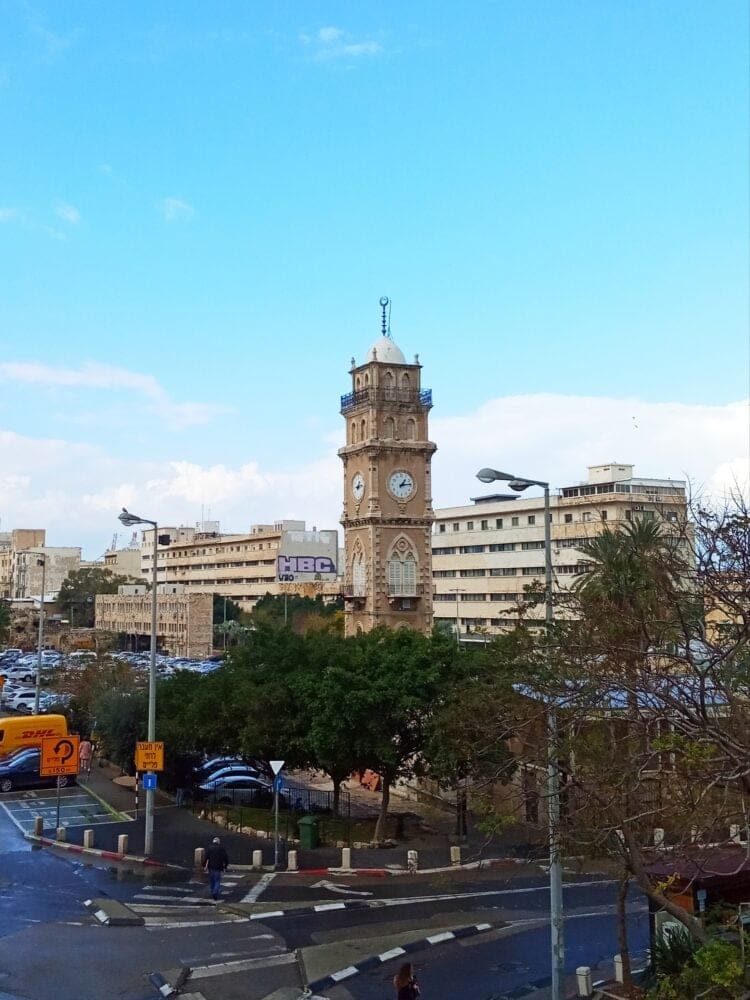
"From the top of a tall tower
Watch a big watch.
Oh, let's hear it
How he knocks loudly:
Tick tock, tick tock!
Ben Hail's clock ticks
during the day and at night
A pulse, a pulse is like this -
Tic Tac, Tic Tac,
Tick tock, tick tock, tick tock."
(Levin Kipnis)

The seven clock towers
On my tours of Haifa's downtown, I usually stop next to the beautiful Jarina Mosque that stands in the shadow of the Missile Tower. I stop there mainly to tell about the famous clock tower that was built above the mosque at the beginning of the twentieth century. This is, of course, a fascinating story, but it is only part of a much broader and more interesting story: at the turn of the 20th century, seven clock towers were built one after the other in the territory that would later be included in Mandatory Palestine: Jerusalem, Jaffa, Haifa, Safed, Nazareth, Acre and Nablus .
The towers (at least most of them, but we won't bother you with the controversy in the research) are part of about a hundred similar towers that were built throughout the Ottoman Empire on the occasion of the semi-jubilee of the reign of Sultan Abdul Hamid II. Ostensibly, the construction of the towers is a simple event, but in truth it embodies a great drama, at the heart of which is a meeting between East and West and struggles for political power and identity.
The five daily prayers in Islam
For most of the days of the Ottoman Empire, similar to the Muslim empires that preceded it, the division of the day was based on the five daily prayers in Islam. Each such prayer opens with the call of the muezzin, which was also used by the public as a vocal aid to determine the time. Thus, for example, it was possible to schedule a meeting immediately after the morning prayer or to decide that the working day ends between the third and fourth prayer. All this changed in the 18th century, when European-style mechanical clocks began to penetrate the Ottoman state. But the really dramatic change came in the middle of the 19th century.
The Ottoman Empire in the light of history
Throughout this century, the Ottoman Empire underwent a series of very significant reforms. Through them, the Ottoman state led modernization processes in its territories. This modernization was also in the area of time measurement - various institutions in the empire began to use and enforce time accurately measured by mechanical clocks, some in the way we know today, that is, in a day that begins at midnight (what was called "Western style" or "foreign style"), and some in the way that was It is still committed to determining the time by the sun, as is customary in the Muslim prayer, with a day that began at sunset ("Turkish style").
In any case, both methods were a real revolution that made time bounded, precise and cutting, in contrast to the much more fluid time that characterized the previous period, which was dictated by the calls of the muezzin.
the clock towers
The clock towers, therefore, were the mouthpieces of the government that heralded the deep cultural and social change that the empire underwent as part of its modernization process. It is not for nothing that they were built during the reign of the sultan most associated with the modernization processes - Abdul Hamid II, who in many ways was the last sultan of the empire (although he was succeeded by Mehmet V and VI, but both did so after the Young Turk revolution and with almost no actual governmental authority).
They reflected the Hamid ideology that demanded progress, but also reflected the control of the central government in the territories of the empire, especially in the face of various European forces whose representatives - missionaries, diplomats, tourists, pilgrims, merchants and others - began to be more and more present in its territories.
The Clock Tower in Jerusalem
A good example of this is the clock tower in Jerusalem. It is a square tower, two of whose ends showed the "Western" time, while its other two ends showed the time in the Turkish style. Thus, the tower could serve as a kind of "translator" between the two methods of measuring time for the subjects of the empire and the foreigners who came to the city, but it also served as a symbol of the Ottoman identity against the intrusion of the West. And what happened to this clock tower? He is the only one of the seven who is no longer standing.
Ronald Storrs
With the British occupation of the Land of Israel and the application of the British mandate to it, the governor of Jerusalem, Ronald Storrs, began to reshape the city. He was guided by modern ideas of urban planning alongside a desire to preserve what he perceived to be the appearance of biblical Jerusalem. In any case, Storrs ordered the removal of the clock tower, which stood above the Jaffa Gate in the walls of Jerusalem. Beyond the attempt to return to the Jaffa Gate what Storrs saw as the glory of the past, it is possible that he also wanted to destroy the symbol of the Ottoman rule that preceded him.
Back to Haifa
About five years after the clock tower was erected there, the "Valley Railway" of the Hijaz railway was also inaugurated - that tremendous project of our acquaintance, Abdul Hamid II, which connected Damascus and the holy city of Medina on the Arabian Peninsula. The official reason was to help the believers in the Hajj, the pilgrimage to Mecca, but of course there were other goals as well. This long railroad had one and only connection to the Mediterranean Sea, in a subsidiary railroad that left the city of Daraa in Syria, went down through Zemach and ended here, at the eastern entrance of Haifa at the time.

A cultural earthquake that changes everything
I imagine the profound change in the lives of the residents of Haifa in the first decade of the twentieth century. People who until recently lived a slow life, of horse-drawn carriages, traditional cafes and family and community life, without their days being sliced into thin slices by the hands of the clock, suddenly have to get used to clocks and trains. Basically, they were a bit like us, when the internet and mobile phones entered our lives. This is not just a technological change, but a cultural earthquake that changes everything.
Downtown tour
This Thursday, August 17.8, from 17:00-20:00, I will guide a tour of the lower city, and I invite you and yours to a journey to the birth of modern Haifa. In this tour we will accompany the lower city throughout its 262 years of development, from being a small walled city to becoming the ultimate entertainment area that it is today. It's a story about megalomaniacal rulers, about stormy sea battles, about technological innovations, about entrepreneurs and architects and about a space that everyone tried to shape in their own image and contributed something to it that made Haifa what it is today. the tour guided by me, Dotan Brom, a doctoral student in history and a certified guide, the owner of the business "Haifa on foot".
For details and registration: 0525348582 (Dotan) Or [email protected]
Did the article interest you?
Thanks
Fascinating article
Where is the wholesale market in Haifa anyway?
It seems that most of the public does not know this environment, neither its history nor what can be done with it
It remains a black hole in the middle of Haifa
The next mayor of Haifa must take care of this matter. Good and blessed Shabat for every one.
The next mayor should promote legislation to demolish buildings that have been abandoned for over 20 years even without the owners' consent. You did not repair or renovate - you will not leave a hazard in the heart of the city. and to erase 100-150 such buildings from Hadar to Haifa Bay. The city needs to return to the MAR and fill it with new construction that will create a new urban sequence like Nesher is doing on Bar Yehuda Road, or Tel Aviv on Shlomo and Sharona Road. The entire wholesale market environment in Haifa should be a MAR with boulevards with shops, squares, residential towers and new offices.
The mayor is coming, apparently he will be an Arab.
Take down the symbols of the Ottoman occupation and continue building the main city center with office towers, hotels and residences. Haifa needs a future - for that there is no choice but to erase the past as well. The British knew this very well and destroyed hundreds of buildings to connect the Haifa-Yigur road.
right