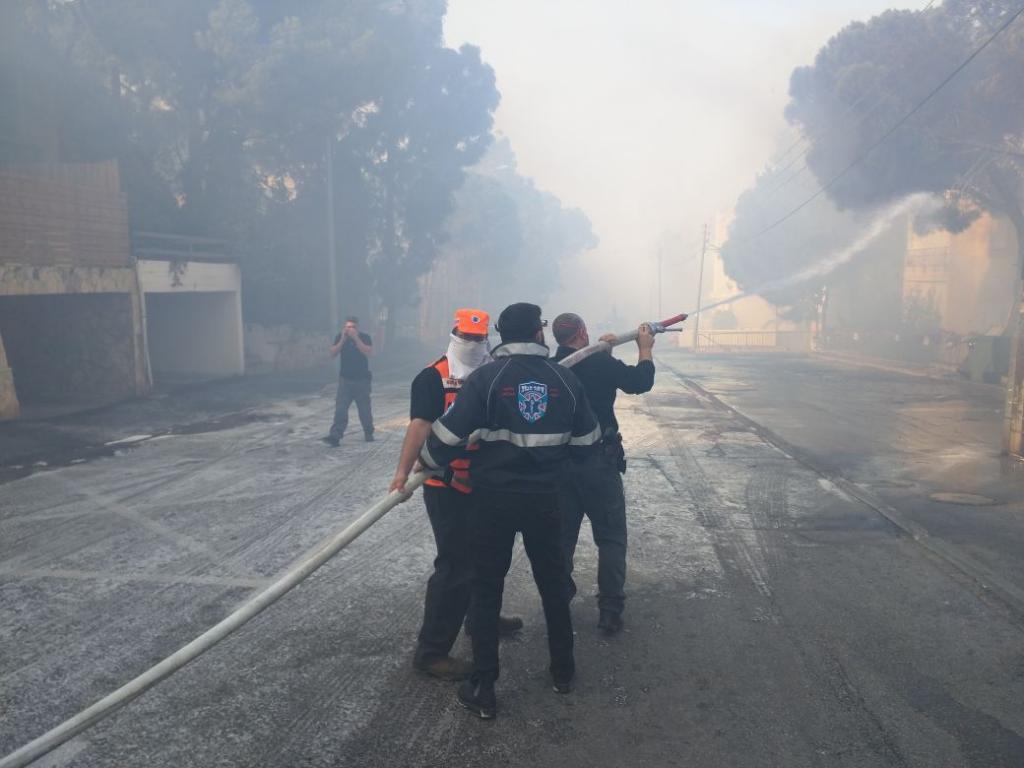
A year has passed since the giant fire broke out in the city of Haifa, the largest fire in the history of the country, inside a residential city. It was on November 24, 2016, a few days after the Fire Authority issued a notice about the danger of fires spreading according to the weather index that signals an "extreme" risk level
In the fire, 60,000 people were evacuated from their homes, 2,109 houses were damaged and burned, and 1,200 dunams of natural woodland were burned. As of today, 40 million shekels have been invested out of a million until the end of the nature restoration works.

"I was sure that this day would end with deaths"

In an interview with Lahi Fe, Uri Chibutoro, spokesperson for the Coastal Fire Department, tells about his personal experience, as he experienced one of the biggest events known to the city of Haifa and the State of Israel: "I was busy putting out the fire near the fire station and we just received a call about the fire in Rommah. I took myself and flew to Rommah, when I saw the flames enveloping buildings and I know that this is a populated area, children are in schools and kindergartens. I was sure that this day would end with deaths and a large number of casualties, because Everything was to our detriment. A fire inside a built-up area and houses, nursing and regular hospitals in Carmel and Pliman, community centers and schools and kindergartens and the majority of the population is there in the eye of the storm. I admit and confess that I was afraid that the result would be bleak."
Exclusive photo - the first minute: the first photo of the fire in Haifa, as taken by Hai Pa reader - Anat Cohen

"Neighborhoods must be evacuated immediately!"
"As soon as the incident started in the field, we opened a map on the hood of a car, we sketched everything and immediately the commander of the Coastal District, sub-tafsar Aryeh Regev, gave an order to evacuate all the neighborhoods, all the way to the sea and I in turn issued a notice to the media about the evacuation and thanks to this decision, my life was saved humans".
"We prepare every day, hour by hour, for the next challenge that will come and it will come, it's only a matter of time"
"It is about 48 hours of great effort put in by everyone who participated, and a good word is due to all the bodies that participated in this operation. After the thing that took more than a day was over, it was a great satisfaction, because to think at what starting point we were and with what results we ended the fire is something that is above and beyond In my understanding - something that I was sure would end in fatalities because everything was to our detriment. Although this case ended successfully, we do not have privilege and do not rest on our laurels and we prepare every day, hour by hour, for the next challenge that will come and it will come, it is only a matter of time."
Chibutro explains that as of today there is no clear disciplinary conclusion regarding the cause of the fire, even though the police, the security services and the fire authority have also carried out investigations. Of the 91 large fires that broke out in Israel (because only the largest ones are investigated), over 70 percent were definitely arsons made by humans. In Haifa, they were unable to reach a conclusive conclusion as to whether they were arsons.
The conclusions and lessons that were produced in the coastal district following the wave of fires in November 2016
Writing and implementing an "extreme-extreme" procedure
Before the wave of fires in question, there was a clear division of the firefighting authority's preparations in accordance with the weather index according to three levels of risk: normal, high and extreme. One of the lessons was to classify another situation in which the meteorological conditions are particularly high for several days in a given sequence that guides the authority to special preparation.
The extreme-extreme procedure, which was written, assimilated and became mandatory in the fire authority, concerns several areas, among them the determination of the preparation in terms of the number of fighters who are at the fire stations at any time, in addition to a comprehensive work arrangement in 24-hour/24-hour shifts, manning of jump-off points at critical points within the district ( Shlomi, Zebulon) in order to shorten the response time and increase the manpower at the existing stations in the Haifa area.
International air assistance
During the events of the wave of fires, the Fire Authority came to know that the aerial firefighting has difficulty responding to extreme scenarios in which a large amount of aircraft is required in several events taking place at the same time.

Therefore, at the initiative of the Commander of the Coastal Sub-Tafsar District, Aryeh Regev, and in coordination with the Fire Commission, a procedure was written for the request for air assistance from foreign countries to be made available even before the fire broke out. The practical meaning is that firefighting planes from foreign countries will be in Israel during these days, which have been defined as extreme - extreme.

Enforcement in the private sector
In the patrols conducted following the fires, both in Zichron Ya'akov and in Haifa, it became clear that the majority of the damage was sustained by buildings adjacent to which there were trees (mainly conifers), which allowed the sequence of the burning and its transfer from the open areas to the built-up area. Therefore, in joint headquarters work of the firefighters with the Haifa municipality, it was decided to launch a pilot and for the first time carry out enforcement in the field of private yards, and relying on the municipal bylaws.
As part of the pilot, a mapping of the Dania neighborhood area was carried out in which the problematic areas were surveyed, the residents and property owners were given instructions to carry out and to our delight there is a considerable response which obviates the need for enforcement. It seems that those residents who saw before their eyes more than once what a fire could cause understood well the accompanying meanings and hence the root of their commitment to the matter. In light of the success of the pilot, there is an intention to expand it to all areas of the city of Haifa and later to the other sectors of the district.
"Orange" firefighters (Home Front Command)
In conjunction with the frontline command, a plan was built on how to improve and optimize the procedure for receiving the assistance of the orange firefighters in large-scale incidents. The program includes, in addition to regular training sessions designed to maintain operational competence, also providing a response to logistical issues that occurred last November. It should also be noted that 29 new fire engines belonging to the Home Front Command were transferred to the use of the Fire Authority at various stations throughout the country.

Characterization and establishment of non-stationary NPCs
A large-scale event requires a division into work sections. Thus, for the purpose of the example, the commander of the "X" station receives under his responsibility the management of fire fighting in the "Vai" neighborhood. He manipulates the teams available to him and provides the United CPC with a situational picture of the progress of the event from all its aspects. As part of the preparatory work and characterization of the required needs, each such CPC regional station received all the control aids required for the commander in order to conduct the campaign.
logistics
The logistics system in the district has gone through nothing less than a real revolution. The insight was that the district logistics division was required to provide everything necessary for the local fighters and the forces that come to their aid in the first 24 hours, until the arrival of reinforcements and assistance from the national level and/or provision from civilian suppliers.
A regional logistics warehouse was established (this is in addition to the station warehouses) and many equipment and means were purchased for its benefit, starting with operational equipment (hoses, jumps, crossings, etc.) and moving on to equipment intended for the stay of large forces for several days of combat in a row.
buffer zones
In the "Fire and Water" incidents, the Fire Authority observed that areas where work was carried out to thin the vegetation and create buffer lines were significantly less damaged than areas where the vegetation was blown into the houses. In these areas, the sequence of vegetation caused the fire to quickly move to the houses and cause damage on a tremendous scale. Therefore, they continued even more strongly the project they started even before the wave of fires to build buffer lines in places that were characterized in the past as having destructive potential. Examples of areas where you can see the terrain route before and after are the city of Nesher, certain neighborhoods in Haifa and the university area.
Deepening the cooperation with the Israel Police and Haifa Municipality
Large and complex events require close cooperation with related parties, in which each party brings its capabilities and comparative advantage to light. In such events, a joint committee is established where the representatives of these bodies sit side by side, receive an up-to-date picture of the situation and carry out instructions down to the field level. A classic example of the saying that the whole is greater than the sum of its parts.
The cooperation was practiced and deepened as reflected in the district exercise which took place in May 2017, about 6 months after the great fire. The representatives of the bodies understand each other, speak a common language, locate in real time the weak points and the needs arising from the field and give them an immediate response, each in his own field.