


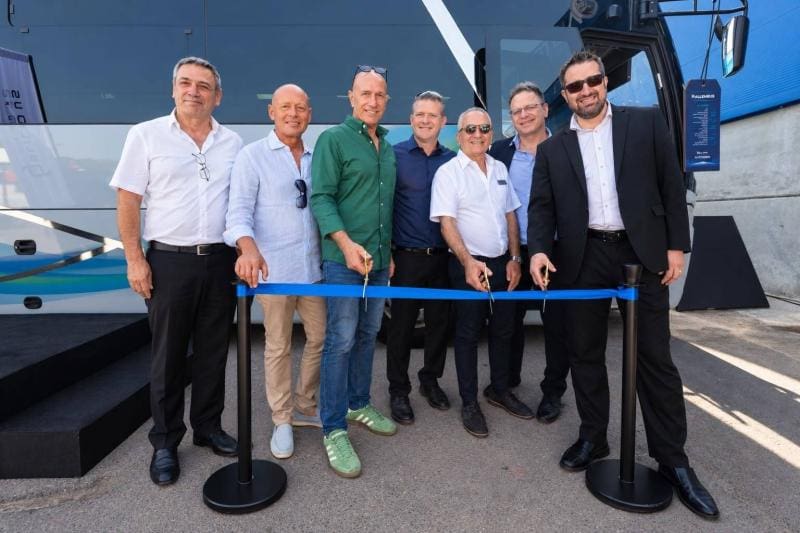
(haipo) – A significant morning was recorded today in the transportation sector in Israel with the unveiling and delivery of the country’s first intercity bus based on hydrogen technology. The event, held in the presence of senior executives from the Belilius Group, Bazan management, the Ministry of Energy and the Ministry of Transportation, marks another step in the implementation of alternative propulsion solutions and the examination of their feasibility in everyday use. The new bus offers an exceptional driving range, extremely fast refueling and zero polluting emissions, placing Israel on the map of countries promoting hydrogen-based heavy transportation.
Technological leap: 600 km range and refueling in 12 minutes
The new bus, model Audace 1050 From home ALLENBUS and Marcopolo, based on fuel cell technology that converts hydrogen into electricity. Meaning: Zero polluting emissions, and the only emission is clean water.
The salient data:
- Long-distance driving range of over 500 km, and under optimal conditions — nearly 600 km.
- Fast refueling: Less than 12 minutes, similar to a diesel bus.
- Four hydrogen tanks at 700 bar pressure allowing for a full fill in less than five minutes.
- High voltage battery from CATL To improve energy efficiency.
These capabilities position the bus as a significant solution compared to conventional electric vehicles, which suffer from short driving ranges and long charging times.
State support: 2.5 million NIS as part of "Pioneer and the Leap Forward"
The bus is being developed and imported to Israel with the support of the Ministry of Energy and Infrastructure, which provided a budget of NIS 2.5 million for the project. The ministry is professionally supporting the project and examining the bus's performance as part of assessing the potential for expanding the use of hydrogen in the transportation sector.
Passenger experience and safety: 53 seats and advanced systems
The bus is designed to transport 53 passengers in a spacious, air-conditioned space. It is equipped with a ZF axle system that ensures a stable and smooth ride, and a number of active safety systems:
- Dead zone detection
- Warning for pedestrians and cyclists
- Braking and stability control systems
- A mechanism to prevent drunk driving
First pilot in Israel: The bus joins Bazan's fleet
The bus will be integrated into the Bazan Group's vehicle fleet and will be used to transport workers between Nahariya and the refinery. Bazan, which has been leading the hydrogen sector in Israel in recent years, sees this move as another milestone in the clean energy revolution.
Shlomi Basson, Senior Deputy CEO of Bazan: "The bus will be fueled at the station we established and will emit only water. This is another step in the gradual transition to clean energy, while maintaining continuity of supply."
Prof. Brian Rosen, the Chief Scientist at the Ministry of Energy and Infrastructure: "This is a significant step in combining clean energy with operational efficiency. The bus allows us to closely examine the potential of fuel cells in a variety of other areas."
Summary: Israel Enters the Hydrogen Era
The delivery of Israel's first hydrogen-powered bus marks the beginning of a profound change in the heavy-duty transportation industry. The technology, government support, and the commitment of leading companies all together create a real infrastructure for a revolution that will impact air quality, operational efficiency, and the future of energy in Israel.
Did the article interest you?
The real transportation revolution will be a 250-300 km/h high-speed train between Haifa and Tel Aviv, something that should already exist today – that is the speed of new trains built in North Africa and Europe.
In Morocco, the 320 km/h high-speed train lines were inaugurated in 2018.
Egypt is building 2000 km of high-speed trains with German company Siemens, which will be inaugurated in 2028.
A 350 km/h train will begin operating between Dubai and Abu Dhabi in 2030.
In our case, at best, construction will begin in 2030, we are only talking about 250 kilometers per hour, and the target for opening a line of only 100 kilometers is 2034. This is unacceptable. The entire project needs to be accelerated and a more ambitious deadline set.
It is forbidden to combine it with the TABZ.
Imagine a hydrogen bomb with an explosive belt.
What happened that the beast didn't come to cut the ribbon???
An animal gave birth to you and the world suffers.