


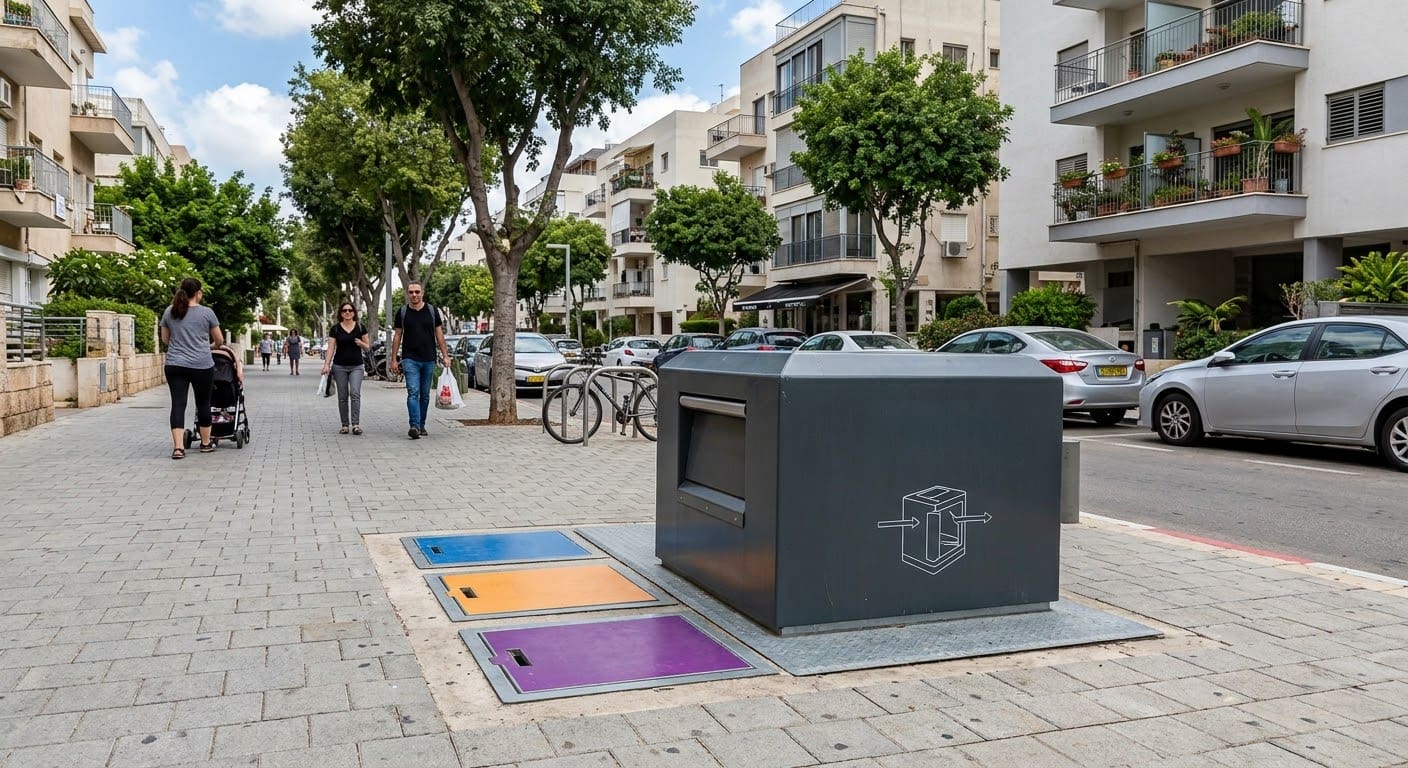
(haipo) – Garbage cans scattered on sidewalks, garbage carts parked in parking lots, waste overflowing over the edge of the container, and unpleasant odors are a familiar sight on many streets in Haifa. However, in recent years, more and more local authorities in Israel have been exploring or already implementing another solution: buried garbage cans, or by their more familiar name, in-ground bins.
The method is not new, but in recent years it has gained momentum as part of a broader concept of a clean city, improving public space and sometimes even moving beyond smart management of the waste disposal system. The obvious question is whether Haifa is also on the path to significant change in this area and whether buried bins may become an integral part of the city's streetscape in the future?
Less trash on the street, more public space
A buried bin is essentially a waste container located below ground level, with only the opening for the disposal remaining visible. Unlike large bins and garbage carts placed above ground, a significant portion of the system is hidden. The method has several notable advantages: it allows for the reduction of the volume of garbage facilities visible on the street, improving the appearance of public spaces, keeping animals away from waste, and reducing exposure to odors and dirt.
When properly designed and maintained, the phenomenon of littering around the bins can also be reduced, a problem that is particularly common in areas where open trash cans or garbage carts are accessible to animals. In Haifa, for example, trash cans were and are still accessible to wild boars, cats, and other animals, who come to them in search of food and scatter the waste around them. Some systems can also incorporate sensors that measure the fill level of the bin and transmit the data to a control center.
This way, at least in principle, it is possible to plan evacuation routes according to the actual need and level of occupancy, and not just according to a predetermined schedule.
In Haifa, people were talking about buried bins years ago.
The discussion of buried bins is not new in Haifa. As early as 2021, Avihu Hahn, then deputy mayor and chairman of the Green Party, raised the issue in a question to the City Council. Hahn asked why the Haifa Municipality was not promoting a buried bin project as part of addressing the city's cleanliness situation and promoting the "smart city" concept. The question also raised the possibility of using smart bins equipped with sensors, which would be able to transmit real-time data on the amount of waste in the bin and the need to empty it.
The idea behind the move is clear: instead of simply removing trash according to a fixed schedule, technology can be used to get a more up-to-date picture of the situation and streamline the work of the sanitation system.
But since then, the question remains whether Haifa is facing a significant transition to this system, and if so, in which areas and on what schedule.
Tirat Carmel has already begun during
While the discussion on the subject has continued in Haifa over the years, other authorities have already begun to take practical steps. In Tirat Carmel, for example, the municipality began installing buried trash cans in 2025 as part of a move to upgrade the city's garbage disposal system. The move, carried out through the Public Works Department, is intended to improve the city's appearance and reduce the hazards associated with placing trash cans and carts on the streets.
One of the considerations presented as part of the move is the need to keep animals away from waste. In residential areas, animals attracted to food scraps can turn the area around the bins into a center of dirt and hazards, and in some cases even create a traffic and safety hazard.
Buried bins are designed to address some of these problems by storing waste in a container located below ground level.
Other authorities are also examining the method.
Tirat Carmel is not alone. Other local authorities in Israel have also begun to promote solutions for buried bins in recent years, among other things as part of urban renewal projects, developing new neighborhoods and upgrading sanitation systems. In localities where the move is being implemented, buried bins become part of urban planning and not just a spot-on replacement of one bin for another.
Thus, already at the street planning stage, it is possible to allocate a designated area for containers, plan the access for evacuation trucks, and integrate the system with additional infrastructure. Local councils and smaller communities can also find ways to go beyond the system, in an attempt to improve the quality of life and the visibility of the streets.
What are the benefits of a Motman tin?
Better urban visibility: The most obvious advantage is aesthetic. Instead of a row of large bins and garbage carts on the street, most of the container is underground and the public space looks neater and cleaner.
- Odor reduction: The waste is contained in a closed container and underground. When the system is sealed and properly maintained, this can reduce odors reaching the environment.
- Animal removal: One of the challenges in the municipal garbage system is animals attracted to waste. A buried and closed bin makes it difficult to access the waste and reduces the risk of littering the street.
- Space saving: In places where street space is limited, the fact that most of the container is underground allows for more space to be left free for pedestrians and road users.
- Smart management option: Advanced systems can incorporate sensors that monitor the tank's fill level. The data can help the local authority plan the evacuation more efficiently and avoid, as much as possible, unnecessary truck trips.
- Reducing waste dispersion: A closed container that is less accessible to animals may reduce the amount of waste scattered around it.
Buried bins also have disadvantages.
Switching to buried bins is not a magic solution. Establishing the system requires infrastructure work, excavation, and allocation of underground space. In older, dense areas, where water, sewage, electricity, communications, and gas infrastructures exist, installing underground tanks may be more complex and expensive.
Maintenance doesn't end once the bin is installed either. Regular maintenance is required of the container, lifting mechanism, discharge opening, and associated systems. Another problem is accessibility. If a buried bin is located in a spot that is not convenient for residents, people with disabilities, or the removal truck, the system can actually become a nuisance.
In addition, even a buried bin can become a hazard if residents place large waste next to it instead of throwing it in. In other words, even the most advanced technology cannot replace proper public behavior and an effective enforcement and maintenance system.
And what about the environment?
One of the main advantages of closed, buried bins is the ability to reduce direct contact between the waste and the environment. However, it is important to be precise: a buried bin is not a standalone solution to soil or groundwater contamination. The mere fact that a bin is underground does not guarantee prevention of contamination. This depends on the quality of the bin, its tightness, maintenance, and the manner in which the waste is handled.
Therefore, when talking about environmental contribution, it is correct to see buried bins as part of a broader system of waste management, which includes collection, disposal, recycling, waste treatment, and ongoing maintenance.
So is Haifa on the road to change?
The big question is not just whether buried bins are better than regular bins, but whether Haifa is ready to make the switch on a city-wide scale. The city of Haifa faces complex conditions: old streets, mountainous topography, dense areas, existing infrastructure, and a large number of neighborhoods with different characteristics. Therefore, a comprehensive transition to a new system is not a simple process.
On the other hand, in areas where infrastructure work, urban renewal, or the development of new neighborhoods are underway, solutions for buried bins can be incorporated in advance as part of the planning. The question is whether the municipality will choose to continue with specific solutions, or will it formulate a comprehensive urban plan that will define where buried bins will be placed, in which neighborhoods, at what rate, and what budget will be allocated for this.
Ultimately, a landfill is much more than a garbage collection facility. It is part of how a city plans its streets, manages waste, and designs public space.
In Haifa, where the issue of cleanliness and the treatment of garbage hazards is repeatedly on the agenda, the transition to landfill bins, if and when widely implemented, could be a significant step in changing the face of the city.
It now remains to be seen whether Haifa will join the authorities that have already begun the process, or whether the buried bins will remain at this stage mainly as part of the discussion about the "smart city" of the future.
The Haifa Municipality informed Haifa:
"At this stage, the municipality does not plan to expand the use of buried bins throughout the city. This is due to operational considerations and experience gained from operating systems of this type, including malfunctions related to groundwater infiltration into underground rooms, which may increase odor hazards, as has occurred in other cities. At the same time, the municipality is regularly examining various systems and methods for garbage removal, with the aim of streamlining the removal system, improving service to residents, and adapting removal methods to the different characteristics of the neighborhoods and areas in the city."
"In this framework, technological solutions are also being examined and promoted, including pneumatic garbage removal. As part of this system, planned for some neighborhoods of the city, the garbage will be concentrated in a central system and at a designated terminal, from where it will be transferred to the transfer stations."
זוועה מה שהולך ברחובות, איפה כל מנקי הרחובות, תתחילו עם זה !
In all cities in Israel, municipalities are carrying out projects to bury power lines and eliminate power poles, especially in neighborhoods undergoing TAMA 38 and evacuation and construction.
There is endless TAMA 38 throughout the Carmel, but the Haifa municipality allows the poles to continue to be the main landscape in the neighborhoods, instead of demanding, together with the electricity company, that every street in Haifa undergo a project to bury electrical poles. The sidewalks are already very narrow. At least they will remove the dangerous electrical poles and bury the lines. It is also safer in case of missile attacks.
Buried bins – a disaster and a risk of death in agony for the animals. You didn't write, but you mean cats that the local authority doesn't take care of spaying and neutering to the appropriate extent. Even though it receives a budget for this from the Ministry of Agriculture. The other animals that consume garbage have already been destroyed. Even the homeless who collect bottles can fall in. And there have already been cases.
I understand that buried trash cans are not always the solution, because educating people is harder. I also encounter municipalities that are not open to simpler things regarding trash. I live on Hillel Street, and at least 5 apartment buildings have two small trash cans that stand on the sidewalk and prevent people from passing, and they throw the trash next to the bins because there is no room, especially on weekends.