


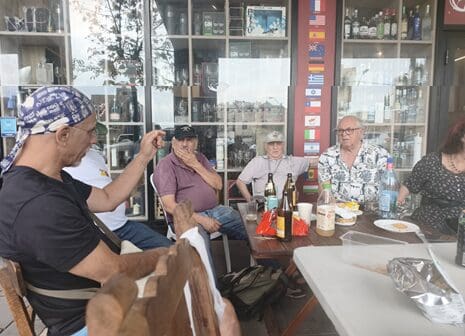
I arrived from Tel Aviv for a Saturday visit, and at the flea market I discovered an institution that Haifa has kept to itself: a parliament without elections, without a coalition, and without security guards. If you ask me, it could replace the Knesset, at least until Saturday night.
On Saturday afternoon, I arrived from Tel Aviv to visit a friend in Haifa. I thought we would sit down for coffee and catch up on news, but instead she took me to the most important institution in the city, only no one had bothered to hang an official sign on it yet. On the upper street of the market, near a local wine shop, under a Haifa portico, there were a few simple tables and around them people were all talking together. Bottles of beer, glasses, pretzels and snack bags completed the decor. Nothing seemed festive, and yet it was clear that I had arrived at a proper meeting and that I was about to discover a side of Haifa that you don't see on a regular short visit.
Those present call themselves "the parliament." There are no elections, no coalition, and no protocol, so surprisingly, you can start working right away. Some come regularly, some join by chance, and some pass by on the street and are drawn into the conversation. One raises their voice, another points a finger to emphasize an argument, and someone waits for the precise moment to say one sentence that will close the discussion, at least until someone opens another bottle.
No one needs to announce the opening of the session, nor are there any three calls. The place itself does it. Against a backdrop of bottles and small flags from different countries, the parliament faces the street as if all of Haifa is invited. A person comes to wander around the market, stays for a drink, and before he realizes what has happened, they are already asking him what he thinks about the country, the neighborhood, the prices of apartments or the right way to prepare fish.
In the Knesset, you need a committee; here, a plate of pretzels is enough.
Not far away, the Missile Building and the Istiqlal Mosque add to the conversation without saying a word. The Sail Tower, which Haifa residents call "the Missile Building," draws the eye upward with its unusual shape; the mosque reminds us that there are older stories in this city. I liked their proximity.
In Haifa, apparently, even buildings don't have to agree on a style to get along in the same area. Around them, people continue to shop, pass by, talk, and in this special parliament, the meetings and discussions continue.
The government falls, the bagel remains.
This parliament has its own rhythm. The conversations do not proceed in a straight line; they jump from the port to the Carmel, from French to Hebrew, from an old memory to a new joke. Sometimes two people speak at the same time, a familiar parliamentary tradition, and sometimes there is a small silence in which everyone checks to see if anyone is really offended. Usually not. Here, an argument is not a reason to dissolve the government but a form of closeness.
There is even a division of portfolios here, with appropriate CVs: the "Foreign Affairs" portfolio is held by someone who speaks ten languages, the "Finance Portfolio" brings with it a history of managing several businesses in London; and the "Health Portfolio" brings the personal experience of someone who has undergone several surgeries. In this government, at least there is no need for a search committee, it is enough to listen to the stories around the table.
Meanwhile, a journey of its own is underway on the table. The cheese plate is passed from side to side, the bag of chips is passed around, and the crackers are moved from hand to hand as if they were appointed to a liaison committee. Wine is poured into glasses, bottles of beer and juices are passed between the neighbors at the table, and every now and then the most important request of the meeting is heard: "Pass it to me, please." Someone stops in the middle of a resolute argument to take a piece of cheese, and another hands the crackers to the one they were arguing about just a moment ago. Opinions remain divided; there is actually agreement on the chips. Amidst all these small transfers, even a guest from Tel Aviv is starting to feel at home.
As a Tel Avivian, I'm used to a city that constantly presents itself: new places, lines, noise, and the promise that something is happening now. In Haifa, I discovered a different rhythm. There's something very Haifa about this encounter: a shady sidewalk, a neighborhood store, a nearby market, people who came from different countries and continue to carry their accents, habits, and memories. You don't need a fancy setting to create a community. Sometimes it's enough for the same table to appear again next Saturday and for someone to save you a chair.
I sat there and watched. At first I felt like a guest, then a witness, and finally a small part of the circle. I don't remember who won the arguments, probably no one, but I remember the heat with which they argued. In a world where most conversations take place in front of a screen, it was refreshing to see people looking at each other, interrupting, laughing, correcting, and continuing.
Maybe that's why the name "Parliament" is so appropriate. Not because big decisions are made there, but because it is where something happens that the Knesset in Jerusalem sometimes forgets: people meet and talk to each other, not just about each other. They bring opinions, stories, and jokes to the table, and for a few hours they create a small public. Not perfect, not quiet, but alive, and at the end of the session no one demands a car that survived.
When I got up to return to Tel Aviv, I thought about the creativity of the Haifa residents I met. From wine shops and a few tables on the sidewalk, they invented a parliament for themselves, with portfolios divided according to life experience and with a place for a guest as well. This is creativity that I love: the ability to turn an ordinary meeting into something that has its own character. I came to visit a company and discovered people who know how to shape the life of their city. If the Knesset is looking for ideas, let them send a delegation to Haifa.
Just bring crackers!

If you were to walk around the beaches of Haifa, there is also a parliament there. On every beach, the same meetings are held every day for parliamentary meetings, conversations are held. Without hurting others, there is a very personal attitude.