

"Soap, towel, toothpaste, sheets..."
Below is another chapter in the behavior of the members of the P.K.P. party – the Communist Party in Israel. The period is the 40s, before the establishment of the state. The members of the party, who had a strong orientation towards Soviet communism, were persecuted by the British in Israel, and the General Histadrut even expelled them from its ranks. The members of the party, whose Yiddish name was P.K.P., saw the Zionist movement as an imperialist body and a factor that had to be fought. And when these members were persecuted by both the British Secret Service and by the members of the General Histadrut, they felt threatened. Therefore, they spread among them strict rules of conduct. There were also P.K.P. members in Haifa.
Dr. Eli Nachmias from Haifa, who researched the issue, clarified: "During all the years that the communists were underground, they tried to convince Jews and Arabs to join the Communist Party. They had leaflets and pamphlets containing propaganda material. The seizure of these materials by the British was a reason for the arrest. Another reason for the arrest was the possession of instructional books and theoretical books by Marx and Engels, Lenin and Georgy Plekhanov.
"The communists isolated themselves and did not trust anyone. So much so that they prepared a kind of 'shulchan aruch' in case they were captured by the authorities. Some of them were handed over to the British by the Zionist parties."
What Dr. Eli Nachmias calls "Shulchan Aruch" was called by the members of the P.K.P. "Notes on the Conduct of Members." The wording is colloquial and in the simplest Hebrew. Under the heading: "The Conduct of Members in the Police," it says: "If you are caught with material in your hand (meaning written material dealing with ideology and methods of action), say that you have only just found it. If (you are caught) without material, deny everything. Do not enter into arguments with the detectives. Answer briefly, yes or no. Do not let them provoke you by having them condemn the actions of the party, etc. Do not pay attention. Remain silent. Remember what you said the first time and repeat it stubbornly. Try not to be confused by them. Be careful not to fall into their trap if they tell you that an unknown person has already given them everything. This is just a means to weaken your spirit and get the information out of you. Do not sign any paper before you have read it. "If you don't know Hebrew, demand that it be translated for you. During the search, be careful not to have any material brought in. Don't let them search you without foreign witnesses. If you've been beaten, shout. If you're caught on the street, call for help."
Indeed, words of a murderer: "Remember, if you weaken and reveal only a little, it is to your detriment. Because then they will continue to beat you until they get everything out of you. And if you answer 'I don't know,' they will let you go. If your room is clean (meaning: free of party materials) and no one comes to you, you can give up your address. If a friend lives with you, or friends are about to come, or the room is not clean, you will only give up the room after twenty-four hours (meaning, obviously, until the address is revealed).
Further: "According to the law, you can only give testimony before the investigating judge and not before the police. But it depends on the circumstances and you don't always have to use it (i.e., on this basis). If you are arrested, try to take soap, a towel, toothpaste, sheets, clothes, a comb, money, etc. with you. The food is bad and if you have money, you can buy it in the prison canteen.
"In prison: If you are beaten, demand a doctor. Treat other prisoners with courtesy. Do not get into unnecessary fights with the police. Be careful and do not be frank with everyone, because even those who are listening to the wall will listen. Demand what you deserve. If a lawyer comes to you, do not let anyone be present during the conversation. In all situations, think about your actions. Do not act hastily. Inner security and peace are very important. Do not forget that you must hold the banner of the revolution high under all circumstances and at all times." So much for the comments on the behavior of the members of the P.K.P.
School riot!
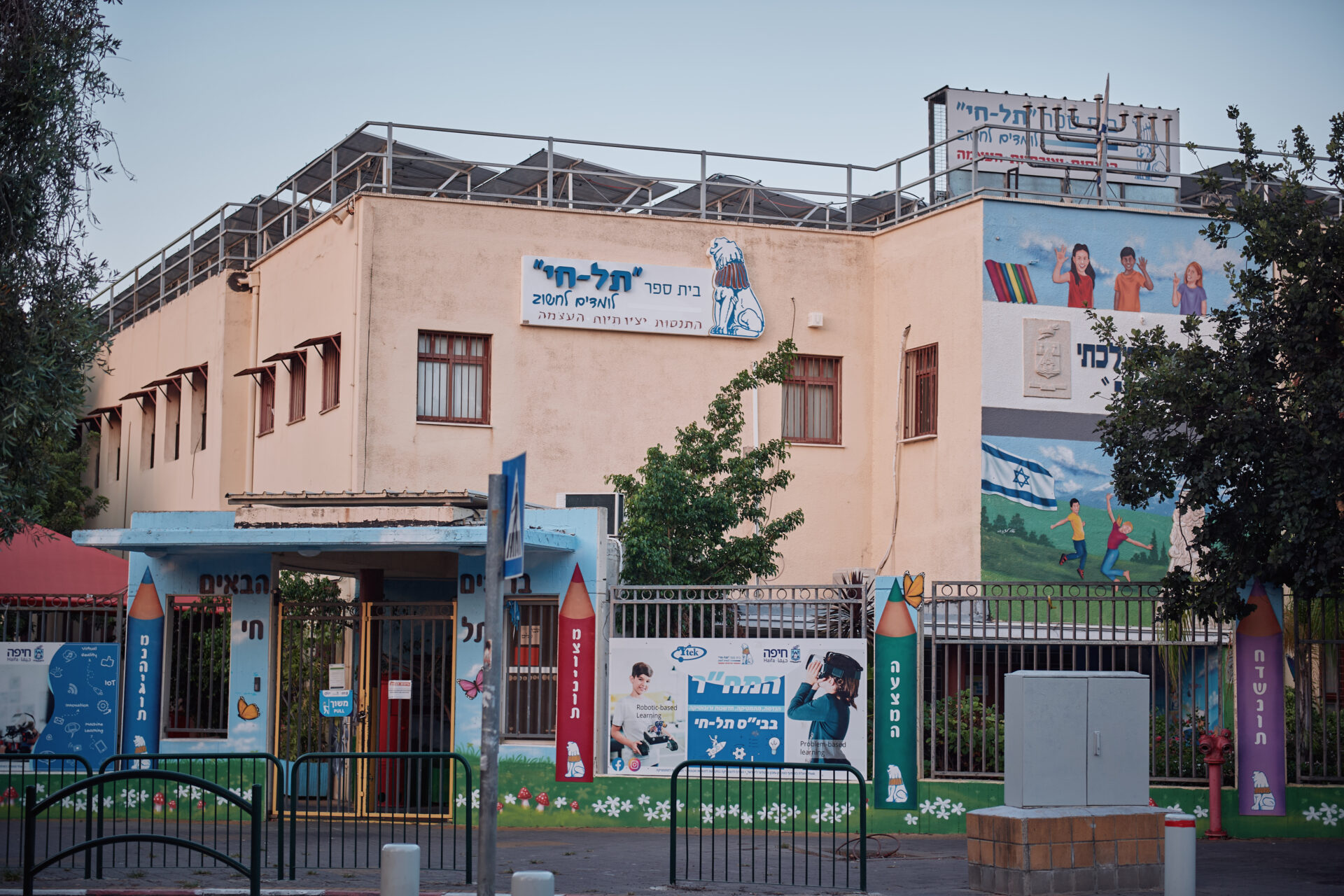
This happened in the 20s at the "Tel Hai" school, which was the first school in the Neve Sha'anan neighborhood of Haifa. You can relax: the uprising did not involve bloodshed. In those distant years, the school's name was "Popular School."
The school was housed in a shack and had about 25 students from grades 1 to 8. The first principal was named Israel Gluzman. He was not only the principal, but also his own deputy, his own secretary and assistant, his own sun, his own teacher, and his own supervisor. In other words, a one-man educational and administrative team.
All the students, from grades 1 to 8, studied in one room and Teacher Gluzman taught everyone in the presence of everyone. This meant that the first grade students listened to the Torah lesson taught by the older eighth graders. And is it any wonder that the eighth grade students, who were about 13-14 years old, were bored by the Torah lesson taught by the lower graders?!
Once an entire class was absent from school. What did it turn out to be? The boy who was the only student in the age group, did not come to school. Why did he not come? Because he was sick. In other words: a class of only one student.
This is how Gamliel Lerman, Amnon Green, Meir Chabinsky and Malkiel Slutsky describe the development of the rebellion at the school: "One day, all the seventh and eighth grade students, a total of five children, got together and decided to rebel. They left the school barracks and marched down the mountain to the Hadar HaCarmel neighborhood. It was a matter of more than an hour on a bumpy road. They arrived at the elementary school and told the principal, Mr. Karmi, how distressed they were, being forced to study in the same room where the younger children also study. And what did the rebels want? To be accepted into the school in Hadar HaCarmel, despite the great distance from their homes. And it is interesting that the principal Karmi agreed to accept them.
Meanwhile, Principal Gluzman found out about the rebellion. He closed the barracks, sent the rest of the students on vacation, and ran from Neve Sha'anan to the elementary school in Hadar HaCarmel. A short distance away on a mountainous road. When he arrived, he encountered the five rebels, who were in an ecstasy of joy that from tomorrow they would begin studying at the elementary school in Hadar HaCarmel.
Gluzman told them: "Please don't rush! Please wait a few minutes in the yard." He entered Principal Karmi's room and slammed him: "You are destroying my entire school. Starting tomorrow, you are leaving it without students, without Torah, and without bread." His painful words made an impression on his colleague. The result: the five rebels were forced to return to the elementary school in Neve Sha'anan, and continue to study in the same room with first-grade students.
And here is a prank that student Israel Sharon (we are not related) performed at school. One day he and his friend Haim Gil, who was one of the first reporters on Israeli television, each decided to set the school clock ahead. That is, to move the hands five minutes ahead, thus ending the lesson ahead of time. However, one did not know about the other, so the hands were moved 10 minutes ahead. Israel Sharon's luck ran out, and the sun saw him move the hands. The principal was furious and suspended Israel from school for two weeks. But let's face it: How could the education system in Israel have developed if it weren't for those pranks that our prickly asses performed? Just comparing these actions to the actions that are taking place in educational institutions today makes one shudder.
The story of the student revolt and the story of moving the clock are taken from the book: "90 to Neve Sha'anan - The Founding of a Neighborhood 1922 - 2012." It was written by Dr. Eli Nachmias and Yonatan Reznik.
Horsepower oil "tanker"
Clarification: The following story has no connection whatsoever to the oil crisis and the problem with Iran. To do this, one must imagine sailing back 75 years.
"Confirmation: We hereby confirm that Mrs. Sheindel Shapir has been engaged in selling oil in our neighborhood since her husband was murdered during the events of 1936. At first she would transport the oil by donkey, and with the increase in the population of Neve Sha'anan and the proliferation of new housing developments in its vicinity, Mrs. Shapir began to transport the oil by horse. This approval is given to the above in connection with her request to receive supplies for the horse." So much for the wording of the approval granted by the Neve Sha'anan Mutual Association, Haifa. This was in early December 1951. The approval also appears in the book on Neve Sha'anan.