

A plan to build an airport in Haifa has been canceled!!!
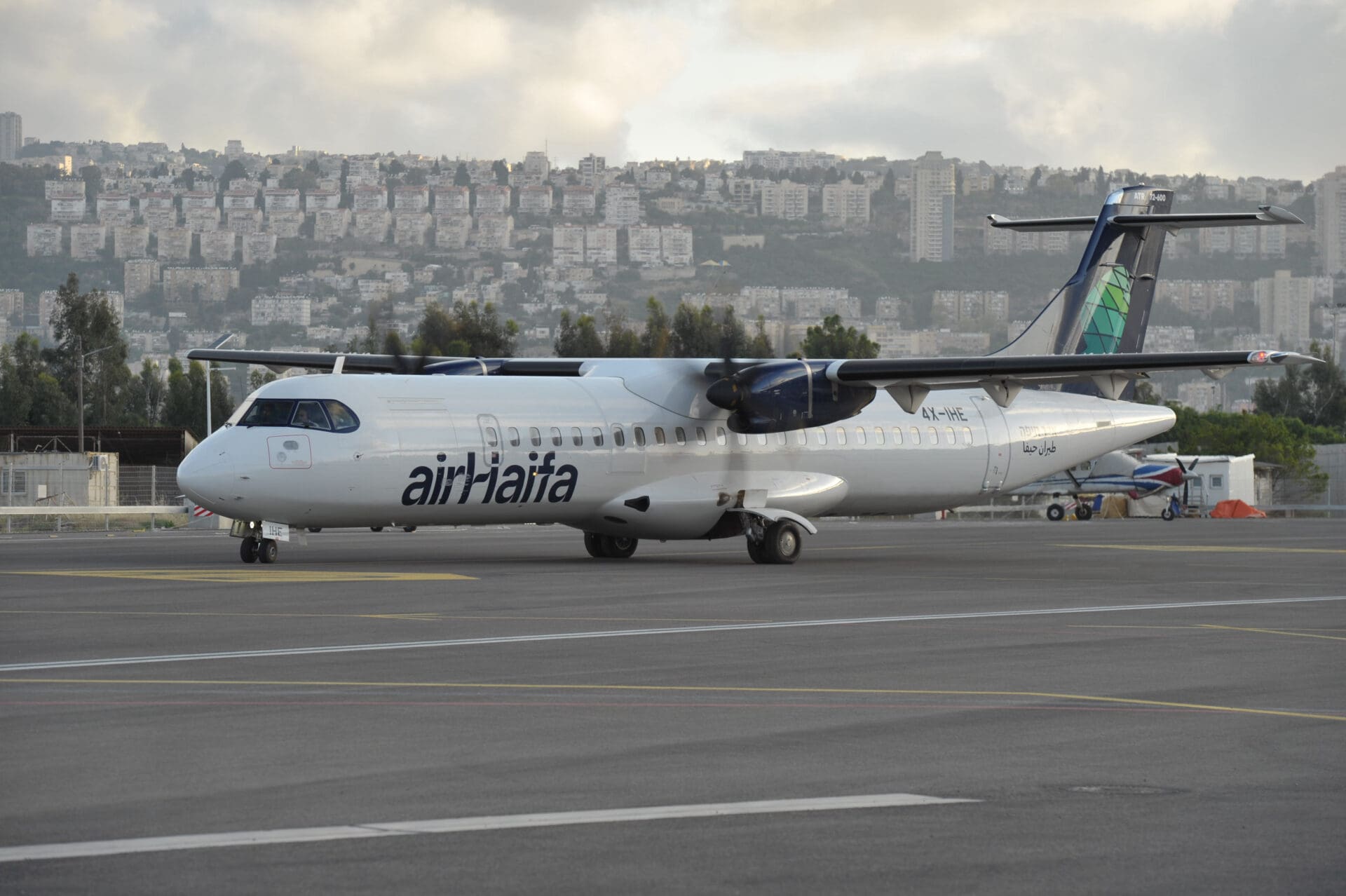
From the balcony of my house, I look out over Haifa International Airport. Passenger planes are landing there even after 10 p.m.
The airport in Haifa was the first to be built in Israel. It was in 1934, about three years before the airport in Lod was built. And this poor and neglected Haifa was, in fact, already an international airport, serving the British Royal Air Force and the employees of the I.P.C. oil company.
Skip to December 1972: The issue of an airport in Haifa occupied Haifa City Council member Dr. Dov Laufer. In a question to Mayor Moshe Fliman, entitled: "Cancellation of the plan for an international airport near Haifa." Thanks to the Haifa City Archives - I read, among other things: "Twice I asked... to put the question of the second international airport in the country on the council's agenda... I did not hide my concerns that the Ministry of Transportation was going to abandon the plan, and move the second center of gravity in the country, from the north to the south." And here, Council member Laufer, the late, quoted the words of the late Mayor, Moshe Fliman, the late, spoken about two years earlier. According to the quote, Fliman agreed that Haifa's development in the areas of tourism, trade and the economy depended to a large extent on the development of air transport, and that the city's needs and its central location in this part of the country required the establishment of the country's second international airport, in the vicinity of Haifa. The Mayor was also quoted As someone who announced that the municipal administration would clarify the matter with government institutions, with the intention of pressuring and influencing that if a second international airport is planned in Israel, then it is right that it should be located in Haifa. This was, as mentioned, about two years before the question.
And so, the council member claimed, the city engineer informed him that the Ministry of Transportation had abandoned the plan, and even if an international airport were ever built in the north, it would not be in the vicinity of Haifa. Now Dr. Laufer wanted to know what the mayor had done on this issue, if anything. And the mayor surprised him! He announced that neither the Ministry of Transportation nor any other government body, none of them had decided to build an international airport in Haifa.
On the contrary, it was the municipality's initiative, and Moshe Fliman, who headed it, raised this issue in a personal meeting with the Minister of Transportation, Shimon Peres, back in February 1972. And what did the future president reply? Peres announced that the establishment of an international airport in the Haifa area was not a current issue due to the expense of hundreds of millions of pounds, and because of the thousands of dunams of land needed for such an airport, which are not in Haifa and its surroundings. Despite Shimon Peres' response, the mayor of Haifa returned and demanded that an international airport be established in the vicinity of the city, or not far from it.
No to looting!
From a statement published by the Situation Committee attached to the Hebrew Community Committee in Haifa. The date: Passover Eve, 1948: "To the Jewish settlement in Haifa! Brothers and sisters in the homeland: The warning action of the 'Hagana' forces silenced the rampage of the Arab gangs in Haifa. It was not a foreign army, but our army, our sons and brothers, who carried out... a military operation that reopened the roads, bridges, streets, alleys and placed essential service centers under our protection. Haifa was and will remain a Hebrew city. The operation ended with the decision of our Arab neighbors to leave and evacuate the city... When they leave, they leave their property behind and we must do what we can to protect it. Many eyes throughout the world will follow our actions here to see how we treat our neighbors and their property. Do not desecrate the sanctity of victory by acts of robbery and looting... The campaign is not over yet. There are still many enemies within the country and beyond its borders. The struggle on the international stage continues. We have not yet reached rest. We will continue "To be awake and alert. And may this victory in the celebration of Passover, the holiday of liberation, be a sign of the victories to come for the establishment of the free Jewish state..."
The manifesto is quoted from the book "Haifa - Dictionary of the Present City" published by the Haifa City Museum.
Tracking Communists
The year is 1942. Officials in the Jewish government institutions in Israel were following members of the Communist Party here and documenting their movements. And who was following? The ISH, the news service of the "Hagana". The ISH passed on the information it found to the heads of the "Hagana" in the various regions and to the secretaries of the workers' councils. In other words, Mapai people. And so the following document came to the secretary of the Haifa Workers' Council in those years, Abba Khushi. It should be remembered that Abba Khushi's position was dominant in the party institutions and in the Jewish establishment. The document is in the Abba Khushi collection at the University of Haifa.
And so it is written, among other things, in the document, entitled: "In the communist youth organizations". The reporter is a man who introduces himself as "Omri." And it goes like this: "The guy who brings the newspapers and leaflets to the cells, his name is Shimon. Grisha, the cell secretary, moved to live at 17 Tavor Street (a one-story house). His real name is A. Grisha was among the participants in the national convention of the communist youth that was held some time ago. The guy was also a communist abroad (Vienna) and came to Israel with the 'youth aliyah'... His father and sister are also communists. His place of work, in the army barracks.
"In the 'Youth Aliyah' in kibbutz (this and that) there are two or three young communists. The information is from an inside source. One guy who left the 'Youth Aliyah' in kibbutz (Gingi) plays a role in the communist youth in Haifa.
"An internal source confirms that there is a communist cell in the 'immigrant camps'.
"(A person named so and so) examines new candidates before they are accepted into the cell. The active (a member of the youth cell secretaries) meets regularly with a senior party instructor, who explains to them the topics for the conversations they should have in the cells.
"The name of the other guy from 'HaShomer Hatzair', B. B., who is taking care of him, is A. M.'s party nickname. B. B.'s party nickname is 'Uzi'."
So much for the report by the Shi'a on what is happening in the communist youth organizations in Haifa and in some of the kibbutzim in the area.
Hebrew on the stage of the "Beit Halawutz"
The late Dr. Eli Nachmias, who researched, among other things, the origins of the Haifa Workers' Council for generations, uncovered the following letter. This is a reply letter written by Dr. Panya Melnik from the management of the "Beit HaChalutz" in Haifa. The "Beit HaChalutz" was a women's shelter on behalf of the Women's League for Israel. Its location: 5 Yalag Street, next to the abandoned "Ron" cinema building.
The letter was sent to the Haifa Workers' Council in April 1945. It reads: "We received your letter... regarding the rental of the hall to the 'Literary Circle' which regularly organizes various activities in a foreign language... We state that the 'Literary Circle'... is the circle known (by the name) 'Music and Art for All', and it does not regularly organize activities in a foreign language with us. Rather, it rented the hall with us several times for musical balls, and only a few times did it arrange a performance in German. We also drew their attention to this and informed them that we do not agree to allow them to organize any more performances in a foreign language." End of quote.
The management of the "Beit HaChalutz" made it clear that it does not check in advance the issue for which the hall is booked with clients who sell to it, and that is the only reason why this misunderstanding could have occurred. And what do we learn from the letter? That the Haifa Workers' Council of the Histadrut, which is a partner in the Women's League, not only arranged work and also cared for the workers and their health, it also determined in which language various events would be held in halls that belong directly and indirectly to the Histadrut, and the language is Hebrew, of course!
Don't make it easy for yourself. The Haifa Workers' Council in the mid-40s, under the leadership of Secretary Abba Khushi, was a real ruling force in "Red Haifa." It is also important to remember that in those years, the supporters of the Hebrew language stuck to their mission of introducing the use of our language into everyday life in general, and in contacts with foreign governments in particular. After all, these were years of pre-statehood and of struggle also for the Hebrew character.
Shimon Peres always ignored Haifa, hated Haifa.
Naming the neighborhood after him was a terrible mistake.
Because of him and his obsessive preoccupation with Gaza, plans for the Haifa international airport, which had already been defined as a vital national project in the Kadima government, were shelved, but he put the brakes on it for investments like the "joint" Erez industrial zone in Gaza.
And this kind of nonsense was simply one of the most damaging to the city. I didn't know it started back in the 70s, but it's not surprising.
Hadar needs to return to being a proud Jewish Zionist neighborhood.
All the anti-Zionist sectors that hate Hadar (and the state) should be driven to hell from the neighborhood they destroyed and continue to destroy. Including the entire Jerusalem faction that settled in Hadar.