


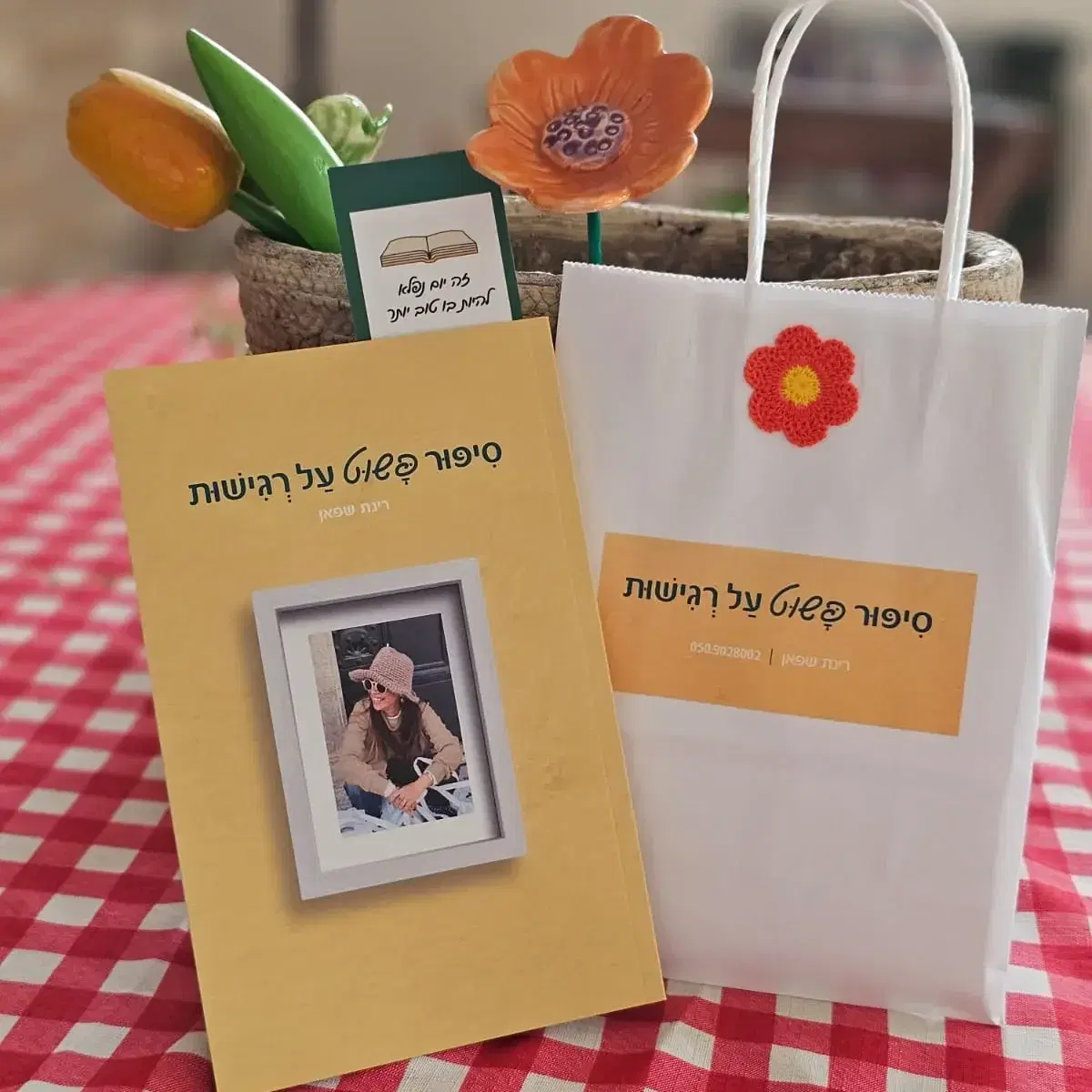
(From the book - A Simple Story About Sensitivity, the stories are true, the names are fictitious)
On Saturday evening, the mother of Uri, my student, called me and said that she and Alon were getting divorced. She shared that they had told the children the previous evening, and Uri took it very hard. She asked that I be more sensitive to him than usual during this time.
I was saddened to hear, they are actually a good couple, Alon and Gili. They always come with a smile to parents' days, to ceremonies and to every event. Always hand in hand with warm glances between them. I was surprised, but I remembered that my father always said: "We never know what goes on in other people's homes, and sometimes we don't even know what goes on in our own home."
I promised her that I would wrap him up and take care of him, and I asked them to try their best to end it well.
On Sunday morning, Uri was waiting for me at the gate, crying. I immediately hugged him and told him that right now it seemed like the end of the world, but slowly he would realize that parents who are happy apart were better than parents who were sad together.
He claimed it wasn't just because of that. That morning on the bus he told Liron, his best friend, the news of his parents' divorce, and Liron entered the classroom and shouted: "Uri's parents are getting divorced." Here the crying got stronger again, and so did my hug.
"You're so right, it's insulting and unfriendly. I promise to take care of it," I said.
"But why, Rinat, why did he tell it like that?"
"I don't know what motivated him, Uri, but I promise to find out." I took him to the staff room and washed his face.
In moments like these, when my anger builds quickly, I prefer not to respond so that the intensity doesn't miss the point, understanding and internalizing the act in such a way that the same child won't repeat it, out of grief and taking responsibility. Therefore, when I entered the classroom, I didn't say a word to Liron. At the end of the lesson, I asked Liron to accompany me to another classroom, where I taught math. He immediately took my bag and accompanied me. On the way, I asked him: "What kind of friend are you, Liron?"
He looked at me as if he didn't understand the meaning of the question. "I don't know," he replied.
"I'll try to refine the question. Let's say from one to ten, with 'ten' being a super loyal friend, one in whose hands you feel safe entrusting your most intimate secrets, and 'one' being a friend you don't trust enough to share your pain with, because he might hurt you with it. Where do you place yourself?"
"I don't know," he replied.
"You're right not to know, Liron, because on the one hand you're a good soul, helping me, my parents and my friends, on the other hand, you're able to take Uri's pain, which the sky fell on him following his parents' divorce, and shout it out loud, exposing his pain with insensitivity, if not more than that. Can you explain to me what motivated you to do such a thing? I'm really asking in order to understand and thereby help you."
"I don't know why I did it, it's really wrong." I could tell from his look that he still didn't understand the seriousness of the act and was giving me the 'admit and leave Yeruham' exercise. Anyway, I asked him to go back to class and apologize to Uri in a way that he would forgive him.
In the third period, when I returned to class, I asked Uri if Liron had apologized to him. Uri said no, and Liron immediately jumped up and said: "I told you I'm sorry. What, didn't you hear?"
I asked them both to wait for me outside, gave the class work, and went out to meet them. We sat down on a bench under the olive tree, turned to Uri, and said to him: "Uri, two days ago you received news that your parents were getting divorced. I can only imagine the pain you feel. Every child wants both of their parents together, even if they sometimes fight or get angry with each other. Believe me, this desire has no age. I have a friend who is almost fifty, whose parents got divorced thirty years ago, and she is still waiting for the day they will return, even though each of them has already started their own family. And right now, you probably feel uncertain about what will happen and helpless, because you have no ability to change the situation. Sometimes you hurt for your mother and sometimes for your father, and you don't want to take sides, but to love both of them and for them to love each other again." He started to cry, I hugged him and continued, "Know that the coming period is not going to be easy, and I would be happy if you would help me, put your head on me to rest, use my shoulders of trouble to lean on. I will hold you, I have all the strength to help you and I want you to know that you are not alone, I am here for you."
Uri cried and I continued to hug him, while looking at Liron, whose eyes spoke of understanding and true regret. "Do you understand, Liron?" I told him, "This is how a friend of 'ten' speaks, hugs and protects."
"I understand Rinat, really," he said, his eyes filling with tears. "Uri, I'm really sorry, I don't know why I did it, but you have to believe me that I want to make amends and that you trust me. I promise not to do anything like that again and I want to help you, because when my parents fight, I'm always afraid they'll get divorced and I go to my room and cry. If you want, I'll apologize to the whole class, because Rinat says we have to take responsibility in the forum we hurt." Tears streamed down his cheeks.
Uri looked at him, placed a hand on his shoulder and said, "I forgive you, don't cry."
And entered the classroom.
This is the job!
The writer: Rinat Shafan – An educator, lecturer, and author of the books: "Sun," "A Simple Story About Sensitivity," and "Barefoot," and I came to a pretty simple conclusion: The best stories are written from life itself.. You are invited to follow, find yourself between the lines, and walk with me in bare words. – To purchase, click here.