


Introduction: This is a story I wrote a few years ago (written in Munich, 10/7/2021), about my friend Professor Gabriel Moked, who passed away recently. He immigrated to Israel as a child after escaping death in the Holocaust. Here he studied Hebrew, became a writer and philosopher, and even greatly influenced the political discourse in Israel. He served as chairman of the Hebrew Writers' Association in Israel, published an important journal, "Now," on Hebrew literature and poetry, and became one of the most important editors and literary critics in the country. I met him after I started writing poems and stories and was accepted into the Writers' Association, where I even served as a board member for several years.
About 8 years ago, I used to travel to Tel Aviv on Thursdays to meet him at a cafe near his house on Ben Gurion Boulevard at the corner of Dizengoff. I was honored to become friends with him. We talked for a long time, although writers, poets and theater directors were sitting around him. Gabriel Moked liked to hear from me about developments in technology and communication. When I wanted to tell him something private, I would speak to him in Polish, and thus a cultural/personal connection was created between us.
As they say, "It sounds better in Yiddish," this also happens in other mother tongues.
I really missed the man since I stopped seeing him, when, due to his illness, he had difficulty descending the stairs of his house.
The late Gabriel Moked passed away at the end of May 2026, may his memory be blessed.
He told me personally the story of his survival as a child during the Holocaust, and I wrote it in his honor.
Gavris's childhood years – Gabriel Moked in occupied Poland
At the end of 1944, Gavrysh was about 11 years old. His life seemed normal on the outside, because he looked like a local Polish boy, but one thing was clear to him, he was not allowed to identify as a Jew. In fact, this did not bother him, because he spoke only Polish and was an excellent student.
His mother, who was a wise woman, knew that in order to save him she had to live under a false identity. However, as someone who came from Warsaw, the big city, she knew how to play the role of the "Warsawianka" similar to the women of the Polish elite, which consisted of educated people with noble behavior, according to the following characteristics:
- "Slobo Honoro" – "Word of Honor." Never break a word of honor or a promise made to someone. If you do, you will never be forgiven.
- When meeting a woman, one should always greet her with a kiss on the back of her hand.
- You must express yourself in high Polish, and if you fail even in one word, they will immediately discover that you are nothing but an ignorant and a pretender.
- You should always be dressed neatly and neatly, not necessarily in expensive clothing, but the items should match each other. Even if just one button is missing, it shows that you are a "slumper."
- You must master the verses from "Pen Tadeusz", which is the work of Adam Mickiewicz, the Polish Shakespeare, and more...
Gavrysh's mother obtained Polish identification papers and had no trouble presenting herself as a 100% "original" Pole. She found refuge for herself and her cute son in the somewhat sleepy town of "Zakofna." It's a picturesque place known as the winter sports capital, located in the mountain range that is a continuation of the Alps and the Tatra Mountains. This mountain range served as the border between Poland and what was then Czechoslovakia. The area is also called Podhale, located south of Krakow, the ancient capital of Poland. The people there speak a somewhat strange language, containing a Polish dialect, but pronounced similarly to Czech.
There is a belief that mountain people are not particularly smart (sorry), and why? A Jewish doctor living in Zurich, Switzerland, once told me that mountain people had difficulty obtaining water, since the springs and rivers are in the valleys, and since they could not always go down and walk many kilometers to get buckets of water, they melted snow and got distilled water that did not contain minerals. Using such water over time harmed the drinkers, and they became a bit stupid. The Jewish doctor was referring to the residents of Switzerland, but there is no shortage of such people in Poland either. After little Gebrish and his mother fled Warsaw, they arrived in Zakopane. The child probably did not know at the time that his father, who was a famous doctor who treated many people, had been murdered by the Nazis because of his Jewishness.
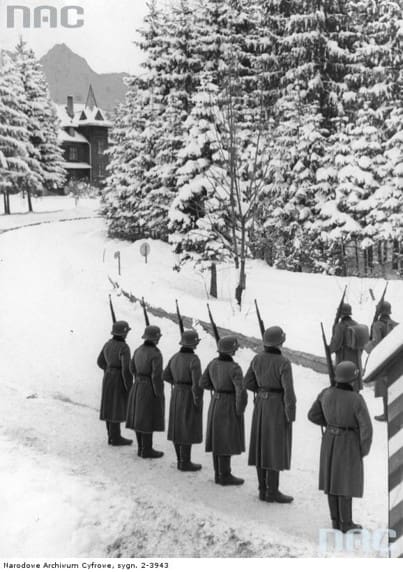
Zakopane was a sleepy town, with not much to do in the summer. The town was then ruled by Nazi military units, who held the inhabitants in an iron grip, and to prove their rule, they held drills and military parades on the main street. The officers and soldiers were dressed in their elegant uniforms, and marched every morning in a rhythmic and orderly manner, armed, and woe to anyone who dared to oppose them. The sight of the parade was frightening, but at the same time interesting.
The war was progressing in the right direction, Germany was attacked from the east by Russia, from the west by the United States and Britain, and from the south the British invaded through Italy. Many of the Duce's soldiers, especially the communists, were happy to betray their German comrades, and for this they paid a heavy price.
When the Germans realized that they were at the end of the battle, they tried to recruit the young Poles in Podhale into the German army. At first, they approached them politely and enthusiastically. They explained to the locals: "You are more similar in your culture to us Germans, enlist and join the glorious German army, and you will gain world fame!" Although the young people in Podhale were not great geniuses, there were still those who understood that this could be a trap for the gullible. Although there were locals who joined the Nazis, many young Poles fled to hiding places in the mountains, where even a hawk could not detect them.
After the Germans realized that they had not been able to convince all the young men to enlist in their army, they moved on to Phase 2, as usual, announcing that any young man who evaded military service would be severely punished, meaning they would be sentenced to death. These threats were also of little use, and the Germans' success was limited.
The rhythmic marches continued in Zakopane even as rumors spread that the Russians were approaching. The German duck march was impressive, but had already lost some of its grandeur. Everyone knew that the Russians were coming sooner or later.
On the morning of January 29, 1945, the Germans disappeared from the city as one man. There were no more marches, no more terror posters, and no more shouts of "Achtung!" heard through megaphones.
The residents began to feel that something of great importance was about to happen. That afternoon, loud singing was heard approaching the city. "The Russians are coming!" Gavris watched the scene with astonished eyes – "What is this, an army? How are they marching?"
A strange convoy of various types of vehicles, as well as horse-drawn carts, entered the city. The Russian soldiers did not look at all like a threatening army. Each soldier was dressed differently from the next, and the weapons were also different. One held a long rifle, another a tomigan (an antique submachine gun), and the third a nagan (an old Russian pistol). One wore a fur hat on his head, and the other a steel hat. There were also many women among the soldiers, and they all smiled at the residents. The boy wondered how this large evening of Russians managed to drive away the Germans who were marching in a forcible and threatening manner.
He stood by the side of the road and waved to the people in the convoy. Since he was a particularly handsome boy, the convoy commander caught his eye, and he turned to him and said: "Krasiv Malchik, my hands!" "Beautiful boy, come here!" The boy went up to the commander, who lifted him into the vehicle and drove him. It was a great ride for the young man to freedom!
And if Stalin's soldiers weren't the messengers of Messiah, then who were??
*The film "Life is Beautiful" (Italy 1997), starring Roberto Benigni, who is also the director, depicts a father who does everything in his power to enable his son to survive in a POW camp. He does this by convincing his son that everything that is happening around him is just a game, and in order to win, one must follow the rules. Benigni "tried" to imitate the cute Gavris in the final scene of that film, but Gavris is ours and he lives in the State of Israel and even contributes a lot to it!
Did the article interest you?
exciting.
Joins
Thank you Eyal for your response:
Today there is a global problem called "copyrights." The rights that writers and painters have that last 75 years... also include photographers, including a photograph of Haifa Bay, of which there are hundreds on the Internet in a fairly casual photo - its use could end in a legal claim of tens of thousands of shekels.
The photo that appears in the article is extremely rare and was taken from the Polish State's photo archive, which has been making efforts for 80 years to document the Nazi atrocities in Poland between 1939 and 1945.
Go to Google Images and you can see dozens of photos of Gabriel Moked.
That's right – life is in danger. Living in an anti-Semitic society is huge. I'll share with you an experience I had as a first-grade child when I played in my yard in Poland with 5 Christian children:
One of the children said: Look at Tolk (me), he has brown eyes, he is one of us, he is Jewish!!!
All the children except one turned their backs on me and walked away. I was offended and ran home and told my mother (a Holocaust survivor). She went down to the yard and took the child home and shouted at his parents: "Are you teaching the child to be anti-Semitic? Do you know that this was a serious offense in communist Poland? I'm going to the police!"
The parents of the little anti-Semite begged not to turn them over to the police and immediately beat their child…
The above happened shortly before our immigration to Israel.
Note: I wish they would practice this in anti-Semitic countries today.
What hurts is not his personal story, but how common these stories were of Jews who were forced to hide for years under false identities and in daily fear of being discovered, in Hungary, Poland, the Czech Republic, Romania, and more.
It would have been better to put his picture in the article and not just a fairly generic picture from an archive in Poland.
He's not just... that was the intention.