


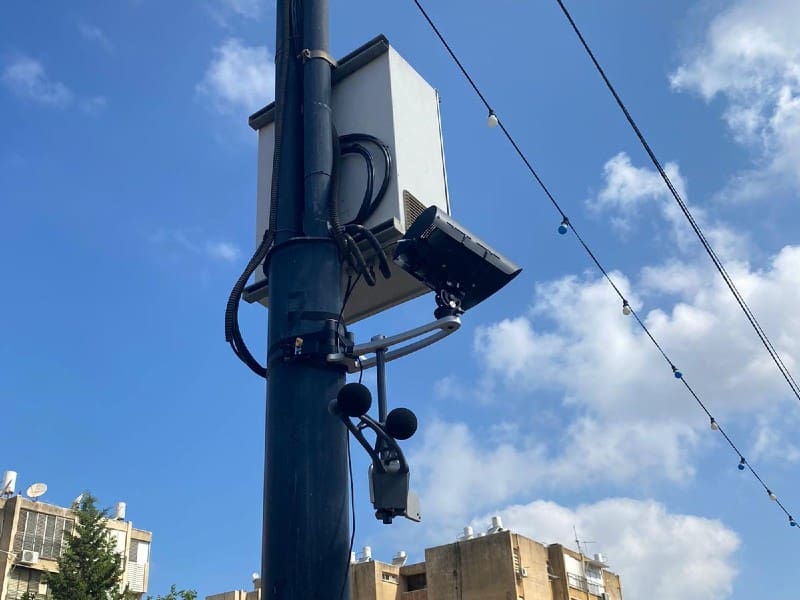
(haipo) - Unnecessary horns, loud motorcycles, and loud “upgraded” vehicles have all become a daily nuisance for many residents in recent years, especially in Haifa. Now, Haifa and Kiryat Bialik are joining the national “Quiet Cities” project, which seeks to tackle the phenomenon through advanced digital enforcement.
What is the “Silent Cities” project?
This is an initiative of the Ministry of Environmental Protection, under which budgetary support is granted to local authorities for the purpose of purchasing and operating smart enforcement systems to detect noise hazards from vehicles. The systems combine noise sensors, cameras and technology to identify offenses and enable data-based enforcement, without the need for an inspector to be present on the ground. A call for applications was published to local authorities, with over 50 residents, with the aim of expanding noise prevention efforts in Israel's major cities.
Are Haifa and Kiryat Bialik included and what is the budget?
The Haifa Municipality and the Kiryat Bialik Municipality received this week (27/1/26) a commitment to support in the amount of up to 750 thousand shekels. The budget is intended for the purchase, installation and operation of the enforcement systems, in accordance with the terms of the call for proposals, which were published on the Ministry of Environmental Protection website. The Noise Exposure Prevention Division at the ministry is accompanying the project and is responsible for monitoring with the authorities.
According to the terms, municipalities must complete the procurement and installation within 14 months from the date of approval of eligibility, with the milestones and conditions for transferring payments being defined in advance.
What will enforcement look like in practice?
In the first phase, enforcement will focus on a particularly common offense: using a horn for purposes other than preventing danger. This is one of the most annoying sources of noise in urban areas, especially at busy intersections.
At a more advanced stage, the systems will also enable enforcement against abnormal noise from vehicles such as motorcycles and vehicles that have undergone modifications designed to create increased noise. The locations of the systems will be determined by the municipalities, based on an analysis of public complaints and known nuisance hotspots.
Does it really work?
According to data from the Ministry of Environmental Protection, the answer is yes. In cities where the systems are already operating, such as Petah Tikva and Kiryat Ono, there has been a 70% decrease in the number of siren events at intersections where the systems were installed. The ministry estimates that residents of Haifa and Kiryat Bialik, especially those living near major intersections, will experience a similar change within a short time of the systems being activated.
Metrics, control and transparency
The Ministry of Environmental Protection has set clear success indicators for operating the enforcement systems. The systems are required to operate with high availability, so that the monthly downtime does not exceed 10%, and to handle at least 70% of the noise events recorded. In addition, even before enforcement begins, dedicated noise detectors will be placed at selected points to measure existing noise levels. After the systems are activated, a comparison of the data will be conducted, which will allow for the precise quantification of the decrease in noise levels and the improvement in the quality of life of residents.
And what does it mean for residents?
Beyond reports and punishment, the main goal of the “Quiet Cities” project is behavioral change: reducing unnecessary noise, reducing tension in public spaces, and improving the quality of life in the city. For many residents of Haifa and Kiryat Bialik, this is a real hope for quieter nights, fewer unnecessary sirens, and much less deafening noise under the window.
Maybe you'll give fines to drivers with phones, and then we won't have to honk at traffic lights to get them to drive. Because flashing the lights sometimes doesn't help.
It's time for the Sabinia area to be quiet, we can't stand the people who are honking. I hope the cameras will also catch the criminals who threw a grenade under my house.
The horn is an essential tool in the car and should make the driver think twice if pressing the horn is life-threatening and is similar to being fined for pressing the brake pedal.
This is an excuse for local authorities to milk more money from residents under the guise of maintaining peace.
Municipalities in Israel have a "talent" for focusing on marginal matters, and making them central, like the problem of silence. Let them not say that the municipalities are doing nothing....What about the more serious problem of cleanliness on the city streets? Noise in the city is disturbing, but the lack of cleanliness leads to morbidity...
Wise people understand that this is meant to fight the little citizen who wants to demonstrate, don't tell us stories about peace and quiet
In Kiryat Bialik, there is no peace in the public parks. Weekends are complete anarchy.
Before they fine themselves for the noise caused by cars, road cleaning, landscaping, and garbage removal. Municipalities are the main noise sources.
What about the noise made by Haifa Municipality gardeners cutting down plants?
They have nothing to do in life and invent new inventions as if they are signing something "new".
Come on, enough with the nonsense and the desire to make a profit and make people more angry than they are stressed.
Invent laws that are lenient and do good to people, free them from paying to the Nature Conservation Society and the Kayimet Foundation and the Nature and Parks Authority and all sorts of wealthy kibbutzim that hold state assets.
Release the people.
Not only that, but the weekend turns into a day of racing at the Kiryat Bypass (22) and in industrial areas in the area. Loud noise, weak suppression.
The Ministry of Environmental Protection should deal with other issues, in my opinion, there is no shortage of them.
Shabtai Levi Street is a good location for one of these.
The Haifa Municipality garbage truck in Kiryat Haim makes the most noise, and it's even louder this morning.
Are you kidding...? The main victims are the motorcycles at night and the muezzin and the hafels that broadcast at insane decibels towards the neighborhoods opposite.
Whoever forgot, there is a law like Novitsky that no one pays attention to. And whoever blows the horn will blow the horn and move on.
Urgent to install Oskar Schindler!! Terrible sirens from truck drivers and upgraded vehicles
Start at the Shimshon Bikurim intersection
Make some dumplings.
Why only from vehicles, what about noise pollution from loud music from neighbors exaggerating at odd hours?
Completely.
We also have unbearable guys on the rooftop at Independence 111 in Kiryat Ata who, every few weeks or months, listen to loud music in the very small hours of the night (the last time was the day before yesterday).
For them, the party starts right when it's forbidden to make noise (11 p.m.).
But why stop at just music?
In the same building on the first floor there is a family with a dog that barks at us regularly.
He would bark inside the house, but they let him go out onto the balcony and scream at us freely, whenever he feels like it.
I haven't encountered such inconsideration, or rather, lack of self-awareness, in a long time.
This is a new building that I wish had never been built.
There are too many noisemakers clustered here per square meter.
In Haifa, the noise is not just from cars or any other means of transportation, we also have the muezzin.
Nonsense, the motorcycles of the noisy offenders, their license plates are folded, and the cars of parking offenders are also hidden with stickers or rags, enforce this immediately, otherwise it's a blessing in disguise, it won't help.
Start with the bus and truck drivers. They are the biggest noise makers!!!
How long will it take for the installations to be dismantled from the column?