


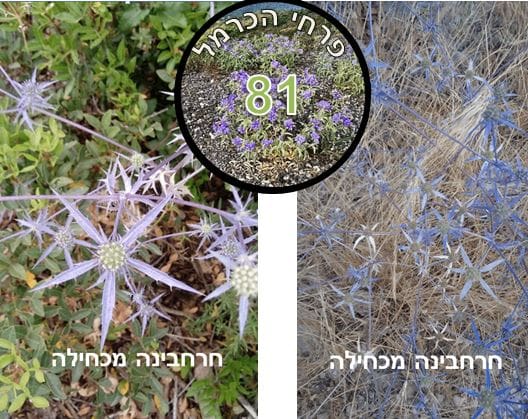
Carmel presents us with flowers in all seasons.
In this column we will always present one of the Carmel flowers, at the same time as it appears in the field, and you will be invited to visit it in one of the places where it blooms.
A blue-green sliver Eryngium creticum
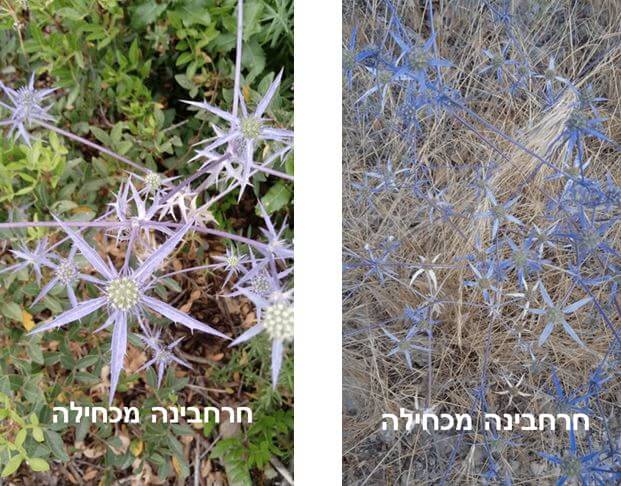
A perennial herb, with a sparse, branched, and thorny appearance, its flowers are tiny, bluish-purple in color, and its height is 20-45 cm. The purple plant stands out very much with its unusual color, it is impossible to ignore it. The bluish sedge is very prominent in the landscape.
Not all species of marigolds are blue. The two most common species of marigolds in Israel are among the blue-flowering: marigolds with a branching, branched stem, which is the most common, and marigolds, which grow only in groves and shady places, and whose stem is upright and does not branch.
Type name – A bunch of shit Derived from the root שרב = dry, while the name of the species – From blue Describes the prominent feature of the plant's stems and leaves that change color from green to blue.
The blue-eyed sedge undergoes a noticeable change throughout the seasons. Growth begins immediately after the first rain, when a rosette of soft leaves emerges from the base of the plant, growing close to the ground. The leaves, which are suitable for human consumption, are rounded in shape and have whitish spots. The leaf has a bitter taste, and it is one of the five plants mentioned in the Mishnah with which a person fulfills the obligation of eating bitter melon on Passover. A special element of the sedge is the plant's thorniness, a rare feature in the Apiaceae family. There are few thorny species in the family, and only two grow in Israel: the sedge and the sedge.
In the spring, several stems with leaves cut into narrow, spiky lobes grow from the rose. The color of the stems and thorns is green, and later, with flowering, they change to a metallic blue and remain that way throughout the summer months.
Blue hyacinth blooms in late spring and summer, from April to August, mainly in May and June.
The flowers are tiny, bisexual, blue to purple in color, grouped into an inflorescence that is an umbel with a diameter of 8 mm.
The flowers in the scalp do not all ripen together, but rather gradually. The flowers on the periphery of the scalp ripen first, and the ripening of the other flowers continues inward. To prevent self-pollination, the reproductive organs do not ripen together; the stamens ripen first, followed by the ovary.
The flowers produce abundant nectar, pollinated by small bees, butterflies, and wasps during the hot summer season.
The inflorescences are dense and are crowned with long, arching spines that remain with the fruit's scalp for a long time.
Each flower has a calyx of five tiny leaves, a corolla of five erect and separated leaves, five stamens, and two stamens. The fruit has two one-seeded carpels, and when ripe it splits into two seedpods. The fruits do not scatter when ripe but remain on the plant. When the stems dry out at the end of summer, the wind breaks them and scatters them across the fields.
Blue-bellied toadstool is common in abandoned fields and around houses throughout the Mediterranean region.
Distribution in Israel: Golan, Galilee, the valleys, Gilboa, Carmel, the mountains and desert of Samaria, the mountains and desert of Judea, the coastal plain, the northern Negev, the Negev.
ID
| family: | Apiaceae (Umbelliferae) - Umbelliferae |
| root: | In-depth and long. |
| height: | 45-20 cm. |
| Leaves: | In early winter, the plant develops a rosette of soft, rounded leaves. In spring, several stems grow from the rosette, which develop leaves that are cut into narrow, spiny lobes that are green in color. When they bloom, their color changes to a metallic blue. |
| stalk: | When young, it is green, but when it blooms, it changes color to blue-purple. |
| rash: | In late spring and early summer, mainly from May to June. |
| flower: | The flowers are bisexual, their color is metallic blue. |
| The structure of the flower: | The flowers are tiny, grouped into flat, 8 mm diameter, scalp-like inflorescences. |
| fruit: | It has 2 monocotyledons, and upon maturation it splits into 2 spermatophores. |
| smell: | The flower is odorless. |
| nectar: | The flowers are abundant in nectar, pollinated by small bees, butterflies, and wasps. |
| uses: | The young leaves are edible. |
A place to meet the flower of the week
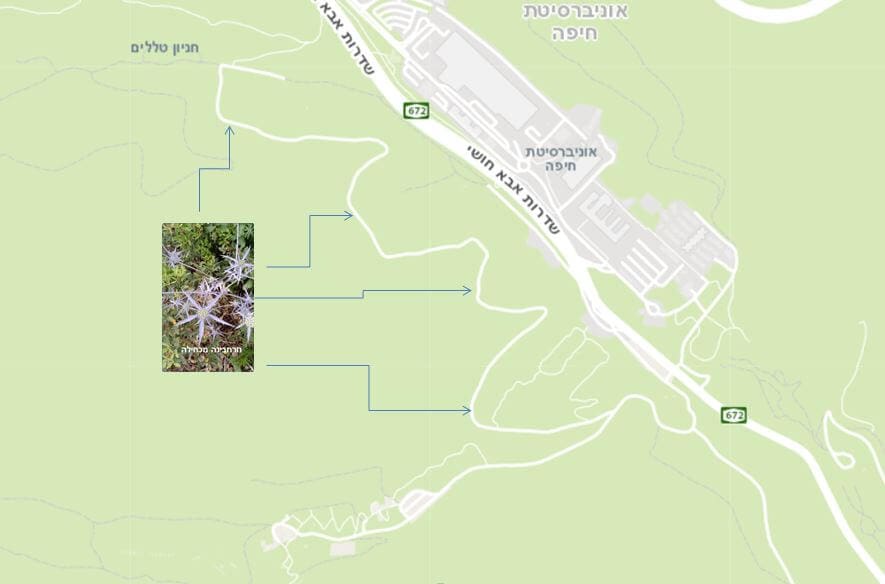
- Drive from Haifa on Abba Khushi Road – Route 672 heading southeast.
- Immediately after the pedestrian bridge to the university, turn right (south) to Tallim parking lot
- Continue about 200 m to the parking lot (located on the left of the road)
- After the parking lot, a paved road begins, go down it (on foot or by car) for about 100 m, until the place where the road turns south (from here there is no more entrance by car).
Continue along the footpath, with specimens of the sedge that bloom scattered along the perimeter path, mainly on its western side, until it meets the road leading to Haibar.
If you go to visit the flower with children, you can tell them the legend of the blue-eyed skunk.
The legend of the blue-eyed rascal
In a small, hidden valley, beyond the high mountain and the Singing Stream, lived a tiny, mischievous flower called the blue-eyed hyacinth. There was no other plant in the field that resembled it. Its petals looked like drops of blue paint that fell from the sky, and they sparkled like stars when the sun touched them.
But the little girl had a secret: every night, right when everyone else falls asleep, she dreams a blue dream. It's a dream in which she turns into a bird, flies through the sky, and whispers secrets to flowers across the land.
One day, as the sun set behind the mountain, Harhabina whispered to the moon:
"I wish I could really be a bird, even just for a day."
The moon, hearing the nightly wishes of all creatures, smiled with its soft light and answered:
"If you can find three things: the dew of dawn, the feather of a gray dove, and the smile of a child, I will grant your wish."
The next morning, as soon as her petals opened, Harhabina set out on a journey. She hopped on the back of a yellow butterfly, hovered over sunflower fields, and asked for help from every friend she met.
She found the dew of dawn on a water lily leaf.
A gray dove feather was given to her by an old dove who had known her since childhood.
But a child's smile, that was the hardest of all.
At the end of the day, when the sun had almost disappeared, a group of people found a little boy sitting alone in the garden, sad.
"Why are you sad?" she asked in a flowery whisper.
"Because no one believes me when I see flowers that talk," said the boy with wet eyes.
The little girl stood upright, moved her petals, and sang a little song about colors, freedom, and dreams. The boy opened his eyes, and then – smiled! A wide, genuine, and bright smile.
At that moment, the moon appeared, and in a silvery instant, Harhabina turned into a blue bird, with wings made of moonlight and stars.
She flew above the world, whispered sweet secrets to the flowers, and returned home like a flower, just as dawn broke.
Since then, every time a child smiles at a flower, maybe, just maybe, the little bundle of joy will fly away among the dreams again.