



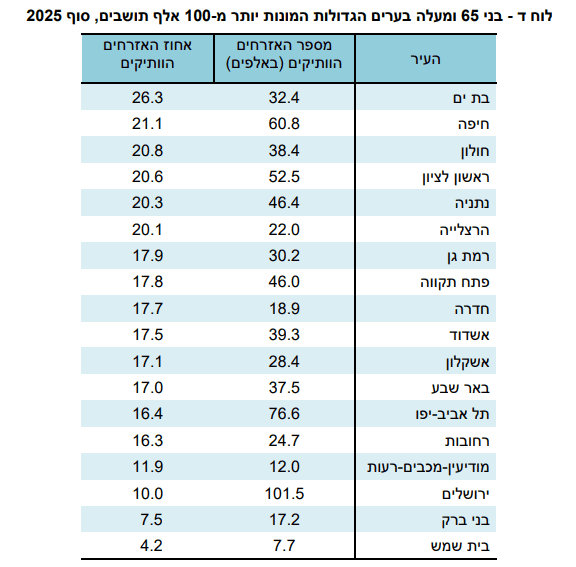
(haipo) – More than a fifth of Haifa’s residents are 65 years old and older, making the city the second largest city in Israel in terms of senior citizens. Data from the Central Bureau of Statistics, published on the occasion of International Senior Citizen Month, indicate that Haifa is home to approximately 60.8 residents aged 65 and older, constituting 21.1% of the city’s population. The demographic data adds to a broader picture of the lives of senior citizens in Israel, including questions of loneliness, personal security, economic status, health, and access to services.
Haifa among cities with a high proportion of senior citizens
Haifa ranks second among cities in Israel with more than 100 residents in terms of the proportion of people aged 65 and over in the population. Bat Yam ranks first, with a proportion of senior citizens of 26.3%. Haifa follows with 21.1%, followed by Holon with 20.8%, Rishon LeZion with 20.6% and Netanya with 20.3%. In Tel Aviv-Yafo, by comparison, the proportion of people aged 65 and over is 16.4%.
At the national level, at the end of 2025, the population of Israel aged 65 and over numbered approximately 1.317 million people, constituting 13.3% of the total population. The proportion of senior citizens in Israel has increased over the years: when the state was established, they were approximately 4% of the population, and today their share is three times greater.
More women, more living alone
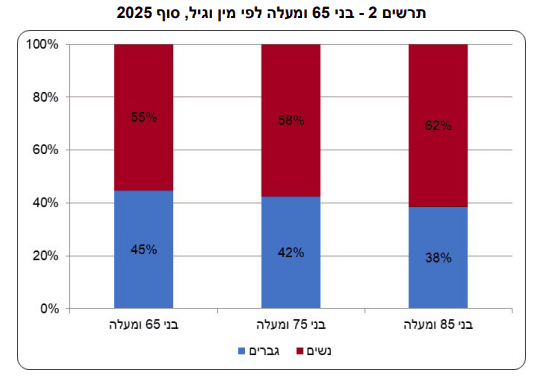
Among Israel's senior citizens, women are in the majority: about 55.4% of those aged 65 and over are women, compared to 44.6% of men. The gap increases with age, and among those aged 85 and over, women make up 61.6% of the population.
One of the most striking figures concerns living alone. Approximately 292 senior citizens in Israel live alone, about 24% of all those aged 65 and over. The rate of older women living alone is significantly higher than that of men: about 32% of women compared to about 14% of men.
These data take on additional significance in light of the findings of the CBS Social Survey for 2025, according to which 26% of those aged 65 and over feel lonely often or sometimes. For comparison, among the younger population, the rate of those reporting a feeling of loneliness is 19%. Alongside this, 85% of senior citizens stated that their family members value them to a great extent.
Satisfied with life, but not everyone manages to make ends meet
Despite the challenges, the picture of satisfaction among senior citizens is largely positive. According to the social survey, 89% of those aged 65 and over in Israel are satisfied with their lives: 34% defined themselves as "very satisfied" and another 55% as "satisfied."
However, when asked about the future, only 28% estimated that their lives would improve in the coming years. 40% believed that their lives would not change, and 17% estimated that their situation would be worse.
The picture is also not uniform in the economic sphere. 81% of those aged 65 and over reported that they manage to cover their monthly household expenses, while 18% stated that they are unable to do so. The expenditure data for older households also indicate the significant weight of the housing item: among households of a single person aged 65 and over, 37.8% of total consumption expenditure is directed towards housing. Among households of couples of this age, the rate is 29.8%.
It is important to emphasize that these are national data, and not data detailing the economic situation of senior citizens in Haifa.
Feeling of personal security and leaving the house
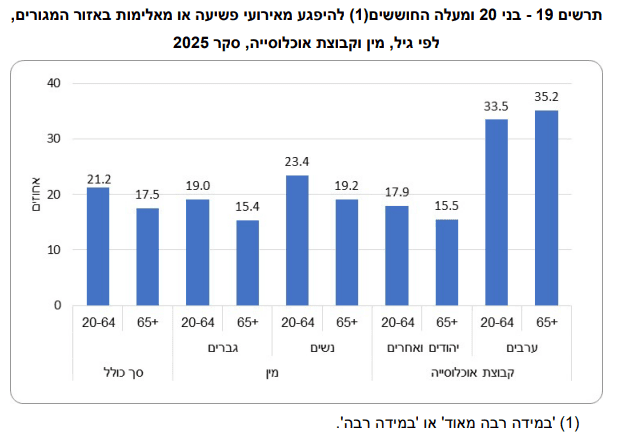
The social survey also indicates a sense of security that is not self-evident for some of the older population. 18% of those aged 65 and over reported that they feel not very safe or not at all safe walking alone in the dark in their area of residence. Among older women, this rate reaches 24%.
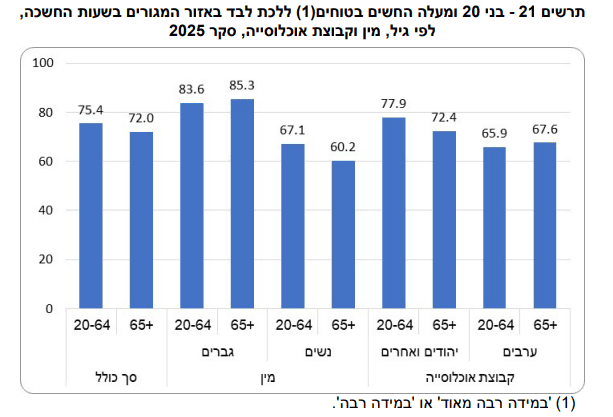
It also shows that 14% of senior citizens do not leave their homes after dark, and among women this rate is 18%. These are national figures, but they also raise questions regarding the planning of urban spaces: street lighting, comfortable and safe sidewalks, accessible public transportation, and spaces where one can move around safely even in the evening.
The Internet is coming to life, but not everyone uses it equally
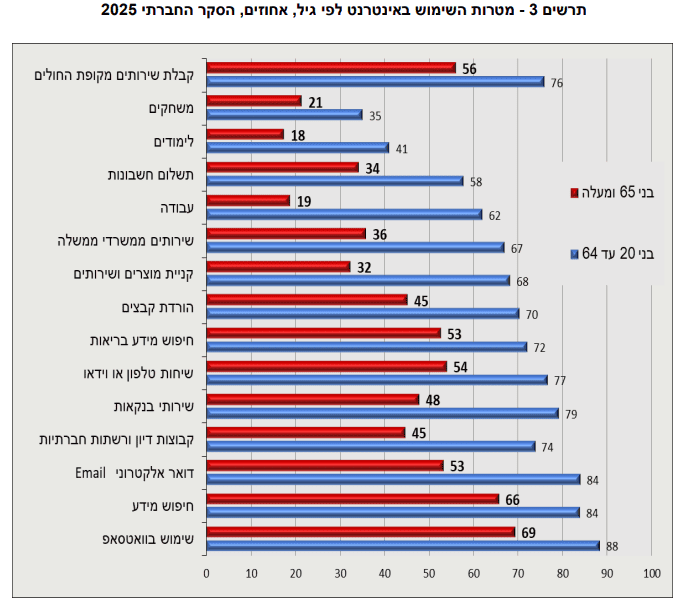
Internet use among those aged 65 and over is on the rise. In 2015, the rate of users was 49%, and by 2025 it had already reached 74%. However, online use is still lower than that of the younger population, of which 93% use the Internet.
The data shows that senior citizens also use the Internet for everyday needs: 48% use it to perform banking transactions, 34% to pay bills, 36% use it to receive services from government ministries, and 53% search for information on health issues. 56% use the Internet to receive services from the health insurance fund.
Alongside the digital expansion, a gap remains in the ability to use the Hebrew language. 66% of those aged 65 and over reported very good command of spoken Hebrew, 15% reported good command, while 19% defined their command as medium or weak, or stated that they do not speak Hebrew at all. In the area of reading, 25% reported medium or weak command, or the lack of ability to read Hebrew.
This data is particularly significant in a diverse city like Haifa, where services and information need to be accessible to populations with different linguistic backgrounds. However, the survey does not detail the rates of Hebrew proficiency among senior citizens in the city itself.
Longer life, but not all years are healthy
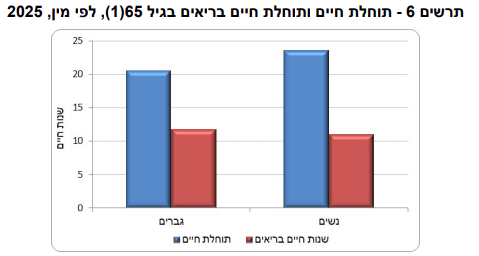
Life expectancy in Israel continues to be high, and among women it is higher than among men. In 2025, life expectancy at age 65 was 20.2 additional years for men and 23 years for women. This means that a man who reaches the age of 65 is expected to live on average until the age of 85.2, and a woman until the age of 88.
However, the number of years of life does not tell the whole story. According to the Central Bureau of Statistics, the number of healthy life years expected after age 65 is 11.7 for men and 11 for women. The gap between life expectancy and healthy life years highlights the importance of health services, access to medical care, community support, and opportunities to maintain an active lifestyle.
Senior citizens are also more vulnerable on the roads.
Another area where the vulnerability of older people is evident is road safety. In 2025, 1,866 people aged 65 and over were injured in road accidents in Israel. 101 of them were killed and 554 were seriously injured.
The proportion of elderly pedestrians among the fatalities is particularly notable: 57 pedestrians aged 65 and over were killed in road accidents, accounting for 45.2% of all pedestrians killed that year. This rate is significantly higher than the share of senior citizens in the population.
In Haifa, where more than 60 residents aged 65 and over live, national data emphasizes the importance of safe walking infrastructure, accessible crosswalks, appropriate traffic light times, and sidewalks that allow comfortable movement even for those who have difficulty walking.
A large population that requires urban preparedness
The data paints a complex picture: on the one hand, most senior citizens are satisfied with their lives, many of them are active, use the Internet, volunteer and continue to be a significant part of society. On the other hand, some deal with loneliness, financial difficulties, a sense of insecurity and gaps in access to services.
In Haifa, where more than a fifth of residents are 65 years old and over, this is not just a demographic statistic but also an ongoing urban challenge. The high proportion of senior citizens requires addressing their needs in the areas of housing, transportation, healthcare, public space, community services, and digital accessibility.
The national data do not necessarily indicate the situation of senior citizens in Haifa in each of the areas, but they provide important background for understanding the challenges facing a city with an especially large elderly population.