


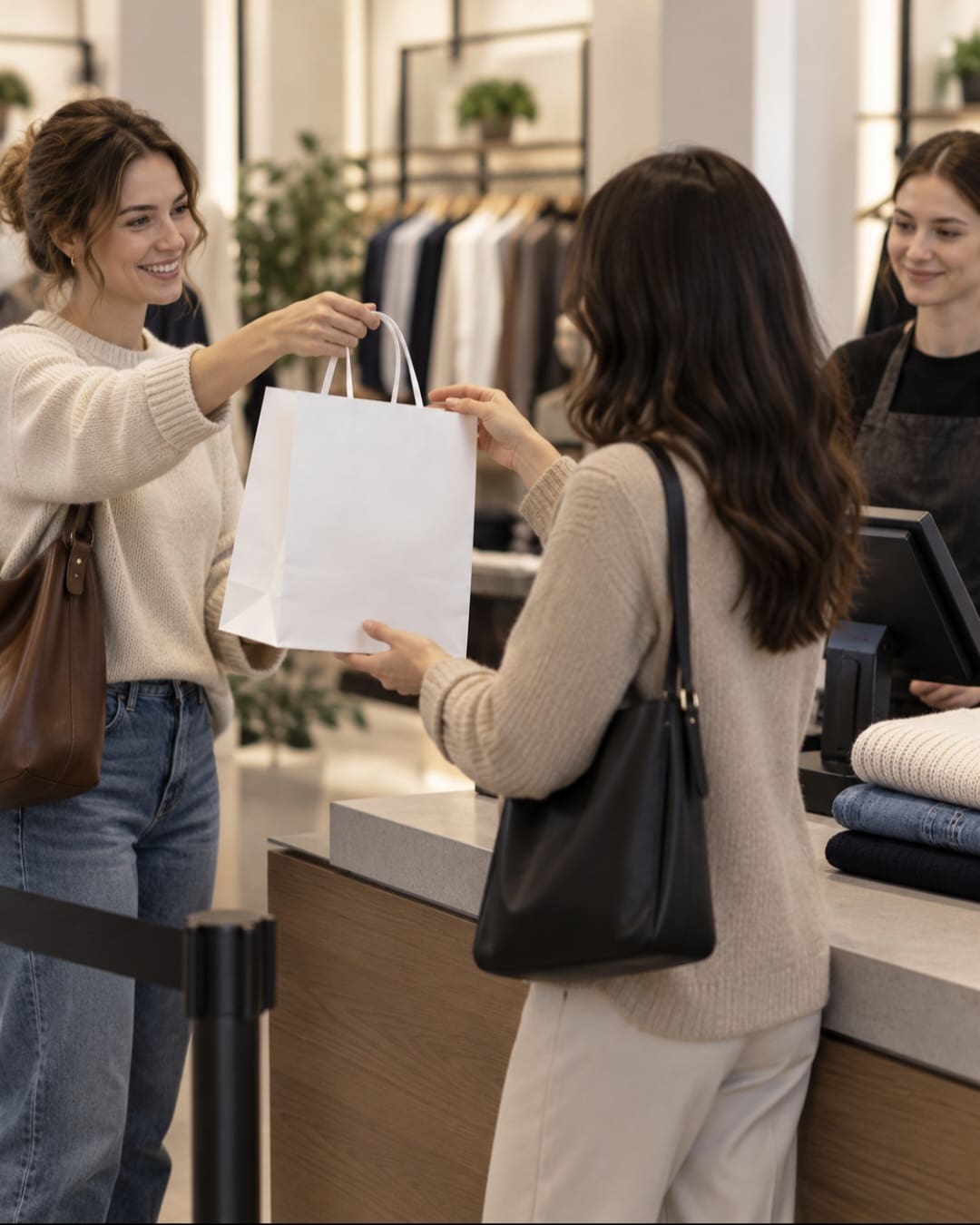
The story before you is an illustration of a familiar consumer situation.
Rina enters a clothing store with her adult daughter. The two of them walk through the shelves, try on, deliberate, and carefully choose a few items of clothing.
Satisfied with their choice, they went to the checkout. The purchase amount amounted to 450 shekels.
Rina handed over the credit card and paid.
When the cashier finished transferring the items, the familiar question was heard: "Want a bag in shekels?"
Rina looked at her daughter, then at the bag placed next to the cash register, on which was the store's name.
"What are you saying?" she turned to her daughter. "Isn't it rude that after a purchase of 450 shekels they ask me to pay for the bag too? And another bag that advertises the store? And what exactly is expected of me, to carry all the clothes in my hands?"
A woman standing behind her in line couldn't help herself. "You're absolutely right!
They charge us money and at the same time turn us into a walking advertisement.
Ask for a bag without their logo!"
The cashier, who was forced into the discussion, politely replied: "Ma'am, these are the store's procedures.
"Everyone pays for a bag."
"But I'm not willing to pay to advertise you." Reena replied.
"I'm a customer, not an advertising sign."
At that moment, the woman standing behind her opened her bag and pulled out two white bags, new and without writing.
"Take one," she said, handing it to Rina.
"I'm already here prepared. I'm tired of paying for other people's advertisements."
Rina's daughter, who up until that moment had been listening to the exchange, also intervened.
"I'm willing to pay a shekel for a bag without advertising. If I'm paying for it, why do I have to walk around the street with the store's name?"
The cashier shrugged.
"I understand you, but I don't have another bag. These are the bags we get."
"And you don't think that's strange?" Rina asked.
"I just work here," the cashier replied.
"The decisions are made by management."
Meanwhile, the line grew longer. A customer standing at the end of it intervened impatiently.
"You're making such a big deal out of a single shekel? The time we're wasting here is worth much more!"
The woman with the white bags turned towards him.
"That's exactly the point. Every time we're told it's just a shekel. A shekel here or two there, and we pay without asking questions. Why, really?"
"And what if the bag cost five shekels?" the daughter added.
"Even then, would you say it's just a small amount of money?"
The customer smiled awkwardly. "For five shekels I would have brought a bag from home."
"How interesting," Reena replied.
"So, the question is probably not whether we should pay, but how much can be charged from us before we start resisting."
The woman behind her nodded. "And what's most annoying is that we're advertising the store, and we're paying for it!"
Rina put the clothes in the white bag she received, thanked the woman and left the store with her daughter.
But the small conversation at the cash register raises a much bigger question.
Bags bearing the names of stores have become an integral part of the Israeli street. We walk with them in malls, get on buses, enter cafes and walk around public spaces with the brand names emblazoned on our hands.
For the stores, it is also an advertising medium. The business name, logo, and sometimes even the website address appear in a prominent place, and each customer carrying the bag exposes them to the eyes of other people.
For years, we received branded bags as part of the shopping experience. Later, with the increasing awareness of the environmental damage of plastic bags, the payment intended to reduce their use also came into the picture. In Israel, there is a legal obligation to pay for certain types of disposable carrier bags in large food chains. On the other hand, in clothing stores and other businesses, the price of the bag may be determined according to the business's policy. It is important to distinguish between the two.
The environmental goal of reducing the use of single-use bags is important, and there is certainly room for encouraging consumers to bring reusable bags with them. However, alongside this goal, another question arises: Why should a consumer who pays for a bag also carry the business's advertisement on it? After all, a store that wants to advertise its name in a newspaper, on a billboard, or on social media usually pays for the exposure. Here, however, the customer purchases a bag, carries it on the street, and gives the business additional exposure.
One could argue that no one is forcing us to purchase a bag, and of course we can bring one from home, and perhaps that is the right solution. One can also understand the business owners, because for them, producing and purchasing the bags involves costs.
But does it necessarily justify the inclusion of advertising on it when the customer is the payer?
Why shouldn't the customer have the option of choosing a simple bag, without a commercial name?
And if the business wants the customer to bear his name on the street, perhaps he should share in its ownership or bear it himself.
This is a worthy question, especially at a time when the cost of living is felt in almost every purchase, and the public is required to repeatedly examine what it is paying for.
When a small payment becomes a habit that we don't stop to examine, it's easy for us to forget that as consumers, we are also allowed to ask questions.
And maybe the next time we stand at the checkout and are asked, "Want a bag for a shekel?" we should understand the meaning of the bag offered to us.
We should remember: we are the customers, not the advertisers. Why would we pay for advertising we didn't ask for?
I agree that if the bag has the store's logo on it, we are advertising the store, but the main reason for paying the shekel is the important one: environmental pollution.
Let's all make a small effort and walk around with reusable bags.
The savings to the environment are much greater than the savings to the consumer.
But there are also quite a few people who walk around with logos on their clothes and it doesn't bother them.
Nonsense. Reusable bags cause much more damage than disposable bags, which are sent for recycling, unlike reusable bags.
Last Friday I encountered the same phenomenon at a home goods store (a large and famous chain). My husband and I arrived at the store to redeem coupons he received for the holidays. I needed something very specific. On the way, I found another item that came in a plain, factory-made package with a handle. At the checkout they asked me to add a shekel for a bag. I refused!!!! Not ready. This is simply robbery in its own right. As far as I'm concerned, pack it in cheap paper and it's a shame, like 50-60 years ago, but don't force me to pay more.
A store must. Wrap the goods that were purchased and paid for in the store. Either in a convenient packaging bag or in branded packaging without any charge. True. In Europe, the practice is widespread and unfair. When I shop in Europe, if I don't receive proper packaging, I leave the purchase at the checkout!!!!
There is no consumer consciousness at all in Israel.
Every garment here costs 150-200 percent more.
All food here is twice as expensive as in countries around us.
The suckers of cartels and monopolies who feast on us, of course with full approval from the state.
It depends on where you buy. I look for stores whose meat is cheap and vegetables are cheap. What I leave them will remain and rot in the store. We won't buy expensive! Israelis buy expensive, no! There is a choice to look for where it is cheapest. Buy everything there, even worth walking distance. A little driving or walking close to home, but worth it. Save hundreds of shekels this week, less than Uber this month!