


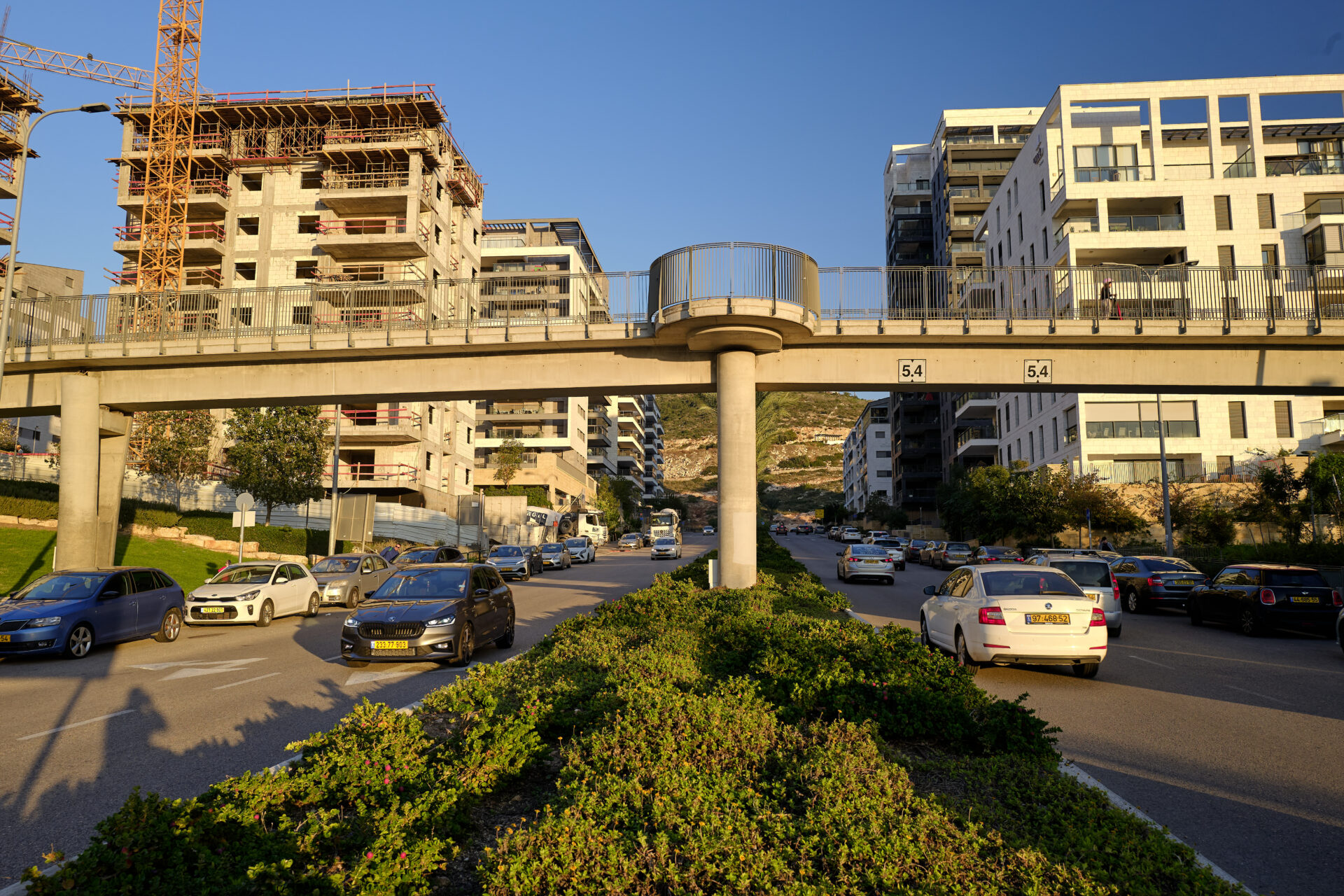
(haipo) The housing market in Haifa has been at a boiling point in recent years: apartment prices are rising at a moderate but consistent pace, rents are becoming more expensive, and the city is experiencing a negative migration of young people alongside new opportunities in nearby cities. In this reality, young couples and families in Haifa are faced with one of the most significant decisions of their lives, whether to buy an apartment or continue to rent. The decision, it turns out, is not just financial. It is influenced by market prices, interest rates, the supply of apartments, the municipal bureaucracy, and also by emotional, family and psychological considerations. We set out to examine what really motivates Haifa residents when it comes to choosing their residential path.
The housing market in Haifa: High demand, limited supply and prices that continue to climb

Yaniv Cohen, economist and owner of ynv finance, explains that the housing market in Haifa continues to be very active. In 2025–2026, apartment prices in the city will average approximately 1.56 million shekels, with a price per square meter of approximately 19,400 shekels in transactions that were actually carried out. According to him, this is a market characterized by high demand and moderate supply, a combination that leads to a moderate but consistent increase in prices.
Alongside this, CBS data indicate signs of stability and even a slight decline in prices in late 2025, which suggests uncertainty among buyers. "Buyers are more cautious," says Yaniv. "They understand that the market is volatile, but they still see Haifa as an attractive destination relative to the center of the country."
Rental prices: large gaps between neighborhoods
The rental market in Haifa is very diverse. A one-room apartment in the Hadar area or in central neighborhoods will cost between 2,200 and 3,300 shekels per month. A two-room apartment will range between 2,800 and 4,200 shekels, and a three-room apartment in Hadar or Neve Sha'anan will cost between 3,500 and 5,200 shekels. In upscale neighborhoods, prices can reach 7,000 shekels or even more.
Demand for rentals is particularly high in student neighborhoods like Neve Sha'anan, where tenant turnover is high. In contrast, in neighborhoods like Merkaz Carmel and Ahuza, rents are high but allow young couples to enjoy a high quality of life without purchasing an apartment at a high price.
Price-to-rent ratio: Should you buy or rent?
One of the important indicators in making a decision is the Price-to-Rent Ratio — the ratio between the price of the apartment and the annual rental cost. In Haifa, the ratio ranges from 36 to 41, a figure that indicates a relatively low return for investors. "This means that buying is less profitable for a pure investor," explains Yaniv. "But for a family looking for stability, it's a completely different story."
The neighborhoods in Haifa: Each neighborhood and its DNA
The choice between buying and renting varies greatly from neighborhood to neighborhood. Ahuza and Merkaz Carmel are considered prestigious, so many prefer to rent there to enjoy the surroundings and accessibility. Hadar, on the other hand, offers more affordable prices and attracts both first-time buyers and renters. Areas around the Technion and Neve Sha'anan are characterized by high demand for rentals due to their young, student population.
Young couples: between a dream of an apartment and a financial reality
Cohen notes an interesting phenomenon: Many young couples choose to rent in prestigious neighborhoods, out of a desire to enjoy a high quality of life, even if it is not the optimal economic move. On the other hand, in cheaper neighborhoods there is a tendency to purchase an apartment, because the required equity is lower.
"The choice is not always rational," he says. "It is also related to the desire to raise children in a certain environment, to closeness to family, to a sense of belonging."
Haifa of 2026: A City in Waiting

Attorney Roy Waller, Senior Partner at Waller & Co., who specializes in local authorities, real estate, and planning and construction, presents a more complex picture. According to him, Haifa is in "waiting mode." Renters have no choice but to stay in the city, but buyers, especially young couples, are looking for their future outside of Haifa.
"Haifa is one of the oldest cities in Israel," he says. "Over 20% of the residents are pensioners, and there is a negative migration of thousands of young people each year." He says that while construction is booming in Tirat Carmel, Krayot and Nesher, in Haifa the process of issuing a building permit takes an average of 445 days, a figure that discourages developers and buyers alike.
The neighboring cities bypass Haifa
Waller explains that the nearby cities have understood something that Haifa forgot: certainty is the name of the game. Tirat Carmel has become a center of attraction for young people thanks to new neighborhoods, modern infrastructure and parks. Nesher benefits from its proximity to the Technion and rapid TAMA processes. The Krayot offers high accessibility to the metro and train, alongside commercial and employment development.
"Haifa is a besieged city," he adds. "Anyone trying to enter from the north gets stuck in traffic jams that are created due to the lack of coordination between infrastructure projects. Public transportation is inadequate, and the cable car and the Carmelite are unable to provide a solution."
Real estate decisions in Haifa: Not just numbers

Chairman of Yaffe Nof, attorney and real estate appraiser Assaf Gastfreund, explains that the decision between buying and renting is not just financial. "Those who buy an apartment do so with a long-term view," he says. "They want stability, an anchor for the family, a connection to the neighborhood and the education system. There is also an examination of future potential, urban renewal, improved infrastructure, proximity to the sea."
On the other hand, renters are mostly young people or families just starting out, who prefer flexibility. "For them, the amount of rent, the ability to move easily, proximity to entertainment centers or work are more important."
High interest rates and economic uncertainty: everyone is on the fence
In the past year, due to high interest rates and heavy financing costs, many have chosen to postpone the decision to purchase. "People are sitting on the fence," says Gastfreund. "They are waiting to see where the market goes. But those who have equity and financial breathing room still see Haifa as a good alternative to the center."
Haifa: Opportunity or Missed Opportunity?
Despite the difficulties, experts agree that Haifa has great potential. The city offers a variety of neighborhoods, significant price gaps, and potential for improvement that is not always priced in. But to realize this potential, profound change is required: releasing construction barriers, improving transportation, attracting businesses, and creating planning certainty.
Buy or rent? The real question
Ultimately, the decision between buying and renting in Haifa is not just a question of which is cheaper. It is a question of stage in life, of personal risk level, of sense of belonging and of trust in the city's future. Haifa is at a crossroads and the choices of its residents reflect the hopes, fears and complex realities of the Israeli housing market.
Did the article interest you?
As a couple with three children, apart from Ramat Eshkol, there is nothing to look for in Haifa. The new construction, mostly in closed neighborhoods, mostly uninformed, makes the city and the surrounding houses very ugly. It is enough to see Doctor 21 and Doctor 47, a typical closed neighborhood, considering the state of the street's density, young people have nothing to look for there, the situation there is already clearly not right. More density, more towers. Haifa, which claimed to be a better, more quality city immersed in green, is deteriorating from bad to bad, all the new construction is ugly, lacking beauty and grace. If we take Neot Navon, they could have made beautiful terraces with garden apartments, and later the Lincoln Hills project, but they chose to be ugly again, to make the place more attractive again, thinking about beauty and design, they choose with abject tastelessness. Young people want parks, to take the children to play, spaces. Haifa is going to become a place of high-rise housing estates. I want to see the decision-makers living in these towers.
The city's mismanagement of urban planning and real estate is a well-known fact.
When building permits under TAMA 38 are issued in violation of the law and in clear violation of authority, along with uncontrolled flooding of TAMAs in the Carmel Ridge and systematic demolition of the building fabric along with massive tree felling, it is not surprising that demand for apartments is declining, even on the central Moriah-Horev axis, and apartment prices are falling accordingly.
A substantial personnel replacement of the leaders of the failed "construction planning" is required immediately, headed by the chairman of the Planning and Construction Subcommittee.
exactly!
Corrupt people with connections and sky-high property taxes