


Walter Clay Loudermilk (1888–1974) was an American scientist who specialized in soil and water conservation. He worked for the United States Soil Conservation Service, and in the 30s and 40s, he traveled the world as part of his work, trying to understand why some cultures thrived and others collapsed.
As part of his many tours, he also visited Israel.
Laudermilk, who was not Jewish, fell in love with the pioneering collective enterprise of afforestation, soil conservation, and agricultural development and wrote a book about it – Eretz Israel, the Promised Land. The book contains quite a few ideas that were realized over the years, such as using the Yarkon River to irrigate the Negev, a vision that was realized in the national carrier.
Laudermilk was one of the initiators and founders of the Faculty of Agricultural Engineering at the Technion and headed it for several years. On the front of the building there is a sign in Hebrew and English with the Eleventh Commandment that Laudermilk composed.
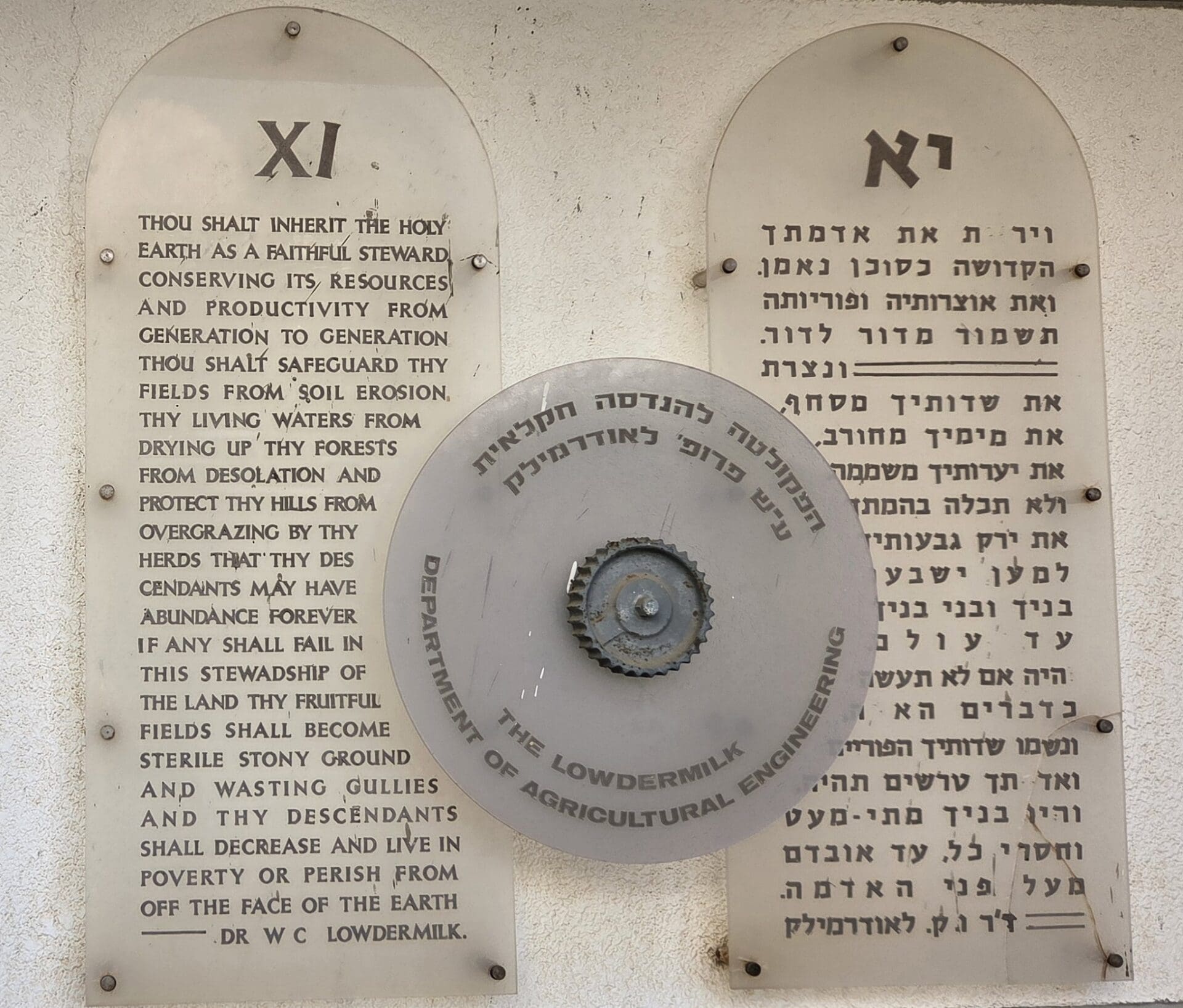
"And you will inherit the holy land as a faithful steward, and you will preserve its treasures and fruits from generation to generation."
This commandment of Laudermilk is a result of his extensive research on the survival of cultures, the results of which he formulated, before coming to Israel, very succinctly: "Civilizations don't just fall because of wars or political crises; they collapse when they destroy the land, water, and forests on which they rely."
The following passage leaves Odermilk with quite detailed operating instructions:
- Protect the soil from erosion
- Protect water sources from drying out
- To protect the forests
- Prevent overgrazing
- To pass on to future generations a more fertile land than we received
Laudermilk warns at the end of the sermon, saying that if man fails in his mission as guardian of the earth, the fields will become barren, the ravines will turn to rocks, and future generations will live in poverty or perish from the face of the earth.

Environmental revolutionary
Laudermilk's basic claim, the claim at the base of the Eleventh Commandment that man is not the owner of the land but only its trustee and that his role is to preserve and develop it for future generations and that they, in turn, will pass it on, is the basis of concepts such as sustainability and sustainable development, which are the foundations of the environmental movement today, but were not at all in the discourse eighty years ago, when Laudermilk spoke about it.
Laudermilk was among the first to present a systems approach in which water, soil, forests, and agriculture are not separate domains but a single ecosystem.
In a world of climate change, fires, floods, and land depletion, Loudermilk's message is not just a call to preserve nature. It is a spotlight on the fact that the question is not what land we received, but what land we will leave behind. This is a topical question not only in the context of land and water conservation but also in the urban context of developing a city at the expense of the nature around it.
Did the article interest you?
🌺🌺🌺