


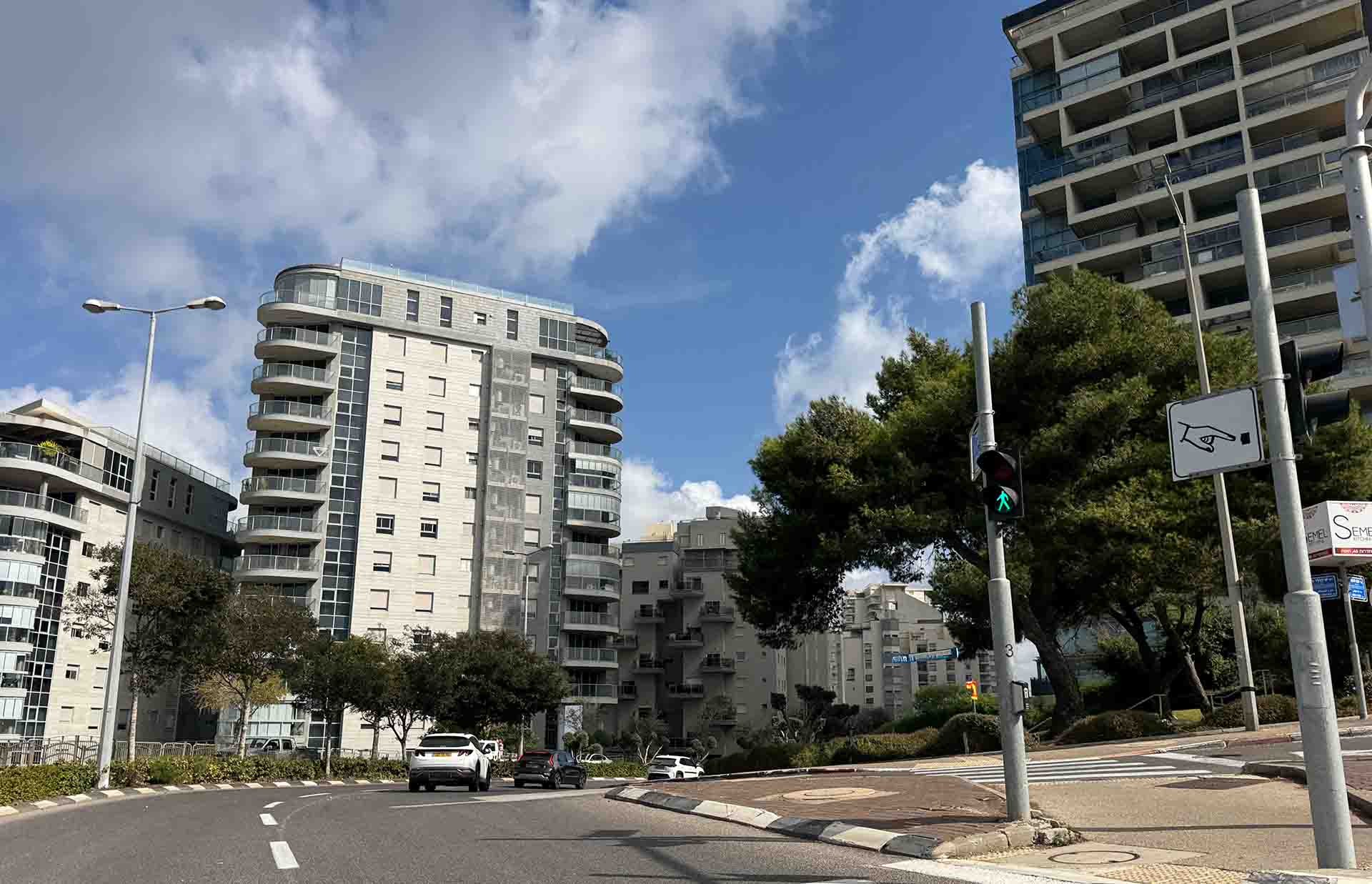
(haipo) – Appeals Committee: A long and complex meeting was held within the framework of the Appeals Committee of the District Planning and Building Committee, on Wednesday, 03/25/2026, regarding one of the most controversial construction plans in Haifa: a plan to expand the Savyoni Danya neighborhood, which was submitted by developer Yuval Alon.
The meeting, which lasted for hours, partly face-to-face and partly via Zoom, dealt with Yuval Alon's request to increase the number of housing units approved under the program from 630 to 800 units. This was despite the fact that the Haifa Municipality had requested to reduce the number of housing units to 531.
Alongside the developer's request to increase the number of housing units in the plan, his lawyers also requested that the obligation to open the dual exit from the neighborhood, connecting to Ramat Alon, be postponed until after the construction of 400 housing units. The request sparked strong opposition from residents of Savyoni Danya, residents of Ramat Alon, municipal professionals, and Deputy Mayor Sarit Golan Steinberg.
Plan details: 630 housing units approved — and the request to increase to 800
The program in question, a number 304-1319011, deals with an area of approximately 60-63 dunams along Mendel Singer and Yaakov Orland streets in the Savyonei Danya neighborhood. The land is owned by the Yuval Alon company, and the district committee has already approved the deposit of the plan in December 2024, on the condition that the scope of construction will be limited to 630 housing units and that the height of the towers will be reduced to 22 floors. The plan includes a mix of uses: commercial space, public buildings of approximately 12.7 dunams and 24 dunams of open space.
Objections to the plan:
The Planning Administration has registered, as of the date of publication of this article, 38 objections to the plan. You can view them here. In this linkAmong the opponents is also the Haifa Municipality, which requested, on 11/3/25, to reduce the number of housing units in the plan from 630 to 531.
The developer wants to add a unit.
On Wednesday, the developer requested a return to the original number he had previously promoted, 800 housing units, and in effect significantly increase the density in the neighborhood and the scope of construction. This is a request for a dramatic addition to a neighborhood where there are already about 1,000 housing units.

Historical background on the neighborhood: from a prestigious development to a controversial neighborhood
Savyoni Danya was established in the 90s as a new extension of the old Danya neighborhood, which for years was considered one of the most prestigious neighborhoods in Haifa. The idea was to create a quiet, green neighborhood relatively isolated from the city, with low-rise construction, narrow streets and little traffic. Over the years, a rural-urban character was maintained, with open views of the nearby wadis and a high sense of privacy.
The lack of a double exit, the narrow streets, and the relative distance from major transportation routes have made the neighborhood a sought-after place on the one hand, but also a neighborhood sensitive to any planning changes on the other. Any significant construction addition is perceived by the residents as a threat to the original character of the place.
Construction will destroy another forested slope in Haifa: felling hundreds of trees and possible damage to Wadi Ein Dor
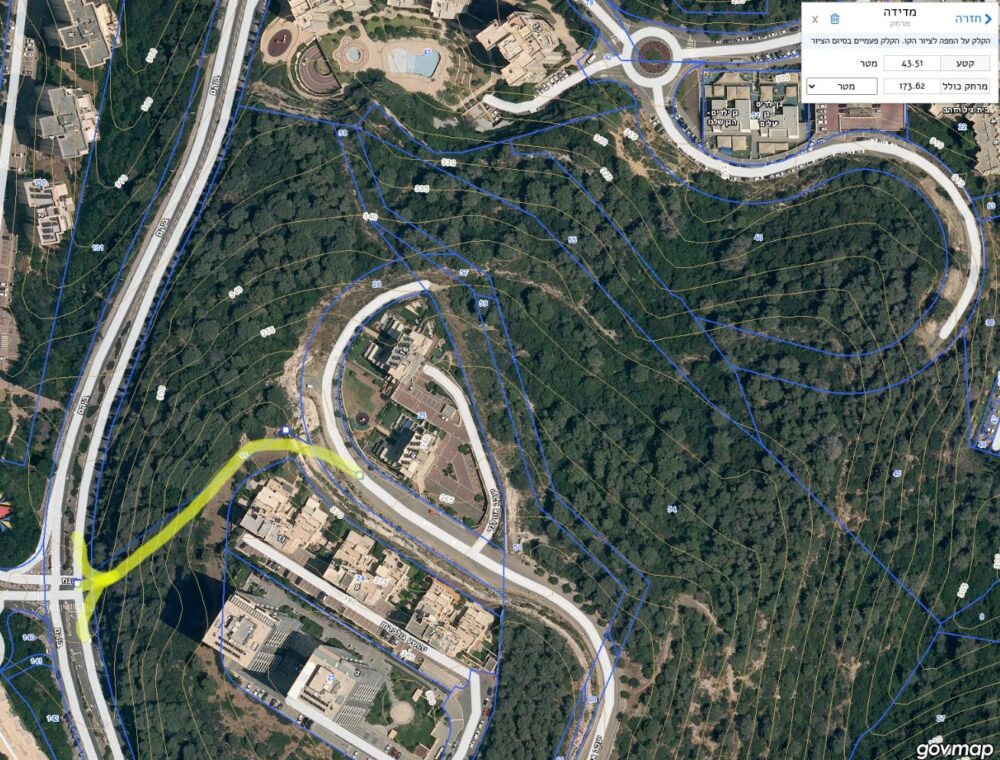
One of the main issues in the discussion is the location of the plan on a forested slope that includes a forest of pines and oaks. As well as the addition of a paved road that will severely damage the forest. According to the plan, about 420 of the 700 existing trees in the area will be cut down. The Society for the Protection of Nature and the municipality warned that this is a significant damage to urban natural values, and that there is a real concern about damage to Wadi Ein Dor, one of the most beautiful and sensitive wadis in the area.
Many residents claim that the area constitutes an important green lung, and that cutting down the trees and erecting tall towers will completely change the character of the neighborhood and the view from it.
Resistance of Savyoni Danya residents: Action committee, fundraising and ongoing struggle
Residents of Savyoni Danya have formed an action committee, which has raised funds to finance professional opinions, legal advice and public campaigns. They claim that the plan in its current form will cause severe damage to the quality of life, burden existing infrastructure and create unbearable traffic congestion.
“This construction is not suitable for the neighborhood,” the committee said. “It involves a sensitive slope, cutting down trees, and a density that does not match the character of the place. The municipality previously requested to build 500 housing units and another 30 units on the Rami lot, but now it turns out that the developer is also a partner there. There is no certainty that the state will ensure public balance on the land it owns.”

Opposition from Ramat Alon residents: Fear of opening the road and flooding the neighborhood with traffic
Residents of Ramat Alon, the neighboring neighborhood, have been opposing the opening of the road connecting the two neighborhoods for years. They claim that opening the road will cause residents of Savyoni Danya and other neighborhoods to use it as a detour toward the Technion and Neve Sha'anan, which will lead to heavy traffic congestion in a quiet, narrow neighborhood.
In the past, Ramat Alon residents proposed alternatives for another road that would lead to Emek Heshemesh or to the estate, but these proposals were rejected due to possible further damage to nature and the forest. The road connecting the neighborhoods already exists for the most part, so any other alternative requires a new breakthrough.
The issue of dual origin: essential safety condition or unnecessary delay?

One of the main conditions in the current plan is the opening of the dual exit from the neighborhood, connecting to Ramat Alon, after the construction of 200 housing units. This means that the 201st unit cannot be built without opening the road.
Residents of Savyoni Danya actually support the opening of the road, as it will shorten the journey to many neighborhoods in the city. On the other hand, residents of Ramat Alon are strongly opposed.
On Wednesday, the developer requested a postponement of the road's opening until after 400 housing units have been built. The request means that all quarrying, construction, trucks, and heavy work will be carried out from within the Dania neighborhoods only, through narrow streets, for months on end, which could severely damage the quality of life and even endanger human life in the event of a fire.
The Action Committee: “The plan is beyond any criticism”
The Savyoni Danya Action Committee presented a series of harsh claims in the hearing: “The simulations are inaccurate. The directions are incorrect, as are the heights. Even from Abba Khushi Street, the 30-story building will obscure the view. The outline plan specified only 22 floors, and now they are asking to exceed that.”
The committee also mentioned the large fire that occurred in the area about a decade ago and the State Comptroller's report that followed it: "One of the things that can prevent a disaster in the event of a fire is a dual exit. There is already approval today to connect the road between Ramat Alon and Savyoni Danya. The municipality has not paved an approved road for 30 years."
Planning history: old stipulations, improvement levy and empty lands
The committee recalled that in the past, before the improvement levy law, planning conditions such as paving a road were used as a condition for construction. In the first Savyoni Danya plan, part of the construction on Yaakov Orland Street was conditioned on paving the road to Ramat Alon, and therefore many plots of land stood empty for years.
"Today there is a development levy, but in the past there wasn't. After the Savyoni Danya neighborhood was built, it was decided to transfer 100 dunams to the municipality, which would only be possible to build on after the road connecting Savyoni Danya to Ramat Alon was opened. This was the condition, which is equivalent to the development levy today. Because the road was not opened, it was not possible to build until today. The current plan allows construction until the road opens after 200 units."
Comparison with similar projects in Israel: What can we learn?
The debate surrounding Savyoni Danya is reminiscent of similar struggles in other cities in Israel. In Jerusalem, for example, an evacuation-construction project in the Kiryat HaYovel neighborhood sparked opposition due to damage to trees and open spaces. In Tel Aviv, the “Givaat Amal” project exposed the tension between developers and longtime residents. In Ramat Gan, the construction project in the stock exchange complex sparked debates over traffic congestion and overcrowding.
In all these cases, the planning committees were required to balance development needs with maintaining quality of life. Sometimes projects were approved only after a significant reduction in the scope of construction, the addition of green spaces or improved transportation solutions. Residents of Savyoni Danya hope that the district committee will take a similar approach and demand adjustments that will prevent irreversible damage to the neighborhood.
Quality of life in the neighborhood: “It is almost impossible to double the number of residents”
Residents of Savyoni Danya claim that it is already very difficult to leave the neighborhood during rush hour. “It is almost impossible to double the number of residents,” they say. “It will hurt both us and the buyers of the new apartments.”
Deputy Mayor Sarit Golan Steinberg She argues that the neighborhood should be examined from a holistic perspective: “We need to check whether the project will not cause more harm than good. Construction is important, but not at any cost.”
The construction period: “A difficult period, but temporary”
Even opponents admit that if the plan is approved, the construction period will be very difficult: noise, dust, trucks, roadblocks and damage to air quality. However, they emphasize that this is a temporary period, while the consequences of unbalanced construction could be permanent.
The developer's position: Request to increase construction and postpone the conditions
The developer wants to increase the number of housing units to 800 and allow him to begin building 400 units without conditions. The opponents want to consider the quality of life in the neighborhood and not allow construction that would destroy the quality of life for both those who purchase an apartment in Yuval Alon's project and those who already live in the neighborhood. "The goal is not to build hundreds of housing units without considering what is happening in the neighborhood, but to find the balance that will allow both the developer to profit and maintain sane life in the neighborhood."
Sarit Golan Steinberg's position: “The entrepreneur's arguments are ridiculous”

Deputy Mayor and chairwoman of the local committee's subcommittee, Sarit Golan Steinberg, attacked the developer's claims during the hearing: "The developer's representative claimed that I had a conflict of interest because I had previously made it clear to the residents that I was opposed to expanding the housing units. I explained to him that this was precisely my job, to voice a professional and public position. Their arguments indicated a lack of familiarity with the neighborhood. You can't talk about pedestrians and bike paths when you can't widen the roads."
Golan added that hundreds of objections were submitted: “Civic involvement helped the committee understand the implications of the project on everyday life.”
What next?
The district committee is expected to make a decision in the coming weeks. Until then, the tension between the developer, the residents, and the municipality will continue to accompany one of the most explosive plans in Haifa.
Yuval Alon's company responded: We have difficulty understanding the opposition to the plan, which will actually benefit the neighborhood:
"We believe that our plan will bring about a significant improvement in Savyoni Danya. It is important to emphasize that of the approximately 64 dunams in the plan, only 28 dunams are designated for residential use, while the rest of the area is allocated for public spaces and public areas. This is the first urban plan in the neighborhood, and the rest of the construction in the neighborhood has actually developed around it."
Regarding the road connecting Savyoni Danya to Ramat Alon — this is a statutory road that has been in the planning stages for years, and there is a budget for its planning. We proposed paving it, which would allow the neighborhood to be opened up and prevent its current situation as a closed neighborhood.
In addition, we have allocated the best area for the construction of a new school. Thanks to the plan, more young people will come to the neighborhood, and it will not become an aging neighborhood. The addition of housing units will also lead to improved public transportation that will serve all residents.
"We are convinced that the plan will do good for the neighborhood — it will develop it, rejuvenate it, and improve the quality of life there. We hope that the proposal will be approved, and we believe that the municipality should support its advancement, because it will benefit the residents and the entire neighborhood."
As soon as they approved the construction of the Trio and Manrev towers in the reserve, which are not at all suitable for a green neighborhood, what do they have to worry about? Not to mention a busy main road that goes down towards Nesher 24/7. In short, far from a luxury neighborhood, and it's a shame! I miss the world of the 70s-80s with its low-rise houses, its green home gardens. The same goes for the mansion of the past, for the Western Carmel of the past with its low-rise houses surrounded by green fields. Everything is being destroyed before our eyes, and in the end we will all live in ugly, crowded concrete cubes with a luxurious lobby and a pool that we visit once in a year.
As soon as they approved the construction of the Trio and Manrev towers in the reserve, which are not at all suitable for a green neighborhood, what do they have to worry about? Not to mention a busy main road that goes down towards Nesher 24/7. In short, far from a luxury neighborhood, and it's a shame! I miss the world of the 70s-80s with its low-rise houses, its green home gardens. The same goes for the mansion of the past, for the Western Carmel of the past with its low-rise houses surrounded by green fields. Everything is being destroyed before our eyes, and in the end we will all live in ugly, crowded concrete cubes with a luxurious lobby and a pool that we visit once in a year.
High-rise construction will be stopped immediately!
When the home front is part of the battlefield – missiles fired at Israeli cities, there is no point in building towers.
Building the towers is not in our best interest!!!
The ultimate goal is to create an urban ghetto, with electronic supervision and control.
"15 Minute City"
Read about it. This is a global trend, of the "New World Order."
The goal is to rob us of our natural resources (forests, streams, sea), and crowd us into urban areas – in towers!!!
You must not let this happen.
In times of trouble (missile, fire, etc.) no one will save us.
As has become apparent in recent years, urban planning is increasingly being transferred to private developers, who function as de facto “super planners” – even though there is no legal basis or official recognition for this. This reality requires a new and incisive examination.
Residents choose a residential environment with a defined character and invest their best money in it. A fundamental change in this character, initiated by private parties, is illegitimate and cannot be done at the expense of the residents.
Developers have no authority, neither statutory nor moral, to determine the image of the city. In practice, their considerations are primarily economic – profit maximization and nothing more. The well-being of residents, their quality of life, and environmental implications are marginalized.
The planning committees – local, district and national – also adopt an approach that promotes almost automatic expansion of construction, while ignoring fundamental considerations: infrastructure burdens, safety and emergency escape routes, and ongoing damage to open spaces and “green lungs.” Fiscal considerations – fees, levies and tax revenues – are given excessive weight.
The developer's claims about his desire to "benefit" the residents are nothing more than lip service. He has no mandate to define their welfare, and there is no basis for the claim that the public is asking for it.
The question also arises as to what this “deep understanding” the District Committee attributes to itself, and what its authority – legal and ethical – is to force residents to make a fundamental change in their living conditions.
In light of the above, any additional construction plan in the Savyoni Danya neighborhood should be rejected and rejected.
You are right in every word!
Every word carved in stone !
Neglecting nature, ignoring neighborhood residents
And her needs are placed on the table of money and bells.
It is to be assumed that the owners of Yuval Alon and his ilk, and members of the appeals committee, would not want to live in concrete tankers,
The future density described.
In the neighborhood, the request suddenly "grew" to 800 units, because according to the calculations of the requesting company, they do not sufficiently fill the company's pockets.
Enough of you greedy people!
It seems to me that everything depends on the bribe that will be paid to whom and how much. Once there is agreement on the bribe, all significant objections will disappear as if they never existed.
What is called: After the Flood
It seems like no one really cares about the residents.
– Pave the road connecting the neighborhoods urgently and urgently. Especially when this neighborhood is surrounded by valleys with a flammable pine forest.
– Towers are a danger to life in war situations. It is impossible to evacuate above the 15th floor in Israel. The existing tall towers in the neighborhood, up to 25 floors, are a disaster in emergency situations. Every missile there will cause the jeweler to evacuate hundreds of residents. We must stop building towers over 15 floors, even at the cost of more buildings and fewer heights. Maximum up to 15 floors. As above, Neot Navon, and all future evacuation and construction in Haifa must stop building death traps.
Why not build? Haifa is not developing or growing. A sinking city of old people. Only new construction will inject young couples and oxygen into the city. Look at Yokneam, Nesher and Tirat Carmel, which bypassed Haifa in a roundabout way.
Young couples cannot afford to buy an apartment in these projects.
Most of the residents of the towers in Savyoni Dania, from Oscar Schindler to Bocha Gloverman, are veteran and elderly home improvers who sold their villas and plots of land in Greater Dania and moved to single-level apartments.
And young people who can afford it are leaving Nesher and Tirat Carmel in favor of Tivon/Yokneam.
We built in Denmark
To put things in perspective. The building rights on the area are 200 apartments in buildings that fit into the slope. The municipality wants to approve 500 apartments in huge towers in the area, the contractor has submitted plans for 630 apartments in several towers as a wall in front of the neighborhood. Now it wants to build 800 apartments in the area (looks like an attack instead of a defense of the plan). The bottom line in the neighborhood is that there is no infrastructure that can support this construction, it was not designed and was not intended for you, and this is in addition to all the damage to the homes in the neighborhood. Hence the strong opposition of the neighborhood residents.