


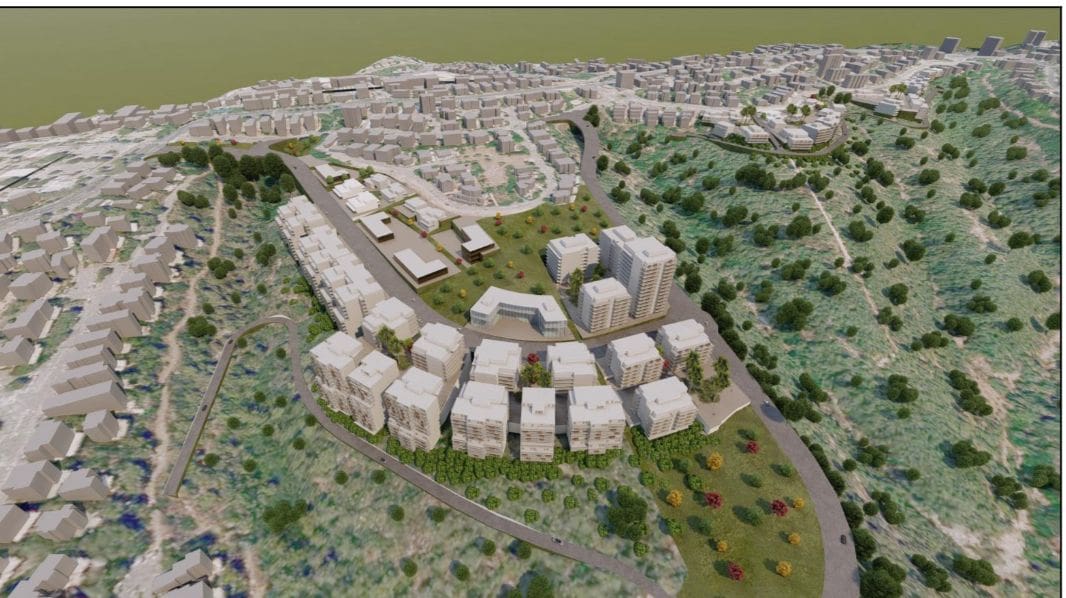
(Live Here) – The (Un)Green Future of the City of Haifa: This coming Monday, June 09.06.2025, XNUMX, the subcommittee of the local planning and building committee in Haifa will convene to discuss one of the most controversial plans in recent years: the Golda Slope plan. This involves the destruction of yet another green wadi, the cost of developing which is enormous, due to the steep slopes.

Will natural areas remain here?
This is a construction plan for a new neighborhood intended for 1,200 housing units, commercial space and public needs on an area of 329 dunams – south of Ramat Golda and west of Dania. On the surface, it seems like another phase in urban development – but behind the plan lies a deep storm, which includes questions about distributive justice, damage to the environment, conflicts of interest and most importantly: what kind of city are we leaving for future generations.
Area designated for residential use during the British Mandate period

Complex solutions will be required
The Golda Slope area was designated for residential use during the British Mandate period, over 80 years ago. The 2000 Outline Plan, approved in 2019, reinforced this designation and determined that the area would undergo reparcelling – a process of unifying and redistributing the land between private owners and the Israel Lands Authority. However, the planning situation in the area is complex: the roads approved in the Mandatory Plan currently pass through private land, and some of them are not at all suitable for today's transportation loads. Thus, the implementation of the plan requires particularly complex engineering, planning, and economic solutions.
Landowners demand justice – but who really paid for the land?
One of the main questions that arises around the plan concerns the historical distribution of the lands. Many of the current landowners are grandchildren or great-grandchildren of purchasers from the first decades of the last century – immigrants from the first and second Aliyah, families and individuals from the Land of Israel and Europe.
Is this property acquired through initiative and effort, or is it simply luck?
Can these lands be considered absolute property rights, even if in reality they were bought cheaply and stood desolate for decades?
On the one hand, there is a sense of injustice among landowners who cannot build. On the other hand, some argue that this is not a real investment but a "geographical inheritance" - and therefore the environmental and social price that will be charged for the exercise of rights is not justified.
The economic deficit led to another delay in approving the plan
In 2017, the plan was submitted for public comment with several conditions, including the neighborhood's compaction and planning improvements. After several extensions, the amendments were made by March 2019, but then it was discovered that the neighborhood was not economically viable.
The city treasurer warned that this was a particularly poor project, due to the low number of apartments and the high costs of building on a steep slope. The city, which had reached an impasse, hired the Gordon architectural firm in 2022 for a more comprehensive plan, which included both the transportation exits from the enclosed neighborhoods and the Mordot Golda neighborhood.
Partial verdict and duty of action on the part of the municipality
In February 2025, a partial verdict was given in the landowners’ lawsuit against the local committee, which determined that there had been a breach of agreement on its part. Although the amount of compensation was not decided, the parties reached an agreement: the plan will be submitted for final approval by the district committee by October 01.10.2025, XNUMX. Now, the city council and the local committee are faced with a decision: whether to continue with the plan despite many objections, or to stop the process – while taking the risk of heavy lawsuits and compensation from the landowners.
A neighborhood on a steep slope: an engineering, transportation, and social challenge


Extremely steep slope
One of the weak points of the plan is the topography of the area. It is an extremely steep slope, with gradients ranging from 25% to 65% – a real challenge for any construction initiative. The city engineering team noted that the slope would make it difficult for pedestrians, cyclists and even strollers. Development in such an area increases costs and creates difficulty in maintaining a proper quality of urban life. Technical details of the plan – such as the outlines of the buildings, parking solutions and protection of mature trees – have not yet been finalized.
The environmental angle: A battle for the last forests in the city
Alongside the economic and engineering considerations, there is an environmental ideological front. Residents and environmental activists claim that the environmental cost of establishing the neighborhood is enormous. The green groves that could disappear are part of the city's ecological fabric and its scenic identity. They claim that this is a renunciation of values that cannot be restored – nature in the heart of a city – in favor of a single neighborhood that will provide a solution for very few families. "If we build on every green lung in the city, we will have no air left," the activists claim. They add that Haifa is a city characterized by its greenery and open spaces – and this is an asset that must be fought for.
Proposal to move building rights and preserve nature
One of the main proposals being made by activists is to relocate building rights – that is, to give landowners alternative land or the option to build in other areas of the city, without damaging the natural area of the Golda Slope. “You can’t insist on an 80-year-old plan just because it exists in the documents,” activists claim. “The municipality can and should raise budgets for compensation or relocation. If they know how to raise money for roads and infrastructure work, they can also do it for urban nature conservation.”
Lack of transparency and open questions forגWhere are the costs?
Another sensitive point is the transparency on the part of the municipality. Activists claim that despite repeated requests, no clear economic data has been published regarding the cost of compensation to landowners if the plan is not implemented. They claim that the council members do not have this information either, even though it is essential for the decision to be made next week. Furthermore, they claim, the cost of developing the neighborhood is also expected to be extremely high – so it is necessary to compare the two scenarios: how much the actual construction will cost versus the cost of not implementing it.
Questions about demographic trends and the real need for construction
The activists also raise a fundamental question: Is this neighborhood even needed? According to them, Haifa's population has not grown in recent years, and there are thousands of empty ghost apartments in the city. "Anyone who is concerned about the lack of housing should first take care of the empty apartments," they say. They also add that the expectation of future demand does not justify sacrificing priceless open spaces. They argue that the solution to the housing crisis – if there is one – should begin with the regulation of existing housing, not with the destruction of nature.
An ideological conflict over the future of the city: Who decides for whom?
The plan for the Golda Slope is actually a microcosm of a broader conflict: between those who see land as a legitimate economic resource that can be exploited, and those who see urban nature as a public value that cannot be converted into money. Between the next generation of landowners, and the younger generation that wants to preserve Haifa as a green city. Between decisions made decades ago, and moral responsibility for the future.
This coming Monday, the subcommittee will have to determine whether to move forward with the Golda Uprising plan – but this is not just a planning decision. It is a choice between different visions of the city of Haifa: a city of property rights versus a city of environmental justice. A city of concrete versus a city of green. One decision, but consequences for generations.
Tama 35 Amendment 4 requires that at least 2,500 apartments be built in a neighborhood of this size. The municipality is only offering half of that, and therefore will undoubtedly be sued to pay for the damage caused.
It seems that the municipality is doing everything it can to propose a plan that is not feasible. You won't hear a claim from it in court that it wasn't aware of this.
Why is construction in Ramat Gural/Ramat Shamir not progressing?
In this case too, it is private land.
Either the state will provide adequate compensation to the landowners or construction will begin there.
Ramat Begin, Ramat Eshkol, Vardiya, Ramat Alon, and Ramat Golda were also once green nature.
And yet these neighborhoods were built.
Instead of urban renewal and taking over abandoned apartments and buildings prone to collapse and constructing/renovating/evacuating new construction, they are building new neighborhoods on the green areas of the city. It is time to invest efforts in the renewal and development of Hadar, neighborhoods in the lower city in order to preserve as much nature as possible in the city and its surroundings.
What is happening with the slopes of Ramat Eshkol?
It really sucks. There are no pieces of nature left 🙁
It's enough to harm nature and the grazing areas of animals, including wild boars. As a resident of Golda, I am not at all willing to harm our Kit neighborhood and the green landscape that can be seen from many houses here.
Planning nonsense.
When will they start thinking with a long-term perspective that takes into account the needs of future generations?
Open spaces must not be demolished until urban renewal options have been exhausted.
I wish someone would hear.
Ilan, they weren't lazy. There is a potential for tens of thousands of apartments in urban renewal in the coastal neighborhoods. Nothing has been happening with it for 20 years, and here, for 1000 units that are probably intended for the rich with high real estate prices, do you want to destroy the entire natural forest?
disgrace
The contractors get land at a cheap price in Haifa, why would they bother to do a construction clearance? It's a mess. They have Tama 38 in Carmel, fewer apartments and more profits.
This is a harmful plan, another waste of public money and harm to landowners.
Destroyer of the city. Terrible heartache to see all the destruction of nature. When will you start talking about Yahav's plan to bring a hundred thousand residents to the city? That's why he approves every plan. Someone will pull the lapel of his coat and tell him that a hundred thousand people will not come to live here. In the meantime, he can barely maintain the question that those who live here will not leave. The hallucination
Why, it might be more appropriate for people from surrounding villages to live in Haifa.
Even so, the young people are running away.
1200 housing units are worth the complete destruction of a wadi and the construction of a poor, destructive neighborhood that is inaccessible by foot in difficult topography and expensive construction with huge excavations?!
Rights can be easily transferred – the municipality will transfer land on the southern slopes along the ‘Wadiyot Road’ near Neot Navon. There, 4 40-story towers will be built with 300 units in each tower. This neighborhood will be called Tzamerot Wadi. It will include 5 towers, 4 of which will be for the rights holders, and a 15-story tower with public services, a school, kindergartens, a sports club, and a commercial center, and above it, long-term rental housing.
The neighborhood will enjoy a flat location adjacent to Neot Navon and with public transportation to it via a metro bus line. This is the ideal solution! The wadi must remain open and a nature reserve forever.
More planned construction crime in Haifa. All the green landscapes are being destroyed, and from the pace of construction one might think that masses of people are flocking to live in Haifa, while in fact immigration there is negative. Anyone who wants to witness the rampant construction crime should watch the approved construction on RNK, Smolenskin and Vitkin streets. The density of construction is terrible, in places that have long been crowded, and leaving the streets is difficult. What will the ambulances leaving Carmel Hospital do, or arriving there?
Instead of developing the infrastructure, roads and sidewalks, they are building more and more huge buildings at exorbitant prices because the municipality is giving land to contractors who go wild as they please. Look at what is happening around Beit Carmel, a great disaster of wild construction, where there is no parking for hospital visitors anyway, and they are filling the area with more and more tall houses that have no buyers, a legacy of clichés that handed out licenses like socks, and now it continues.
Woe to you, Yona Yahav and his deputies, if you give a hand to this plan.